Brief Report - (2025) Volume 15, Issue 4
Received: 03-Aug-2025, Manuscript No. jprm-25-174456;
Editor assigned: 06-Aug-2025, Pre QC No. P-174456;
Reviewed: 19-Aug-2025, QC No. Q-174456;
Revised: 25-Aug-2025, Manuscript No. R-174456;
Published:
30-Aug-2025
, DOI: 10.37421/2161-105X.2025.15.749
Citation: Steiner, Lucas. ”Respiratory Infections: Challenges, Co-infections, Strategies.” J Pulm Respir Med 15 (2025):749.
Copyright: © 2025 Steiner L. This is an open-access article distributed under the terms of the Creative Commons Attribution License, which permits unrestricted use, distribution and reproduction in any medium, provided the original author and source are credited.
Respiratory Syncytial Virus (RSV) is a significant cause of acute respiratory infection in adults, often manifesting with mild to moderate symptoms but potentially leading to severe outcomes, especially in older adults and those with comorbidities. Recognizing RSV in adult populations is important, as it can mimic influenza or other respiratory illnesses. This situation highlights a growing need for improved diagnostics and the development of effective preventative strategies and treatments tailored for adults [1].
When it comes to concurrent infections, co-infection with influenza and SARS-CoV-2 can complicate clinical presentation and patient outcomes. It sheds light on the prevalence, clinical characteristics, and severity of co-infections, demonstrating that concurrent infections can exacerbate disease, particularly in vulnerable populations. Understanding these interactions is crucial for guiding diagnostic testing, treatment protocols, and public health interventions, especially during seasonal outbreaks [2].
Antiviral drugs play a critical role in mitigating the impact of various respiratory viral infections, including influenza, RSV, and SARS-CoV-2. The current landscape of antiviral therapies reveals their mechanisms of action, efficacy, and challenges related to drug resistance and delivery. A priority remains the push for new broad-spectrum antivirals and improved diagnostic tools to effectively combat these pathogens [3].
Significant advancements have occurred in vaccine development against respiratory viruses, driven by the recent pandemic and ongoing threats from influenza and RSV. Cutting-edge vaccine technologies, including mRNA, viral vector, and protein subunit platforms, are reviewed for their application in developing effective immunizations. The overarching goal is to create broad-spectrum and highly efficacious vaccines to protect against emerging and re-emerging respiratory pathogens [4].
Following COVID-19, a notable subset of individuals experience persistent respiratory symptoms, known as Long COVID. Evidence on the prevalence, characteristics, and potential underlying mechanisms of these lingering issues, such as dyspnea and cough, is consolidated here. Understanding these long-term effects is vital for developing appropriate follow-up care, rehabilitation strategies, and targeted therapies for affected patients [5].
Bacterial co-infections frequently complicate viral respiratory infections, leading to increased morbidity and mortality. Exploration into the epidemiology and clinical impact of bacterial co-pathogens in the context of various respiratory viral illnesses indicates the importance of early detection and appropriate antimicrobial stewardship to manage these complex infections effectively and improve patient outcomes [6].
Accurate and rapid diagnosis is fundamental for managing respiratory tract infections effectively and preventing their spread. The current state of diagnostic techniques, from traditional culture methods to advanced molecular and point-of-care tests, is evaluated. A look ahead reveals emerging technologies promising faster, more sensitive, and comprehensive detection of respiratory pathogens, critical for timely treatment and infection control [7].
Air pollution poses a significant environmental health risk, with clear links to increased susceptibility and severity of respiratory infections. A global systematic review and meta-analysis synthesizes evidence on how various air pollutants, like particulate matter, contribute to respiratory tract infections. The findings emphasize an urgent need for stringent air quality regulations and public health interventions to mitigate the burden of these environmental exposures [8].
Children are particularly vulnerable to respiratory infections, meaning understanding emerging pathogens is crucial for pediatric health. This review focuses on novel and re-emerging respiratory viruses and bacteria that threaten pediatric populations. It discusses their epidemiological characteristics, clinical presentations, and challenges in diagnosis and treatment, highlighting a continuous need for vigilance and research in this area [9].
Immunocompromised patients face unique challenges when battling respiratory viral infections, often experiencing more severe and prolonged illness. This article delves into the complexities of managing these infections in such vulnerable populations, covering specific pathogens, diagnostic approaches, and therapeutic strategies. It emphasizes the tailored management required, balancing potent antiviral therapies with potential toxicities and drug interactions [10].
Respiratory Syncytial Virus (RSV) remains a significant cause of acute respiratory infection in adults, often presenting with mild to moderate symptoms but potentially leading to severe outcomes, particularly in older adults and those with comorbidities [1]. Beyond single viral threats, co-infection with influenza and SARS-CoV-2 can further complicate clinical presentation and patient outcomes, exacerbating disease, especially in vulnerable populations. Understanding these complex interactions is crucial for guiding diagnostic testing, treatment protocols, and public health interventions during seasonal outbreaks [2]. Moreover, bacterial co-infections frequently complicate viral respiratory infections, increasing morbidity and mortality. Recognizing the epidemiology and clinical impact of bacterial co-pathogens is vital, underscoring the importance of early detection and appropriate antimicrobial stewardship for effective management and improved patient outcomes [6]. Immunocompromised patients face unique challenges with respiratory viral infections, often experiencing more severe and prolonged illnesses. This necessitates tailored management approaches, balancing potent antiviral therapies with potential toxicities and drug interactions [10].
Antiviral drugs are critical in mitigating the impact of various respiratory viral infections, including influenza, RSV, and SARS-CoV-2. The current landscape of antiviral therapies, including their mechanisms, efficacy, and challenges like drug resistance and delivery, highlights an ongoing push for new broad-spectrum antivirals and improved diagnostic tools to combat these pathogens effectively [3]. Alongside treatment, accurate and rapid diagnosis is fundamental for managing respiratory tract infections and preventing their spread. Current diagnostic techniques span traditional culture methods to advanced molecular and point-of-care tests. Future developments promise faster, more sensitive, and comprehensive detection of respiratory pathogens, which is critical for timely treatment and infection control [7].
Vaccine development against respiratory viruses has seen unprecedented advancements, spurred by recent pandemics and persistent threats from influenza and RSV. Reviewing platforms like mRNA, viral vector, and protein subunit technologies reveals their application in effective immunizations, with the goal of creating broad-spectrum and highly efficacious vaccines to protect against emerging and re-emerging respiratory pathogens [4]. Beyond biological interventions, environmental factors like air pollution also play a significant role. Air pollution poses a substantial environmental health risk, with clear links to increased susceptibility and severity of respiratory infections. Evidence synthesized from global systematic reviews on various pollutants, such as particulate matter, emphasizes the urgent need for stringent air quality regulations and public health interventions to mitigate these exposures [8].
Children represent a particularly vulnerable demographic for respiratory infections, making the understanding of emerging pathogens crucial for pediatric health. There is ongoing focus on novel and re-emerging respiratory viruses and bacteria threatening pediatric populations, with discussions covering their epidemiological characteristics, clinical presentations, and challenges in diagnosis and treatment. This highlights the continuous need for vigilance and research in this area [9]. Furthermore, the long-term sequelae of viral infections are a growing concern. A significant subset of individuals recovering from COVID-19, for example, experience persistent respiratory symptoms, collectively known as Long COVID. Evidence on the prevalence, characteristics, and underlying mechanisms of issues like dyspnea and cough is vital for developing appropriate follow-up care, rehabilitation strategies, and targeted therapies for affected patients [5].
The landscape of respiratory infections presents multifaceted challenges, from the significant impact of Respiratory Syncytial Virus (RSV) in adults, particularly older and comorbid individuals, to the complexities introduced by co-infections with influenza and SARS-CoV-2. These concurrent infections exacerbate disease, especially in vulnerable populations, making rapid diagnostics and targeted public health interventions crucial. Bacterial co-infections further complicate patient outcomes in viral respiratory illnesses, emphasizing the need for early detection and robust antimicrobial stewardship. Significant strides are being made in developing antiviral therapies and broad-spectrum vaccines, leveraging technologies like mRNA and viral vectors to protect against a range of pathogens. However, immunocompromised patients and children remain especially vulnerable, requiring tailored management and continuous surveillance for emerging threats. The long-term sequelae, such as persistent respiratory symptoms in Long COVID, highlight a growing need for specialized follow-up care. Moreover, environmental factors like air pollution are clearly linked to increased susceptibility and severity of these infections, necessitating stringent regulations. This body of research collectively stresses the importance of integrated strategies covering enhanced diagnostics, innovative treatments, effective prevention, and addressing environmental determinants to mitigate the global burden of respiratory diseases.
None
None
1. Christian H, Philipp H, Eva K. "Respiratory Syncytial Virus (RSV) Infection in Adults: A Review".Respiration 102 (2023):1-13.
Indexed at, Google Scholar, Crossref
2. Mohammad AO, Seyed MA, Mohsen M. "Influenza and SARS-CoV-2 coinfection: a systematic review".BMC Infect Dis 23 (2023):361.
Indexed at, Google Scholar, Crossref
3. Frederick GH, Menno DdJ, Jens R. "Antiviral Drugs for Respiratory Viral Infections".Clin Microbiol Rev 35 (2022):e0012720.
Indexed at, Google Scholar, Crossref
4. Qiong L, Bo M, Min Z. "Recent advances in vaccine development against respiratory viruses".NPJ Vaccines 8 (2023):151.
Indexed at, Google Scholar, Crossref
5. Jie H, Qihui Z, Xiaoxia W. "Persistent Respiratory Symptoms in Long COVID: A Systematic Review".Front Med (Lausanne) 10 (2023):1184373.
Indexed at, Google Scholar, Crossref
6. Eric YK, David M, Lisa LM. "Bacterial coinfections in patients with respiratory viral infections".Int J Infect Dis 128 (2023):103-109.
Indexed at, Google Scholar, Crossref
7. Evdoxia S, Sofia M, Fotios K. "Current and future diagnostic approaches for respiratory tract infections".Future Microbiol 17 (2022):795-812.
Indexed at, Google Scholar, Crossref
8. Xiao M, Wenxue W, Yuhan M. "Air pollution and respiratory infections: a global systematic review and meta-analysis".Environ Res 223 (2023):115372.
Indexed at, Google Scholar, Crossref
9. Xiaoyu C, Rui X, Xinyu L. "Emerging Respiratory Pathogens in Children: A Narrative Review".Front Pediatr 10 (2022):905380.
Indexed at, Google Scholar, Crossref
10. Roy FC, Enrique JA, Shamim G. "Management of Respiratory Viral Infections in Immunocompromised Patients".Infect Dis Clin North Am 35 (2021):805-827.
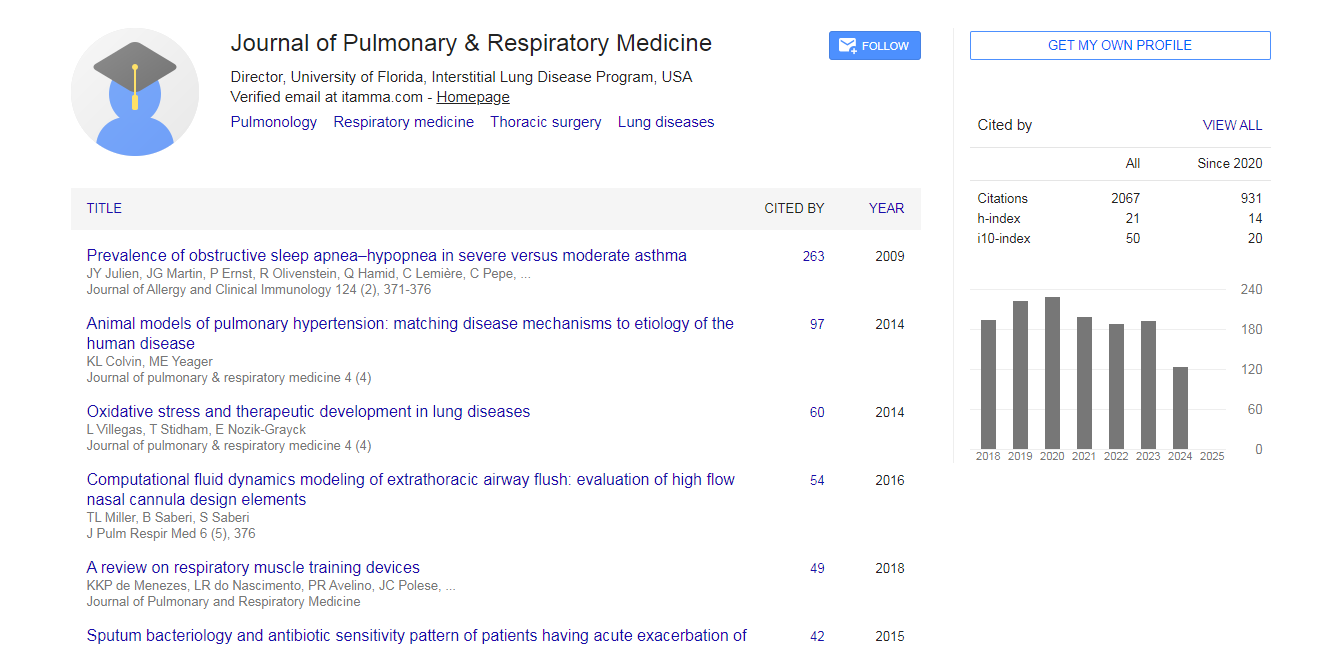
Pulmonary & Respiratory Medicine received 1690 citations as per Google Scholar report