Opinion - (2025) Volume 15, Issue 5
Received: 01-Oct-2025, Manuscript No. jprm-25-174468;
Editor assigned: 03-Oct-2025, Pre QC No. P-174468;
Reviewed: 17-Oct-2025, QC No. Q-174468;
Revised: 22-Oct-2025, Manuscript No. R-174468;
Published:
29-Oct-2025
, DOI: 10.37421/2161-105X.2025.15.763
Citation: Al-Harbi, Mariam. ”Respiratory Infections: Advancing Diagnostics, Treatment, Prevention.” J Pulm Respir Med 15 (2025):763.
Copyright: © 2025 Al-Harbi M. This is an open-access article distributed under the terms of the Creative Commons Attribution License, which permits unrestricted use, distribution and reproduction in any medium, provided the original author and source are credited.
Respiratory infections continue to be a significant global health concern, necessitating ongoing research and advancements across multiple fronts, from diagnostics and treatment to prevention and understanding environmental impacts. Modern approaches are rapidly transforming patient care and public health strategies. Recent advancements in diagnostic technologies for respiratory viral infections are transforming patient care by enabling faster and more accurate pathogen identification. This shift from traditional methods to advanced molecular and immunological assays improves epidemiological surveillance and facilitates timely, targeted treatments, especially critical during outbreaks of novel viruses[1].
However, the management of bacterial respiratory infections still presents formidable ongoing challenges. A primary concern is the relentless rise of antimicrobial resistance and the emergence of pathogens that are increasingly difficult to treat. Effective strategies to counter these threats demand continuous surveillance, the development of innovative diagnostic tools capable of rapid resistance profiling, and a concerted effort towards developing new therapeutic agents to preserve treatment efficacy[2].
Similarly, antimicrobial resistance specifically among respiratory tract pathogens is globally recognized as a growing health crisis, significantly complicating treatment protocols and increasing both morbidity and mortality. Tackling this global challenge requires robust, coordinated efforts in surveillance, stringent antimicrobial stewardship programs, and intensive research into novel antibiotics and alternative therapies[9].
Beyond the immediate infection, a notable proportion of individuals recovering from illnesses such as COVID-19 experience persistent respiratory sequelae, including reduced lung function, chronic cough, and dyspnea, which can extend for many months after the acute phase of infection. A thorough understanding of these long-term effects is absolutely crucial for developing effective rehabilitation programs and providing tailored follow-up care for affected patients[3].
Preventing respiratory infections, particularly in vulnerable populations like children, requires a multifaceted and strategic approach. This involves combining established measures such as widespread vaccination, stringent hygiene practices, and various environmental interventions[4].
Influenza vaccination, for instance, remains the primary and most effective tool for preventing seasonal influenza, with continuous efforts directed at enhancing vaccine effectiveness and expanding coverage globally. Emerging strategies are now focusing on the ambitious goal of developing universal influenza vaccines and improving vaccine delivery mechanisms to provide broader and more sustained protection against a diverse range of viral strains[5].
These pharmacological interventions are complemented by essential non-pharmacological approaches. Measures like meticulous hand hygiene, consistent mask-wearing, and social distancing have proven to be critically effective in preventing the widespread transmission of respiratory infections, especially during pandemics. Evidence consistently demonstrates that when these measures are widely adopted, they can significantly reduce transmission rates and effectively protect entire communities[10].
The complex and dynamic role of the respiratory microbiome in modulating host immunity and influencing an individual's susceptibility to viral infections is another burgeoning area of research. Gaining a deeper understanding of the intricate interactions between these microbial communities and the host immune system offers exciting new avenues for therapeutic interventions designed to enhance respiratory health and build resilience against various pathogens[6].
Furthermore, significant advances in antiviral therapy for respiratory viral infections are bringing new hope to patients and clinicians alike. The development of targeted drugs that either inhibit viral replication directly or enhance the host's natural immunity is profoundly important. These innovations are crucial for managing outbreaks more effectively and for reducing severe outcomes, particularly for infections where specific treatments have historically been lacking[7].
Simultaneously, the impact of environmental factors cannot be overstated. Exposure to air pollution, for example, significantly impairs respiratory health and increases susceptibility to a wide array of infections by compromising the lung's delicate immune defenses. Understanding these pervasive environmental impacts is a key step for public health interventions specifically aimed at reducing pollution and protecting vulnerable populations from respiratory illnesses[8].
All these combined efforts point towards a holistic and evolving understanding of respiratory health and disease management.
Recent strides in diagnostic technologies are revolutionizing the approach to respiratory viral infections, enabling faster and more precise identification of pathogens. This shift incorporates advanced molecular and immunological assays, moving beyond traditional methods. Such innovations are pivotal for enhancing epidemiological surveillance and facilitating prompt, targeted treatments, which becomes particularly vital during outbreaks involving novel viruses [1]. In parallel, managing bacterial respiratory infections presents its own set of significant challenges. The escalating issue of antimicrobial resistance, coupled with the emergence of pathogens that are difficult to treat, demands continuous vigilance. Effective management relies on ongoing surveillance, the development of innovative diagnostic tools for rapid resistance profiling, and the creation of new therapeutic agents to maintain treatment efficacy [2]. These combined efforts underscore the dynamic nature of infectious disease management and the need for adaptable strategies.
Beyond acute management, the long-term impact of respiratory infections is a growing concern. A considerable number of individuals recovering from illnesses like COVID-19 experience lasting respiratory sequelae, including reduced lung function, chronic cough, and persistent dyspnea, sometimes for many months after the initial infection. Recognizing and understanding these prolonged effects is essential for designing effective rehabilitation programs and providing personalized follow-up care for affected patients [3]. This highlights a broader perspective on patient care, extending beyond immediate recovery to encompass sustained health and quality of life.
Prevention is a cornerstone in the fight against respiratory infections, particularly in vulnerable populations such as children. A comprehensive preventative strategy involves multiple layers: robust vaccination programs, diligent hygiene practices, and strategic environmental interventions [4]. Influenza vaccination remains a prime example of a primary preventative tool for seasonal influenza. Continuous efforts are focused on improving vaccine effectiveness and expanding coverage. Future strategies are exploring the development of universal influenza vaccines and optimizing vaccine delivery systems to offer broader and more enduring protection against diverse viral strains [5]. These vaccination efforts are complemented by non-pharmacological interventions. Simple yet highly effective measures like consistent hand hygiene, wearing masks, and practicing social distancing have proven critical in curbing the spread of respiratory infections, especially during widespread epidemics or pandemics. Evidence consistently demonstrates that widespread adoption of these measures can significantly reduce transmission rates and safeguard communities [10].
The intricate relationship between the human host and its microbial environment, particularly the respiratory microbiome, plays a significant and dynamic role in modulating host immunity. This interaction directly influences an individual's susceptibility to various viral infections [6]. Gaining a deeper understanding of these complex interactions between microbial communities and the host immune system offers promising new avenues for therapeutic interventions. Such interventions could potentially enhance overall respiratory health and bolster resilience against a spectrum of pathogens [6].
Advances in antiviral therapy offer considerable hope for managing respiratory viral infections. The development of targeted drugs that either inhibit viral replication directly or enhance the host's immune response is crucial for effective disease management. These innovative therapies are particularly vital for controlling outbreaks and mitigating severe outcomes, especially in cases where specific treatments are currently lacking [7]. Simultaneously, environmental factors significantly influence respiratory health. Exposure to air pollution, for instance, demonstrably impairs lung function and heightens susceptibility to various infections by compromising the lung's natural immune defenses. Understanding these pervasive environmental impacts is key for guiding public health interventions aimed at reducing pollution levels and protecting vulnerable populations from associated respiratory illnesses [8]. The interplay of therapeutics and environmental considerations forms a holistic approach to respiratory health. Furthermore, antimicrobial resistance among respiratory tract pathogens is a growing global health crisis, complicating treatment and increasing morbidity and mortality. Addressing this challenge requires coordinated efforts in surveillance, antimicrobial stewardship, and the development of novel antibiotics and alternative therapies [9].
Respiratory infections pose persistent global health challenges, necessitating continuous advancements in diagnostics, treatment, and prevention. Modern diagnostic technologies, like molecular and immunological assays, significantly enhance the identification of viral pathogens, aiding in timely interventions and epidemiological surveillance, especially during outbreaks of new viruses [1]. However, bacterial respiratory infections face growing hurdles due to antimicrobial resistance, demanding innovative diagnostic tools for resistance profiling and new therapeutic agents [2, 9]. The long-term effects of infections, such as persistent respiratory sequelae post-COVID-19, underscore the need for targeted rehabilitation and follow-up care [3]. Prevention strategies are multifaceted, encompassing vaccination, hygiene, and environmental controls [4, 10]. Influenza vaccination remains a critical tool, with ongoing research into universal vaccines for broader protection [5]. Beyond direct interventions, understanding the respiratory microbiome's role in immunity and susceptibility to viral infections opens new therapeutic avenues [6]. Furthermore, antiviral therapies are evolving, offering targeted drugs to inhibit viral replication or boost host immunity, vital for managing infections lacking specific treatments [7]. Environmental factors also play a crucial role; air pollution significantly compromises respiratory health and increases susceptibility to infections, highlighting the need for public health interventions to mitigate these risks [8]. Collectively, these efforts highlight a comprehensive approach to combating respiratory illnesses, from advanced diagnostics and therapies to robust prevention strategies and environmental considerations.
None
None
1. Xingyu L, Haibo L, Qian C. "Recent advances in diagnostic methods for respiratory viral infections".Front Microbiol 14 (2023):1255792.
Indexed at, Google Scholar, Crossref
2. Helen G, Evangelos JG, Paraskevi P. "Current and future challenges in the management of bacterial respiratory infections".Future Microbiol 17 (2022):341-356.
Indexed at, Google Scholar, Crossref
3. Xuan W, Yafei W, Qiong X. "Long-term respiratory sequelae of COVID-19: a prospective cohort study".Lancet Respir Med 9 (2021):317-324.
Indexed at, Google Scholar, Crossref
4. Susanna E, Nuno P, Rita C. "Prevention of respiratory infections in children: current strategies and future directions".Expert Rev Respir Med 14 (2020):179-191.
Indexed at, Google Scholar, Crossref
5. Catherine D, Ian W, Florence H. "Influenza vaccination: current recommendations and emerging strategies".Vaccine 37 (2019):2683-2692.
Indexed at, Google Scholar, Crossref
6. Michael M, Nora K, Enobong N. "The role of the respiratory microbiome in host immunity and susceptibility to viral infections".Mucosal Immunol 17 (2024):15-28.
Indexed at, Google Scholar, Crossref
7. Yong F, Jun S, Xiaoyun W. "Advances in antiviral therapy for respiratory viral infections".Signal Transduct Target Ther 8 (2023):379.
Indexed at, Google Scholar, Crossref
8. Carlo P, Michele C, Claudia L. "Impact of air pollution on respiratory health and susceptibility to infections".Environ Res 204 (2022):112104.
Indexed at, Google Scholar, Crossref
9. Firas T, Saud A, Esra A. "Antimicrobial resistance in respiratory tract pathogens: a global perspective".J Glob Antimicrob Resist 24 (2021):345-353.
Indexed at, Google Scholar, Crossref
10. Tom J, Lisa D, Elizabeth F. "Non-pharmacological interventions for preventing the spread of respiratory infections: a systematic review".Cochrane Database Syst Rev 11 (2020):CD013918.
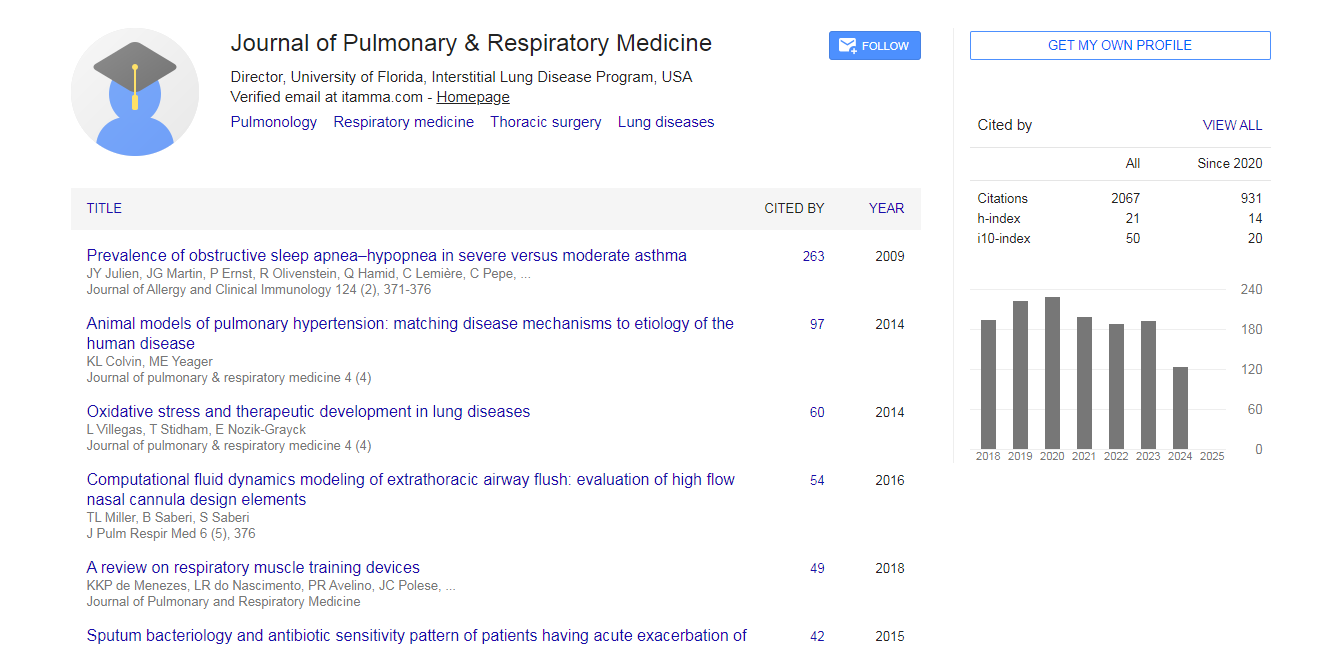
Pulmonary & Respiratory Medicine received 1690 citations as per Google Scholar report