Short Communication - (2025) Volume 15, Issue 4
Received: 03-Aug-2025, Manuscript No. jprm-25-174462;
Editor assigned: 06-Aug-2025, Pre QC No. P-174462;
Reviewed: 19-Aug-2025, QC No. Q-174462;
Revised: 25-Aug-2025, Manuscript No. R-174462;
Published:
30-Aug-2025
, DOI: 10.37421/2161-105X.2025.15.755
Citation: Rahimi, Farid. ”Respiratory Health: Pollution, Occupation, Emerging Crises.” J Pulm Respir Med 15 (2025):755.
Copyright: © 2025 Rahimi F. This is an open-access article distributed under the terms of the Creative Commons Attribution License, which permits unrestricted use, distribution and reproduction in any medium, provided the original author and source are credited.
Air pollution, particularly fine particulate matter (PM2.5), significantly impacts global respiratory health. This review highlights how exposure to these pollutants contributes to a range of respiratory diseases, including asthma, chronic obstructive pulmonary disease (COPD), and lung cancer, by inducing inflammation, oxidative stress, and structural changes in the airways. Understanding these mechanisms is key to developing public health strategies and clinical interventions [1].
Occupational lung diseases remain a significant public health concern, though often underrecognized. This article covers recent advancements in understanding, diagnosing, and managing conditions like occupational asthma, hypersensitivity pneumonitis, and pneumoconioses. It emphasizes the importance of a detailed occupational history and exposure assessment for timely diagnosis and effective prevention in various work environments [2].
Silicosis, an ancient occupational lung disease, is unfortunately resurfacing due to new industrial practices and inadequate safety measures. This review provides an updated perspective on its epidemiology, emphasizing the increased incidence in emerging industries, along with current diagnostic approaches and evolving management strategies, including lung transplantation and novel antifibrotic therapies. Early detection and rigorous exposure control are paramount [3].
E-cigarette or Vaping Product Use-Associated Lung Injury (EVALI) emerged as a severe public health crisis linked to vaping, particularly products containing tetrahydrocannabinol (THC) and vitamin E acetate. This article details the clinical presentation, diagnostic criteria, and management of EVALI, highlighting the importance of recognizing this distinct form of acute lung injury among e-cigarette users. Vigilance from clinicians is essential [4].
Climate change poses a profound threat to lung health, exacerbating respiratory conditions through increased air pollution, allergen exposure, and extreme weather events. This article urges clinicians to recognize and address the respiratory impacts of climate change, advocating for patient education, environmental advocacy, and adaptation strategies within healthcare to mitigate its effects on vulnerable populations [5].
Hypersensitivity pneumonitis (HP), an immune-mediated lung disease triggered by inhaled antigens, presents diagnostic and management challenges due to its varied clinical presentations. This update summarizes recent advances in understanding HP's pathogenesis, highlighting the importance of comprehensive diagnostic workups including imaging, bronchoalveolar lavage, and multidisciplinary discussion, along with current therapeutic options [6].
Residential exposure to biomass fuel combustion, prevalent in many Asian countries, significantly contributes to chronic respiratory diseases. This review examines the health effects of household air pollution from traditional cooking and heating methods, detailing how long-term exposure to particulate matter and harmful gases leads to COPD, asthma, and other lung morbidities, underscoring the urgent need for cleaner energy solutions [7].
Occupational asthma, triggered by workplace sensitizers or irritants, remains a leading cause of work-related respiratory disease. This article discusses the diagnostic challenges and management strategies for occupational asthma, emphasizing the importance of identifying specific causative agents and implementing early removal from exposure to prevent irreversible airway damage and preserve lung function. Prevention through workplace safety measures is critical [8].
Airway remodeling, characterized by structural changes in the airways, is a significant feature in various occupational lung diseases, including asthma and chronic bronchitis. This review explores the mechanisms underlying airway remodeling induced by occupational exposures, such as dusts and chemicals, and its impact on lung function decline and disease progression. Understanding these processes is vital for developing targeted therapeutic interventions [9].
Exposure to environmental tobacco smoke, also known as secondhand smoke, continues to pose serious health risks globally, especially for non-smokers. This narrative review synthesizes the extensive evidence on its adverse health effects, which include increased risk of asthma, COPD, lung cancer, and other respiratory infections, highlighting the ongoing public health challenge and the need for comprehensive smoke-free policies [10].
Air pollution, particularly fine particulate matter (PM2.5), significantly impacts global respiratory health [1]. Exposure to these pollutants contributes to a range of respiratory diseases, including asthma, Chronic Obstructive Pulmonary Disease (COPD), and lung cancer, by inducing inflammation, oxidative stress, and structural changes in the airways. Understanding these mechanisms is key to developing public health strategies and clinical interventions [1]. Exposure to environmental tobacco smoke, also known as secondhand smoke, continues to pose serious health risks globally, especially for non-smokers. Extensive evidence details its adverse health effects, which include increased risk of asthma, COPD, lung cancer, and other respiratory infections, highlighting the ongoing public health challenge and the need for comprehensive smoke-free policies [10]. Additionally, residential exposure to biomass fuel combustion, prevalent in many Asian countries, significantly contributes to chronic respiratory diseases. Health effects of household air pollution from traditional cooking and heating methods show how long-term exposure to particulate matter and harmful gases leads to COPD, asthma, and other lung morbidities, underscoring the urgent need for cleaner energy solutions [7].
Occupational lung diseases remain a significant public health concern, though often underrecognized [2]. Recent advancements in understanding, diagnosing, and managing conditions like occupational asthma, hypersensitivity pneumonitis, and pneumoconioses are crucial. A detailed occupational history and exposure assessment are important for timely diagnosis and effective prevention in various work environments [2]. Silicosis, an ancient occupational lung disease, is unfortunately resurfacing due to new industrial practices and inadequate safety measures [3]. An updated perspective on its epidemiology emphasizes the increased incidence in emerging industries, along with current diagnostic approaches and evolving management strategies, including lung transplantation and novel antifibrotic therapies. Early detection and rigorous exposure control are paramount [3]. Occupational asthma, triggered by workplace sensitizers or irritants, remains a leading cause of work-related respiratory disease [8]. Diagnostic challenges and management strategies for occupational asthma emphasize the importance of identifying specific causative agents and implementing early removal from exposure to prevent irreversible airway damage and preserve lung function. Prevention through workplace safety measures is critical [8]. Hypersensitivity pneumonitis (HP), an immune-mediated lung disease triggered by inhaled antigens, presents diagnostic and management challenges due to its varied clinical presentations [6]. Advances in understanding HP's pathogenesis highlight the importance of comprehensive diagnostic workups including imaging, bronchoalveolar lavage, and multidisciplinary discussion, along with current therapeutic options [6].
Airway remodeling, characterized by structural changes in the airways, is a significant feature in various occupational lung diseases, including asthma and chronic bronchitis [9]. Research explores the mechanisms underlying airway remodeling induced by occupational exposures, such as dusts and chemicals, and its impact on lung function decline and disease progression. Understanding these processes is vital for developing targeted therapeutic interventions [9].
E-cigarette or Vaping Product Use-Associated Lung Injury (EVALI) emerged as a severe public health crisis linked to vaping, particularly products containing tetrahydrocannabinol (THC) and vitamin E acetate [4]. Studies detail the clinical presentation, diagnostic criteria, and management of EVALI, highlighting the importance of recognizing this distinct form of acute lung injury among e-cigarette users. Vigilance from clinicians is essential [4]. Climate change poses a profound threat to lung health, exacerbating respiratory conditions through increased air pollution, allergen exposure, and extreme weather events [5]. Clinicians are urged to recognize and address the respiratory impacts of climate change, advocating for patient education, environmental advocacy, and adaptation strategies within healthcare to mitigate its effects on vulnerable populations [5].
Global respiratory health faces significant threats from various environmental and occupational exposures. Air pollution, particularly fine particulate matter (PM2.5), is a major contributor to diseases like asthma, Chronic Obstructive Pulmonary Disease (COPD), and lung cancer, by inducing inflammation and oxidative stress. Household air pollution from biomass fuel combustion in many Asian countries also exacerbates chronic respiratory conditions, highlighting the need for cleaner energy. Environmental tobacco smoke continues to pose severe risks, increasing the likelihood of asthma, COPD, and other lung infections in non-smokers. Occupational lung diseases remain a critical public health concern, with conditions such as occupational asthma, hypersensitivity pneumonitis, and silicosis being frequently underrecognized. Silicosis, an ancient disease, is unfortunately resurfacing, requiring updated diagnostic and management approaches, including rigorous exposure control. Occupational asthma, triggered by workplace sensitizers, demands early identification of causative agents and removal from exposure to prevent irreversible damage. Airway remodeling, a structural change in the airways, is a key feature in several occupational lung diseases, driven by exposure to dusts and chemicals. Beyond traditional hazards, emerging public health crises include E-cigarette or Vaping Product Use-Associated Lung Injury (EVALI), linked to THC and vitamin E acetate in vaping products. Climate change also profoundly impacts lung health, intensifying respiratory conditions through increased air pollution, allergen exposure, and extreme weather, urging clinicians to advocate for adaptation strategies.
None
None
1. Junpeng L, Xindong H, Zhiqiang Y. "Particulate Matter Air Pollution and Respiratory Diseases: A Narrative Review".Respir Res 22 (2021):204.
Indexed at, Google Scholar, Crossref
2. Amy NL, Matthew GS, Michael SB. "Recent Advances in Occupational Lung Diseases".Ann Allergy Asthma Immunol 131 (2023):708-715.
Indexed at, Google Scholar, Crossref
3. Andrew PF, Jeffrey RS, Lisa AM. "Silicosis: epidemiology, diagnosis, and management".Curr Opin Pulm Med 29 (2023):310-316.
Indexed at, Google Scholar, Crossref
4. Panagiotis KA, Harinivas N, David WCC. "E-cigarette or Vaping Product Use-Associated Lung Injury (EVALI)".Curr Opin Pulm Med 27 (2021):228-235.
Indexed at, Google Scholar, Crossref
5. Christopher JWM, Robert TL, Jason CSHW. "Climate change and lung health: The clinician's role".Lancet Respir Med 11 (2023):74-84.
Indexed at, Google Scholar, Crossref
6. Maria ES, Gisela GA, Marco G. "Hypersensitivity pneumonitis: An update".Rev Invest Clin 74 (2022):26-37.
Indexed at, Google Scholar, Crossref
7. Ming-Hao L, Wei-Ning H, Jing-Jing D. "Health effects of residential exposure to biomass fuel combustion: a review from an Asian perspective".Environ Sci Pollut Res 28 (2021):41725-41738.
Indexed at, Google Scholar, Crossref
8. William MB, David IB, Carrie AR. "Occupational asthma".Curr Opin Pulm Med 26 (2020):175-181.
Indexed at, Google Scholar, Crossref
9. William SB, Paul DB, Margaret RK. "Airway remodeling in occupational lung disease".Curr Opin Allergy Clin Immunol 20 (2020):125-130.
Indexed at, Google Scholar, Crossref
10. Jinhwan K, Jung-Hyun P, Se-Won K. "The health effects of exposure to environmental tobacco smoke: a narrative review".J Thorac Dis 12 (2020):3199-3208.
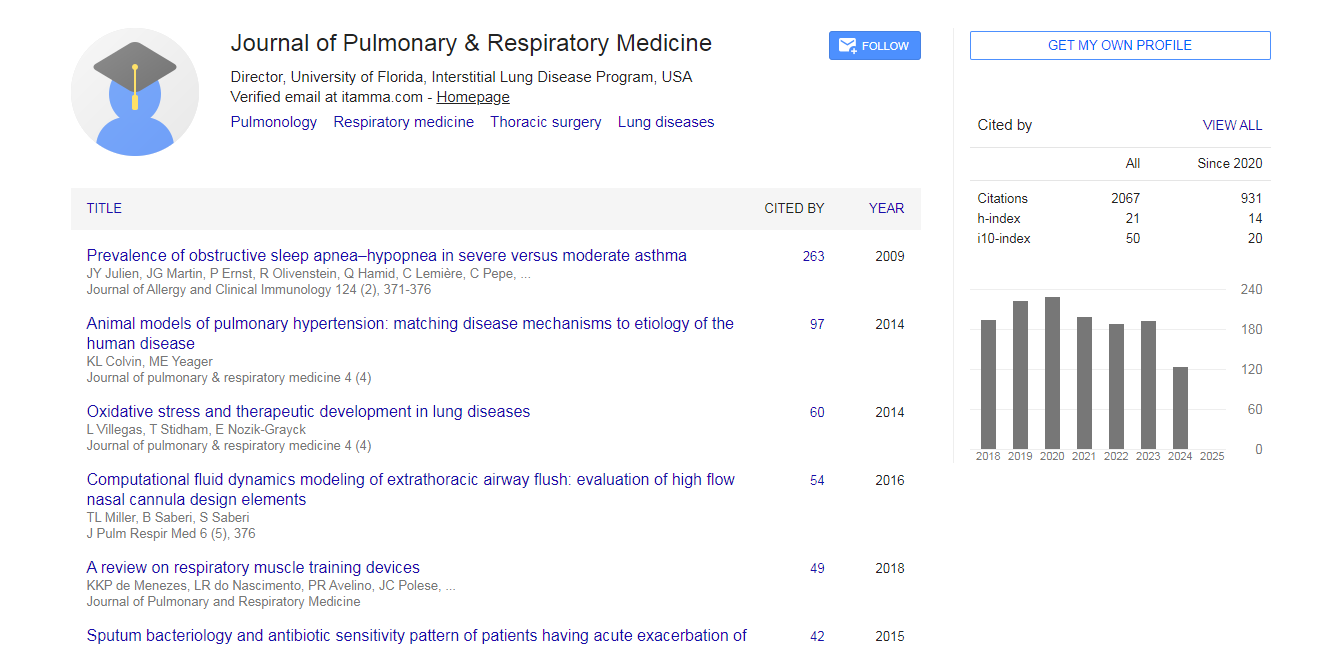
Pulmonary & Respiratory Medicine received 1690 citations as per Google Scholar report