Short Communication - (2025) Volume 16, Issue 6
Received: 01-Dec-2025, Manuscript No. jbmbs-26-183425;
Editor assigned: 03-Dec-2025, Pre QC No. P-183425;
Reviewed: 17-Dec-2025, QC No. Q-183425;
Revised: 22-Dec-2025, Manuscript No. R-183425;
Published:
29-Dec-2025
, DOI: 10.37421/2155-6180.2025.16.310
Citation: Kowalska, Monika. ”Biometrics Enhance EHR Security and Patient Safety.” J Biom Biosta 16 (2025):310.
Copyright: © 2025 Kowalska M. This is an open-access article distributed under the terms of the Creative Commons Attribution License, which permits unrestricted use, distribution and reproduction in any medium, provided the original author and source are credited.
The integration of biometric technologies into Electronic Health Records (EHRs) presents a significant advancement in patient identification and data security within healthcare systems. This innovative approach leverages unique biological or behavioral characteristics to authenticate individuals, thereby enhancing the accuracy of patient records and safeguarding sensitive medical information from unauthorized access. By directly linking individuals to their health data, biometrics offers a more robust and reliable method compared to traditional identification techniques such as passwords or identification cards, which are susceptible to compromise or loss. The implementation of biometrics promises to reduce the incidence of medical errors stemming from misidentification, a persistent challenge in healthcare settings, and contribute to a more secure and efficient healthcare ecosystem. The application of biometrics in EHRs directly addresses the critical need for accurate patient identification to ensure patient safety and the integrity of medical data. Technologies like fingerprint and facial recognition are instrumental in minimizing the risk of 'wrong patient' errors, which can lead to incorrect diagnoses or treatments. These physiological or behavioral identifiers offer a more dependable link to a patient's record than methods relying on memory or easily forged alphanumeric codes, thereby bolstering the reliability of healthcare services. This reliance on inherent human traits provides a foundational layer of security and accuracy in patient management. Despite the compelling benefits, the integration of biometric systems into existing EHR infrastructure is not without its hurdles. Organizations must navigate challenges related to interoperability with diverse legacy systems, stringent data privacy regulations such as HIPAA, and the crucial aspect of user acceptance among both healthcare professionals and patients. Successfully embedding these technologies requires careful consideration of technical feasibility, ensuring compliance with data protection laws, and implementing comprehensive training and educational programs to foster understanding and trust in biometric solutions. Biometric authentication offers a pathway to significantly streamline clinical workflows by enabling faster and more secure patient authentication processes. This efficiency gain allows healthcare professionals to dedicate more time to direct patient care rather than administrative tasks associated with patient identification. Advanced biometric modalities, such as iris scans or vein pattern recognition, provide high levels of accuracy and exhibit greater resistance to spoofing compared to other methods in specific contexts, further enhancing both security and operational efficiency. The utilization of biometrics in EHRs provides a formidable defense against identity theft and unauthorized access to confidential patient records. By anchoring authentication to unique biological traits, biometrics establishes a higher degree of assurance than conventional identification methods, thereby protecting patient data from fraudulent activities. The selection of an appropriate biometric modality necessitates a thorough evaluation of factors including accuracy, ease of use, cost-effectiveness, and the specific security demands of the healthcare environment. The ethical dimensions surrounding the use of biometrics in healthcare, particularly concerning the storage and potential misuse of sensitive biometric data, demand meticulous attention. It is imperative to establish robust protocols for secure storage, encryption, and anonymization of biometric information whenever feasible. The development and implementation of clear policies governing data access, retention periods, and the process for obtaining patient consent are fundamental to maintaining trust and upholding ethical standards in the deployment of these technologies. Biometric systems offer a scalable and efficient solution for verifying patient identities, especially within large and complex healthcare networks. As patient populations grow, traditional identification methods can become increasingly cumbersome and prone to errors. Biometric systems, however, can rapidly and accurately identify individuals, which is essential for effective patient management, streamlined record-keeping, and overall operational efficiency in extensive healthcare settings. Beyond patient care, the adoption of biometric authentication in EHRs can significantly enhance the integrity of data collected during clinical trials. By ensuring accurate and consistent participant identification throughout a study, biometrics minimizes the risk of data manipulation or errors arising from misattributed patient information. This improved data integrity leads to more reliable research outcomes and strengthens the overall validity of clinical trial findings. While biometric systems provide enhanced security, the inherent potential for false positives and false negatives requires diligent mitigation strategies. Robust algorithm design and careful implementation are critical to minimize these inaccuracies. Continuous system monitoring and regular updates of biometric templates are essential to maintain the accuracy and reliability of these systems over time, ensuring their effectiveness in dynamic healthcare environments. Looking ahead, the future of EHR integration with biometrics is likely to involve multi-modal approaches, where different biometric traits are combined to achieve even greater levels of security and accuracy. Advances in artificial intelligence and machine learning will also be pivotal in refining the performance, adaptability, and overall effectiveness of biometric systems within the evolving landscape of healthcare environments.
The integration of biometrics into Electronic Health Records (EHRs) serves as a robust mechanism for patient identification and fortification of data security. This methodology enhances precision by establishing a direct correlation between individuals and their medical information, thereby mitigating the risks associated with misidentification and resultant medical errors. Biometric authentication also presents a more secure and user-friendly alternative to traditional password-based systems, facilitating streamlined access for authorized healthcare professionals while simultaneously protecting sensitive patient data from unauthorized intrusion [1].
The deployment of biometrics within EHR systems can substantially improve patient safety by ensuring that the correct treatment is administered to the right individual. Technologies such as fingerprint and facial recognition, when implemented effectively, markedly reduce the probability of 'wrong patient' errors, a persistent concern in medical settings. This direct physiological or behavioral linkage diminishes reliance on potentially fallible human memory or easily compromised alphanumeric identifiers, thereby increasing the reliability of patient care [2].
Implementing biometric systems within the existing framework of EHR infrastructure presents considerable challenges. These include issues related to interoperability with diverse technological platforms, adherence to data privacy regulations like HIPAA, and ensuring user acceptance. Healthcare organizations must meticulously assess the technical feasibility of integrating various biometric modalities and guarantee compliance with stringent data protection laws. Crucially, comprehensive training for healthcare staff and clear communication to patients regarding the benefits and security features of biometrics are vital for successful adoption [3].
The integration of biometrics into EHRs can also significantly enhance the efficiency of clinical workflows by enabling faster and more secure patient authentication. This allows clinicians to allocate more time to direct patient care, reducing the burden of administrative tasks related to patient identification. Certain advanced biometric technologies, such as iris scans or vein pattern recognition, offer high accuracy and demonstrate superior resistance to spoofing compared to methods like fingerprints or facial recognition in specific scenarios [4].
Biometric authentication in EHRs offers a powerful defense mechanism against identity theft and the fraudulent access of patient records. By leveraging unique biological characteristics, it establishes a higher level of assurance than traditional identification methods. The selection of a specific biometric modality, such as fingerprint, facial, iris, or voice recognition, should be guided by considerations of accuracy, usability, cost, and the particular security requirements of the healthcare environment [5].
The ethical implications associated with the use of biometrics in healthcare, particularly concerning the storage and potential misuse of biometric data, necessitate careful consideration. Ensuring that biometric data is stored securely, encrypted, and anonymized where possible is of paramount importance. The establishment of clear policies governing data access, retention, and patient consent is essential for maintaining trust and adhering to ethical standards in the deployment of these technologies [6].
Biometric technology provides a scalable solution for verifying patient identity within large healthcare systems. Unlike traditional methods that can become cumbersome and error-prone as patient numbers increase, biometric systems can quickly and accurately identify individuals, which is critical for efficient patient management and record-keeping in extensive healthcare networks [7].
The adoption of biometric authentication for EHRs can also contribute to improving the integrity of clinical trial data. By ensuring accurate and consistent participant identification throughout a study, biometrics minimizes the risk of data manipulation or errors that might arise from misattributed patient information, leading to more dependable research outcomes [8].
While biometric systems offer enhanced security, the potential for false positives (incorrectly identifying an individual) and false negatives (failing to correctly identify an individual) must be addressed through robust algorithm design and meticulous implementation. Continuous monitoring and regular updates of biometric templates are necessary to uphold system accuracy and reliability over time, especially within dynamic healthcare settings [9].
The future trajectory of EHR integration with biometrics is expected to involve multi-modal approaches, combining various biometric traits to further enhance security and accuracy. Advancements in artificial intelligence and machine learning technologies will also play a crucial role in improving the performance and adaptability of biometric systems within the evolving healthcare landscape, ensuring their continued relevance and effectiveness [10].
Biometric authentication integrated with Electronic Health Records (EHRs) significantly enhances patient identification accuracy and data security, reducing medical errors and offering a more convenient and secure alternative to traditional methods. Technologies like fingerprint and facial recognition minimize 'wrong patient' errors, crucial for patient safety. While implementation faces challenges such as interoperability, data privacy compliance, and user acceptance, the benefits include streamlined workflows, faster authentication, and stronger defenses against identity theft. The choice of biometric modality depends on accuracy, usability, and cost. Ethical considerations regarding data storage and potential misuse are paramount, requiring clear policies and patient consent. Biometrics offer scalable solutions for large healthcare networks and improve clinical trial data integrity. Continuous monitoring and advancements in multi-modal biometrics and AI will shape its future, promising even greater security and adaptability in healthcare.
None
None
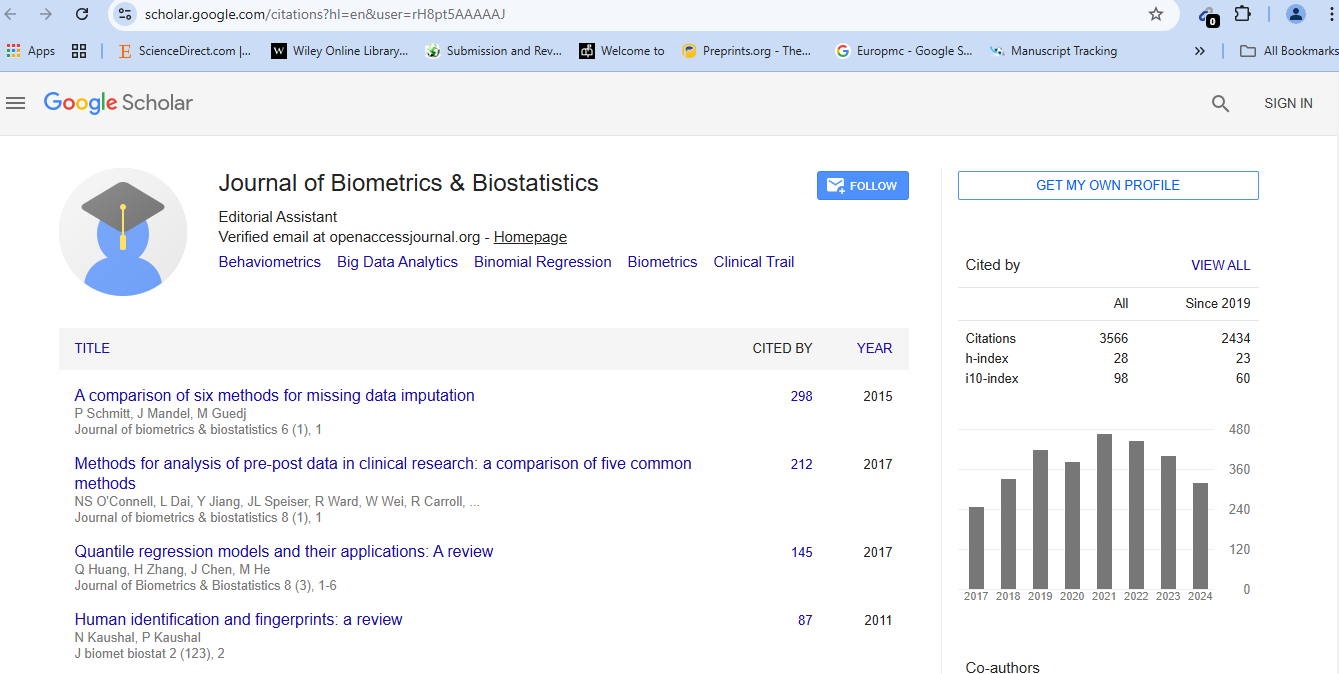
Journal of Biometrics & Biostatistics received 3496 citations as per Google Scholar report