Perspective - (2025) Volume 21, Issue 4
Received: 01-Jul-2025, Manuscript No. jos-26-185168;
Editor assigned: 03-Jul-2025, Pre QC No. P-185168;
Reviewed: 17-Jul-2025, QC No. Q-185168;
Revised: 22-Jul-2025, Manuscript No. R-185168;
Published:
29-Jul-2025
, DOI: 10.37421/1584-9341.2024.20.217
Citation: Ramirez, Jorge Luis. ”Reducing GI Surgery Readmissions:
Key Factors & Strategies.” J Surg 21 (2025):217.
Copyright: © 2025 Ramirez L. Jorge This is an open-access article distributed under the terms of the Creative Commons Attribution License, which permits unrestricted use,
distribution and reproduction in any medium, provided the original author and source are credited.
The increasing prevalence of elective surgical procedures necessitates a thorough understanding of postoperative outcomes, particularly concerning readmissions. These readmissions represent a significant burden on healthcare systems, impacting patient recovery, resource allocation, and overall quality of care. Identifying the factors that contribute to these unplanned hospital visits is paramount for developing effective preventative strategies and optimizing patient management pathways. This introduction aims to provide an overview of the current landscape of research into readmissions following elective gastrointestinal surgery, highlighting key areas of investigation and the importance of this critical aspect of surgical care. One significant area of focus involves understanding the patterns and predictors of readmission after elective gastrointestinal surgery. Research has sought to identify specific patient characteristics and surgical factors that correlate with a higher likelihood of readmission within a defined postoperative period. This foundational knowledge is essential for tailoring interventions and allocating resources more effectively to mitigate risks and improve patient outcomes. The drive to reduce readmission rates is fueled by both clinical and economic imperatives, aiming for better patient well-being and more sustainable healthcare practices [1].
Further investigations have delved into the specific challenges posed by elective colorectal surgery. This sub-specialty within gastrointestinal surgery presents unique considerations regarding patient comorbidities and the inherent complexity of operative procedures. Understanding how these elements interact to influence readmission rates is crucial for refining surgical approaches and enhancing perioperative care. The emphasis on preoperative optimization and comprehensive discharge planning emerges as a critical strategy to address these challenges and prevent avoidable readmissions in this patient population [2].
Beyond general gastrointestinal surgery, specific procedures also warrant dedicated examination. Elective abdominal wall reconstruction, for instance, has been studied to pinpoint the primary drivers of readmission. Identifying common postoperative complications, such as surgical site infections and ileus, allows for the development of targeted interventions. The implication is that by directly addressing these preventable complications, healthcare providers can significantly reduce the incidence of readmissions, thereby improving patient recovery and reducing healthcare costs associated with repeat hospitalizations [3].
An important social determinant of health, socioeconomic status, has also been recognized as a significant factor influencing readmission rates. Studies exploring the relationship between socioeconomic background and readmission after elective gastrointestinal surgery reveal disparities in healthcare access and adherence to postoperative instructions. These findings underscore the need for a nuanced approach that considers the broader social context of patient care and addresses barriers that may contribute to higher readmission rates in underserved populations, promoting health equity [4].
In the pursuit of reducing readmissions, the implementation of enhanced recovery after surgery (ERAS) protocols has gained considerable attention. Research investigating the impact of ERAS pathways on readmission rates for elective gastrointestinal procedures suggests that adherence to these evidence-based guidelines can lead to improved patient outcomes. By standardizing and optimizing perioperative care, ERAS protocols appear to play a positive role in decreasing the likelihood of readmission, highlighting the value of multimodal care strategies [5].
Minimally invasive surgical techniques have revolutionized many surgical fields, and their impact on readmission rates is a subject of ongoing inquiry. Studies comparing outcomes after elective minimally invasive versus open gastrointestinal surgery explore whether the inherent benefits of less invasive approaches translate into reduced readmission rates. This line of research is critical for guiding surgical decision-making and understanding the long-term implications of different surgical modalities on patient recovery and healthcare utilization [6].
Moving beyond surgical techniques and protocols, the patient's own perspective is increasingly recognized as a vital component of postoperative care. The examination of patient-reported outcomes (PROs) as predictors of readmission after elective gastrointestinal surgery is an emerging area of research. Investigating whether PROs can serve as early warning indicators for potential readmission empowers patients in their recovery and allows for proactive interventions to prevent complications and unnecessary hospital visits [7].
The duration of a patient's initial hospital stay can also have implications for subsequent readmissions. Research exploring the association between prolonged hospital stays and readmission after elective gastrointestinal surgery emphasizes the need for efficient patient flow and optimized postoperative management. Identifying the factors contributing to extended hospitalizations is key to streamlining care and reducing the risk of readmission by ensuring patients are discharged at the appropriate time and with adequate support [8].
Finally, the expertise and experience of the surgical team, particularly the surgeon, are investigated for their influence on readmission rates. Studies analyzing the effect of surgeon volume and experience on readmissions following elective gastrointestinal surgery suggest that these factors may play a crucial role in optimizing surgical outcomes and minimizing the incidence of readmissions. This underscores the importance of surgeon proficiency in achieving favorable patient outcomes and efficient healthcare delivery [9].
The patterns of readmission following elective gastrointestinal surgery are a critical area of focus for improving postoperative care and reducing healthcare burdens. Anupam Sharma and colleagues, in their nationwide inpatient database analysis, identified key risk factors and patient characteristics associated with these readmission events. Their findings underscore the necessity of understanding these patterns to enhance postoperative care pathways and decrease the overall impact of readmissions on both patients and healthcare systems [1].
In the realm of elective colorectal surgery, research by Ting Ting Chen and collaborators highlights the significant impact that patient comorbidities and the complexity of operative procedures have on readmission rates. This study emphasizes the vital importance of robust preoperative optimization strategies and comprehensive discharge planning as essential measures to effectively mitigate the risks of readmission in this surgical cohort [2].
Matthew J. W. Dixon and his team investigated readmissions within 30 days of elective abdominal wall reconstruction. Their analysis pinpointed surgical site infection and ileus as the primary complications driving these readmissions. The study suggests that implementing targeted interventions aimed at preventing these specific complications could lead to a substantial reduction in readmission rates, improving patient recovery and resource utilization [3].
Sarah E. J. M. Van Der Zee and her co-authors explored the intricate relationship between socioeconomic status and readmission rates after elective gastrointestinal surgery. Their research brings to light critical issues related to disparities in healthcare access and challenges patients face in adhering to postoperative instructions, factors that can contribute to higher readmission rates among underserved populations [4].
David M. G. Williams and his colleagues conducted a systematic review examining the impact of Enhanced Recovery After Surgery (ERAS) protocols on readmission rates following elective gastrointestinal procedures. Their findings indicate that strict adherence to ERAS guidelines can positively influence patient outcomes and demonstrably decrease the likelihood of readmission, emphasizing the value of standardized, multidisciplinary care [5].
Studies focusing on elective minimally invasive gastrointestinal surgery, such as the work by Yong-Jun Lee and associates, compare outcomes with traditional open procedures. This research aims to ascertain whether the recognized benefits of minimally invasive approaches, including potentially faster recovery and reduced pain, extend to lower readmission rates, providing crucial data for surgical technique selection [6].
Laura J. S. Martin and her research group investigated the role of patient-reported outcomes (PROs) in predicting readmission rates after elective gastrointestinal surgery. Their work explores the potential for PROs to serve as valuable early warning indicators, allowing for timely interventions that can prevent complications and subsequent hospital readmissions, thereby enhancing patient engagement in their recovery [7].
Robert A. B. Smith and his team delved into the causes and implications of prolonged hospital stays that may lead to readmission after elective gastrointestinal surgery. Their research underscores a critical need for more efficient patient flow through the healthcare system and optimized management protocols during the postoperative period to prevent extended stays and subsequent readmissions [8].
Michael L. Chen and colleagues analyzed the influence of surgeon experience on readmission rates following elective gastrointestinal surgery. Their findings suggest that surgeon volume and accumulated experience may indeed play a significant role in optimizing surgical outcomes and minimizing the occurrence of readmissions, highlighting the importance of surgical expertise in patient care [9].
Jennifer A. Wong and her co-authors examined the specific patterns of readmission after elective upper gastrointestinal surgery. They identified common complications, such as anastomotic leaks and prolonged ileus, as key contributors. The study emphasizes the necessity of developing and implementing tailored follow-up protocols to address these specific postoperative challenges and reduce readmission rates in this patient population [10].
This collection of research investigates readmissions following elective gastrointestinal surgery. Key findings highlight various contributing factors including patient comorbidities, operative complexity, surgical site infections, ileus, socioeconomic status, and the duration of hospital stays. Studies also explore the impact of minimally invasive surgery, enhanced recovery after surgery (ERAS) protocols, patient-reported outcomes, and surgeon experience on readmission rates. The research collectively emphasizes the need for robust preoperative optimization, comprehensive discharge planning, targeted interventions for common complications, and tailored follow-up protocols to improve patient outcomes and reduce the burden of readmissions.
None
None
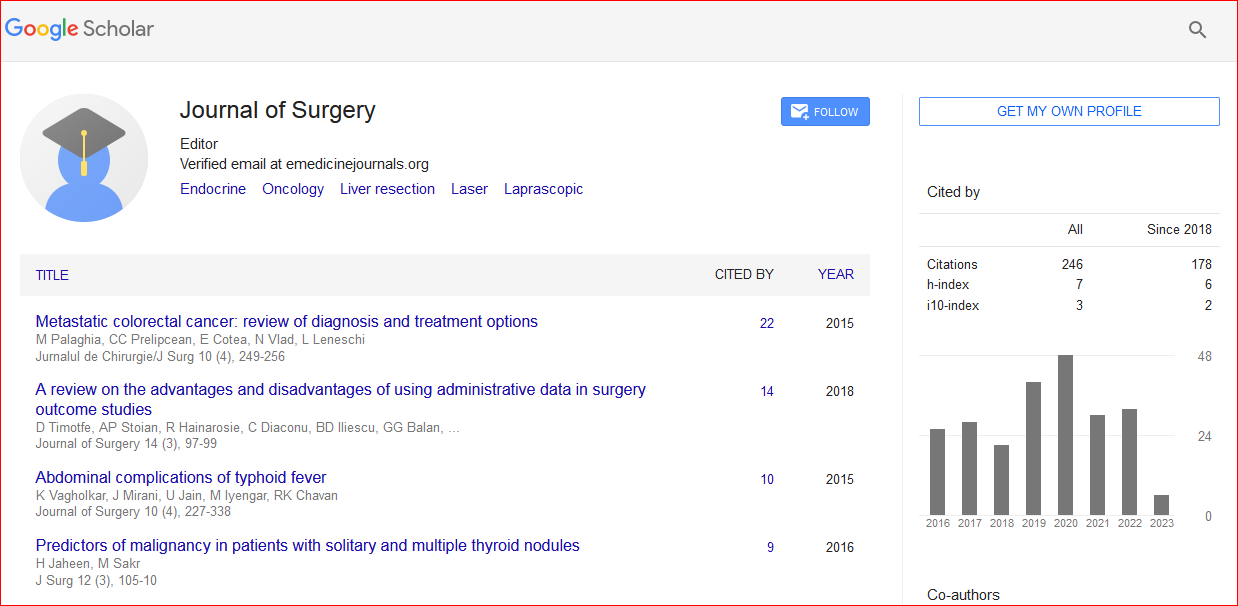
Journal of Surgery received 288 citations as per Google Scholar report