Short Communication - (2025) Volume 16, Issue 5
Received: 01-Sep-2025, Manuscript No. jpm-26-179463;
Editor assigned: 03-Sep-2025, Pre QC No. P-179463;
Reviewed: 17-Sep-2025, QC No. Q-179463;
Revised: 22-Sep-2025, Manuscript No. R-179463;
Published:
29-Sep-2025
, DOI: 10.37421/2090-0902.2025.16.559
Citation: Tanaka, Keiko. ”Reaction-Diffusion Systems: Patterns, Stability and Dynamics.” J Phys Math 16 (2025):559.
Copyright: © 2025 Tanaka K. This is an open-access article distributed under the terms of the Creative Commons Attribution License, which permits unrestricted use, distribution and reproduction in any medium, provided the original author and source are credited.
The intricate field of reaction-diffusion systems has garnered significant attention for its capacity to model complex spatio-temporal phenomena across diverse scientific disciplines. These systems, characterized by the interplay of local chemical or biological reactions and the diffusion of species, offer a powerful framework for understanding emergent behaviors. The mathematical analysis of these systems is crucial for unraveling the mechanisms behind pattern formation, stability, and dynamics. This work aims to provide a comprehensive overview of recent advancements in this area, highlighting key theoretical insights and their applications. Reaction-diffusion systems are fundamental to understanding how spatial patterns emerge from homogeneous states. The mathematical analysis of these systems, focusing on their application in understanding complex spatio-temporal phenomena, has revealed critical insights into bifurcation mechanisms that drive pattern formation. These studies have also elucidated the significant role diffusion coefficients play in either stabilizing or destabilizing homogeneous states. Furthermore, the development of sophisticated analytical and numerical techniques is vital for accurately predicting the emergent behaviors observed in these systems. The highlighted applications range from biological pattern formation, such as in embryogenesis, to chemical oscillations, and crucially, the analysis of their stability under various conditions [1].
In the realm of ecological modeling, predator-prey dynamics governed by reaction-diffusion equations have been extensively explored to understand population distributions and interactions. The conditions under which spatial segregation and pattern formation occur are of particular interest. Studies have demonstrated that differing diffusion rates between species can lead to their spatial separation and significantly influence the stability of their coexistence. The impact of environmental heterogeneity on overall population dynamics is also a critical factor, offering a deeper understanding of complex ecological interactions and the formation of distinct spatial niches [2].
The investigation of traveling waves in reaction-diffusion systems is essential for comprehending phenomena that propagate through space and time. Establishing rigorous criteria for the existence of such waves and analyzing their asymptotic behavior are key challenges. Understanding how reaction kinetics and diffusion properties collectively influence the speed and shape of these propagating fronts is crucial for accurately modeling signals, disease spread, and other dynamic processes [3].
The exploration of fractional diffusion in reaction-diffusion systems has opened new avenues for understanding anomalous diffusion processes. This approach, which employs fractional derivatives to describe diffusion, has shown the potential to generate novel spatial patterns and alter the conditions required for Turing instability. This research significantly expands the applicability of reaction-diffusion models to encompass systems exhibiting sub- or super-diffusive behavior, which are frequently observed in complex or disordered media [4].
The influence of noise on reaction-diffusion systems is another critical area of study, particularly concerning stochastic resonance and pattern selection. The interplay between diffusion, reaction kinetics, and inherent stochasticity can lead to enhanced signal detection and the emergence of robust spatio-temporal patterns. This understanding is particularly relevant for biological processes where random fluctuations are an integral part of system dynamics [5].
Coupled systems of reaction-diffusion equations offer a framework for studying emergent phenomena such as synchronization and complex spatio-temporal dynamics. The investigation of how coupling strengths and diffusion parameters affect the coherence and stability of these interconnected subsystems provides valuable insights into how individual components can coordinate their behavior. This has broad implications for fields like neuroscience, where synchronized neuronal activity is fundamental, and in the study of coupled oscillators [6].
Time delays are an inherent feature in many biological and chemical processes, and their impact on reaction-diffusion systems is a significant area of research. Delays can destabilize previously stable states, leading to oscillations or complex temporal patterns. Identifying the specific conditions under which these delays induce bifurcations and influence overall system dynamics is crucial for accurately modeling systems with memory effects [7].
Spatial heterogeneity, characterized by variations in diffusion coefficients and reaction rates across space, plays a pivotal role in shaping pattern formation within reaction-diffusion systems. This heterogeneity can act as a powerful driver for pattern diversity and stability, fostering the development of localized structures and intricate spatial organization. Such insights are particularly relevant for the accurate modeling of natural systems that exist within complex and non-uniform environments [8].
Finally, the stability analysis of equilibria in reaction-diffusion systems forms a foundational aspect of predicting their long-term behavior. Employing rigorous mathematical tools such as spectral analysis and perturbation methods allows researchers to determine the conditions under which homogeneous steady states remain stable or become unstable, thereby paving the way for the emergence of complex patterns. This approach provides a robust mathematical framework essential for predicting the formation of emergent structures [9].
The mathematical underpinnings of reaction-diffusion systems provide a crucial lens through which to analyze complex spatio-temporal phenomena. Research in this area has focused on identifying the key bifurcation mechanisms that give rise to pattern formation, illustrating how changes in system parameters can lead to the emergence of structured spatial arrangements. A significant aspect of this analysis involves understanding the role of diffusion coefficients; these parameters can either stabilize or destabilize homogeneous states, dictating whether uniform distributions persist or break into complex patterns. The development and refinement of both analytical and numerical techniques are paramount for predicting these emergent behaviors with accuracy. These systems have proven invaluable in modeling a wide array of processes, from the intricate patterns observed in biological development to the dynamic oscillations seen in chemical reactions, with a strong emphasis on understanding the conditions that govern their stability [1].
In ecological contexts, the dynamics of predator-prey interactions are often studied using reaction-diffusion equations to understand how populations distribute themselves in space and how they interact. A central theme in this research is the investigation of conditions that promote spatial segregation and pattern formation among species. It has been shown that differences in the diffusion rates of predators and prey can lead to their spatial separation, a phenomenon that critically influences the stability of coexistence states. Furthermore, the impact of environmental heterogeneityâ??variations in habitat characteristicsâ??on the overall population dynamics is explored, providing a more nuanced understanding of ecological relationships and the development of spatial structures within ecosystems [2].
The study of traveling waves in reaction-diffusion systems is fundamental to understanding processes that propagate through space and time, such as the spread of signals or waves. This research aims to establish precise criteria for the existence of these waves and to analyze their behavior as they evolve. A key focus is on elucidating how the specific characteristics of the reaction kinetics and the diffusion properties of the involved species collectively determine the speed and the precise shape of these propagating waves. This detailed understanding is essential for building accurate models of fronts and signals in various natural and artificial systems [3].
The integration of fractional diffusion concepts into reaction-diffusion systems represents an advancement in modeling systems exhibiting anomalous diffusion. This innovative approach, which utilizes fractional derivatives, has demonstrated the capacity to generate novel spatial patterns that differ from those predicted by classical diffusion models. It also modifies the conditions under which Turing instabilities, a key mechanism for pattern formation, arise. This work broadens the applicability of reaction-diffusion frameworks to include systems exhibiting sub- or super-diffusive characteristics, commonly observed in heterogeneous or complex environments [4].
The impact of intrinsic noise on the behavior of reaction-diffusion systems is a subject of considerable interest, particularly concerning phenomena like stochastic resonance and pattern selection. It has been observed that the synergistic interplay between diffusion processes, reaction kinetics, and inherent random fluctuations can enhance the detection of weak signals and contribute to the emergence of robust spatio-temporal patterns. This is of great importance for understanding biological systems where inherent randomness plays a significant role in overall function and organization [5].
Analyzing coupled reaction-diffusion systems allows for the investigation of emergent phenomena such as synchronization and the formation of complex spatio-temporal dynamics. This research explores how the strength of the coupling between different subsystems, along with their respective diffusion parameters, influences the degree of coherence and overall stability. These findings offer insights into how spatially distributed, interacting components can coordinate their activities, which is relevant to understanding synchronization in neural networks and the behavior of coupled oscillatory systems [6].
The incorporation of time delays into reaction-diffusion systems is crucial for accurately modeling processes where past states influence current dynamics. Such delays are common in biological and chemical systems. Research in this area focuses on how these delays can destabilize states that would otherwise be stable, potentially leading to oscillations or intricate temporal patterns. The identification of specific conditions under which time delays trigger bifurcations and alter the overall system dynamics is vital for systems exhibiting memory effects [7].
Investigating the role of spatial heterogeneity in reaction-diffusion systems reveals how variations in diffusion coefficients and reaction rates across different spatial locations can profoundly influence pattern formation. It has been demonstrated that such heterogeneity can act as a driving force for the emergence of diverse patterns and enhance their stability, often leading to the formation of localized structures and complex spatial organizations. These findings are especially pertinent for modeling natural systems characterized by non-uniform environments [8].
The stability analysis of equilibrium states within reaction-diffusion systems is a fundamental step in predicting their long-term behavior and understanding transitions to complex dynamics. Utilizing advanced mathematical techniques, including spectral analysis and perturbation methods, researchers can precisely determine the conditions under which homogeneous steady states are stable or unstable. This rigorous analysis is essential for forecasting the emergence of patterned structures and understanding the underlying mechanisms of pattern formation [9].
This collection of research explores the multifaceted behavior of reaction-diffusion systems, focusing on pattern formation, stability, and dynamics. Studies investigate how factors such as diffusion rates, reaction kinetics, spatial heterogeneity, time delays, and noise influence system behavior. Key areas of investigation include the analysis of bifurcation mechanisms leading to pattern formation, predator-prey dynamics in ecological models, the propagation of traveling waves, and the impact of fractional diffusion on emergent structures. Furthermore, the research delves into stochastic resonance, synchronization in coupled systems, and the stability of equilibrium states. Applications span from biological pattern development to epidemic modeling and chemical oscillations, offering a comprehensive understanding of spatio-temporal phenomena.
None
None
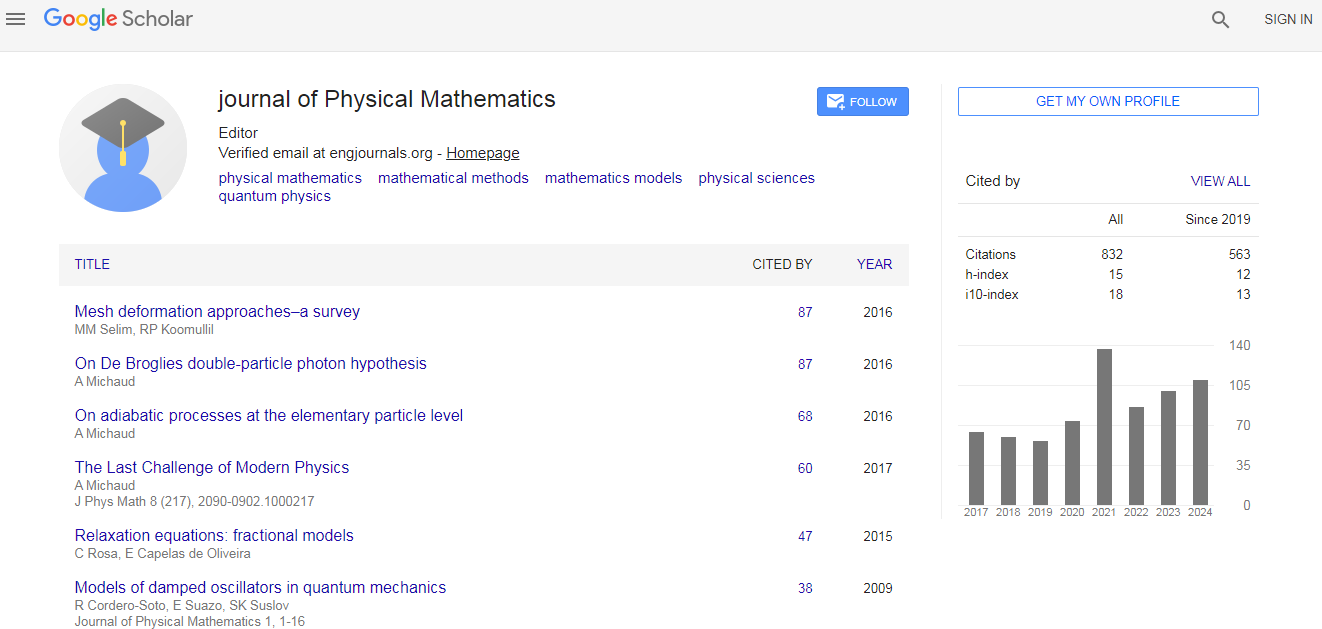
Physical Mathematics received 686 citations as per Google Scholar report