Opinion - (2025) Volume 11, Issue 4
Received: 01-Jul-2025, Manuscript No. ohcr-25-174296;
Editor assigned: 03-Jul-2025, Pre QC No. P-174296;
Reviewed: 17-Jul-2025, QC No. Q-174296;
Revised: 22-Jul-2025, Manuscript No. R-174296;
Published:
29-Jul-2025
, DOI: 10.37421/2471-8726.2025.11.205
Citation: Costa, Valentina. ”Rare Oral Conditions: Diverse Challenges, Systemic Clues.” Oral Health Case Rep 11 (2025):205.
Copyright: © 2025 Costa V. This is an open-access article distributed under the terms of the Creative Commons Attribution License, which permits unrestricted use, distribution and reproduction in any medium, provided the original author and source are credited.
Oral epithelioid hemangioendothelioma is a rare vascular tumor that often presents in the head and neck region, including the oral cavity. Diagnosis relies on a combination of clinical, histopathological, and immunohistochemical features, distinguishing it from other vascular lesions. Treatment typically involves surgical excision, with prognosis generally favorable though recurrence can occur. Understanding its diverse presentation is crucial for early detection and effective management[1].
Langerhans cell histiocytosis (LCH) is a rare proliferative disorder of Langerhans cells, with oral manifestations being common and often crucial for diagnosis. These can include gingival lesions, bone destruction leading to tooth mobility, and soft tissue involvement, mimicking more common periodontal diseases or inflammatory processes. Early recognition of oral signs is vital for timely diagnosis and management, potentially preventing systemic complications[2].
Orofacial granulomatosis (OFG) is a rare chronic inflammatory disorder characterized by persistent or recurrent swelling of the oral and facial tissues, often affecting the lips, buccal mucosa, and gingiva. Its etiology is complex and thought to involve immune dysregulation, genetic predisposition, and allergic reactions to certain foods or dental materials. Management is challenging, often requiring a multi-modal approach including dietary modifications, local corticosteroid injections, and systemic immunosuppressants[3].
Melkersson-Rosenthal Syndrome (MRS) is a rare neuro-mucocutaneous disorder characterized by a classic triad of recurrent orofacial edema, facial nerve paralysis, and fissured tongue, though incomplete forms are more common. The exact etiology remains unknown, but genetic, infectious, and immunological factors are implicated. Diagnosis is often clinical, supported by histopathological findings, and management aims to reduce symptoms and prevent recurrences, typically involving corticosteroids or other immunomodulators[4].
Cowden Syndrome (CS) is a rare autosomal dominant disorder characterized by multiple hamartomas and an increased risk of various cancers. Oral manifestations are present in a high percentage of patients and can be the earliest diagnostic indicators, typically presenting as multiple mucocutaneous papules, papillomatosis, and fibromas on the lips, tongue, and gingiva. Recognizing these specific oral signs is crucial for early diagnosis, leading to prompt genetic testing and lifelong cancer surveillance[5].
Pemphigus Vulgaris (PV) is a severe autoimmune mucocutaneous blistering disease, with oral lesions often being the initial and sometimes the sole presentation, making diagnosis challenging. These lesions present as fragile bullae that quickly rupture, forming painful erosions on any oral mucosal surface. Early diagnosis through biopsy and immunofluorescence, followed by systemic corticosteroids and immunosuppressants, is crucial to prevent widespread disease and improve prognosis[6].
Oral sarcoidosis is a rare manifestation of a systemic granulomatous disease, often presenting as non-specific lesions like nodules, ulcers, or diffuse swelling, making diagnosis challenging. It can affect any part of the oral cavity, including salivary glands and jaw bones, and may be the first sign of systemic sarcoidosis. Histopathological examination revealing non-caseating granulomas is key for diagnosis, and treatment depends on the extent of systemic involvement, often involving corticosteroids[7].
Oral Kaposi's sarcoma (OKS) is a vascular neoplasm primarily associated with human herpesvirus 8 (HHV-8) infection, predominantly seen in immunocompromised individuals, especially those with HIV/AIDS. It manifests as purple, red, or brown lesions that can be macules, patches, plaques, or tumors, commonly affecting the palate, gingiva, and tongue. While antiretroviral therapy has reduced its incidence, OKS remains an important indicator of immune status and requires careful management to prevent progression and improve quality of life[8].
Granular cell tumor (GCT) is a rare benign soft tissue neoplasm that frequently occurs in the oral cavity, with the tongue being the most common site. These tumors typically present as solitary, asymptomatic nodules, although multiple lesions can occur. Histologically, they are characterized by large, polygonal cells with abundant granular eosinophilic cytoplasm. Complete surgical excision is the treatment of choice, with a good prognosis and low recurrence rates for benign forms[9].
Oral amyloidosis is a rare manifestation of amyloid deposition, where abnormal proteins accumulate in various tissues, leading to organ dysfunction. In the oral cavity, it can present with diverse non-specific symptoms such as macroglossia, nodules, petechiae, or xerostomia, often mimicking other benign or inflammatory conditions. Diagnosis requires biopsy with Congo red staining to confirm amyloid deposits, and early detection is critical as oral involvement can indicate systemic disease requiring comprehensive management[10].
The oral cavity is frequently affected by a spectrum of rare conditions, each presenting unique diagnostic and management challenges. Oral Epithelioid Hemangioendothelioma is a rare vascular tumor that often presents in the head and neck region, including the oral cavity [1]. Diagnosis for this tumor relies on a combination of clinical, histopathological, and immunohistochemical features to distinguish it from other vascular lesions. Treatment typically involves surgical excision, with a generally favorable prognosis, though recurrence can occur [1]. Similarly, Oral Kaposi's Sarcoma (OKS) is a vascular neoplasm primarily associated with human herpesvirus 8 (HHV-8) infection, predominantly seen in immunocompromised individuals. It manifests as purple, red, or brown lesions that can be macules, patches, plaques, or tumors, commonly affecting the palate, gingiva, and tongue [8]. While antiretroviral therapy has reduced its incidence, OKS remains an important indicator of immune status and requires careful management [8]. Another notable neoplasm is the Granular Cell Tumor (GCT), a rare benign soft tissue neoplasm that frequently occurs in the oral cavity, with the tongue being the most common site [9]. These tumors typically present as solitary, asymptomatic nodules, and complete surgical excision is the treatment of choice with a good prognosis [9].
Inflammatory and granulomatous disorders also significantly impact the oral cavity. Orofacial Granulomatosis (OFG) is a rare chronic inflammatory disorder characterized by persistent or recurrent swelling of the oral and facial tissues, often affecting the lips, buccal mucosa, and gingiva [3]. Its complex etiology involves immune dysregulation, genetic predisposition, and allergic reactions, making management challenging and often requiring a multi-modal approach including dietary modifications and immunosuppressants [3]. Oral Sarcoidosis is another rare manifestation of a systemic granulomatous disease, presenting as non-specific lesions like nodules, ulcers, or diffuse swelling [7]. It can affect any part of the oral cavity and may be the first sign of systemic sarcoidosis. Diagnosis relies on histopathological examination revealing non-caseating granulomas, with treatment depending on the extent of systemic involvement [7].
Autoimmune and proliferative disorders often manifest with distinct oral signs. Pemphigus Vulgaris (PV) is a severe autoimmune mucocutaneous blistering disease, with oral lesions often being the initial and sometimes the sole presentation, presenting as fragile bullae that quickly rupture into painful erosions [6]. Early diagnosis through biopsy and immunofluorescence, followed by systemic corticosteroids, is crucial to prevent widespread disease [6]. Langerhans Cell Histiocytosis (LCH) is a rare proliferative disorder of Langerhans cells, where oral manifestations are common and crucial for diagnosis [2]. These can include gingival lesions, bone destruction leading to tooth mobility, and soft tissue involvement, often mimicking common periodontal diseases. Early recognition of oral signs is vital for timely diagnosis and management, potentially preventing systemic complications [2].
Oral manifestations serve as crucial early diagnostic indicators for several systemic syndromes. Melkersson-Rosenthal Syndrome (MRS) is a rare neuro-mucocutaneous disorder characterized by a classic triad of recurrent orofacial edema, facial nerve paralysis, and fissured tongue, though incomplete forms are more common [4]. Its etiology involves genetic, infectious, and immunological factors, with diagnosis being clinical and management aiming to reduce symptoms and prevent recurrences [4]. Cowden Syndrome (CS), a rare autosomal dominant disorder, is characterized by multiple hamartomas and an increased risk of various cancers. Oral manifestations are present in a high percentage of patients, typically as multiple mucocutaneous papules, papillomatosis, and fibromas, making their recognition crucial for early diagnosis, genetic testing, and lifelong cancer surveillance [5].
Finally, Oral Amyloidosis represents a rare manifestation of amyloid deposition, where abnormal proteins accumulate, leading to organ dysfunction. In the oral cavity, it can present with diverse non-specific symptoms such as macroglossia, nodules, petechiae, or xerostomia, often mimicking other benign conditions [10]. Diagnosis requires biopsy with Congo red staining to confirm amyloid deposits, and early detection is critical as oral involvement can indicate systemic disease requiring comprehensive management [10]. The diverse pathologies discussed underscore the fundamental importance of careful oral examination. Recognizing these varied oral presentations, whether they are neoplastic, inflammatory, autoimmune, or indicators of systemic syndromes, is essential for accurate and timely diagnosis, leading to appropriate treatment strategies and improved patient outcomes.
The oral cavity is a site for diverse rare conditions, ranging from vascular tumors like Oral Epithelioid Hemangioendothelioma [1] and Kaposi's Sarcoma [8], to benign Granular Cell Tumors [9]. These conditions present unique diagnostic challenges due to their varied clinical appearances. Inflammatory disorders such as Orofacial Granulomatosis [3] and Oral Sarcoidosis [7] involve persistent swelling or non-specific lesions, often requiring histopathological confirmation of granulomas. Autoimmune blistering diseases like Pemphigus Vulgaris [6] frequently manifest first in the oral mucosa, making early diagnosis crucial to prevent systemic spread. Furthermore, several systemic conditions show critical oral manifestations. Langerhans Cell Histiocytosis [2] can present with gingival lesions and bone destruction, while Melkersson-Rosenthal Syndrome [4] is characterized by a triad of orofacial edema, facial nerve paralysis, and fissured tongue. Cowden Syndrome [5] reveals early diagnostic clues through mucocutaneous papules, indicating a higher cancer risk. Lastly, Oral Amyloidosis [10] shows non-specific symptoms like macroglossia, signifying systemic amyloid deposition. Across these diverse pathologies, early recognition of oral signs is paramount. Diagnosis often relies on a combination of clinical assessment, histopathology, and immunohistochemistry, leading to timely and effective management, whether through surgical excision, corticosteroids, or immunosuppressants. Understanding the varied presentations and systemic implications of these rare oral conditions is key to improving patient outcomes and initiating appropriate surveillance.
None
None
1. Hao C, Xiangdong C, Ruirui L. "Oral Epithelioid Hemangioendothelioma: A Comprehensive Review of Clinical, Histopathological, and Immunohistochemical Features and Treatment Strategies".J Maxillofac Oral Surg 22 (2023):275-285.
Indexed at, Google Scholar, Crossref
2. Soraia MMS, Celso AL, Maria MG. "Oral Manifestations of Langerhans Cell Histiocytosis: A Systematic Review".J Clin Exp Dent 12 (2020):e101-e106.
Indexed at, Google Scholar, Crossref
3. MaÅ?gorzata W, MichaÅ? S, MaÅ?gorzata J. "Orofacial granulomatosis in childhood".Przegl Gastroenterol 17 (2022):307-313.
Indexed at, Google Scholar, Crossref
4. Veeramani A, Suresh S, Arun V. "Melkersson-Rosenthal syndrome: a rare cause of oral facial swelling - a case report and review of literature".J Stomatol Oral Maxillofac Surg 123 (2022):97-100.
Indexed at, Google Scholar, Crossref
5. Beatriz ALM, Cibele S, LetÃcia C. "Oral Manifestations as Early Diagnostic Clues for Cowden Syndrome: A Systematic Review".J Maxillofac Oral Surg 21 (2022):681-690.
Indexed at, Google Scholar, Crossref
6. Károly G, László T, Imre S. "Oral Pemphigus Vulgaris: A Challenging Diagnosis and Treatment".Front Med (Lausanne) 9 (2022):856950.
Indexed at, Google Scholar, Crossref
7. Júlio MBL, Lara RMdS, Francisco NC. "Oral Sarcoidosis: Report of 2 Cases and Review of the Literature".Head Neck Pathol 15 (2021):1020-1025.
Indexed at, Google Scholar, Crossref
8. Stefania M, Francesco DS, Flaviana D. "Oral Kaposi's sarcoma in HIV-infected patients: A narrative review".Oral Dis 29 (2023):1790-1801.
Indexed at, Google Scholar, Crossref
9. Marco B, Roberto D, Enrico F. "Granular cell tumor of the oral cavity and oropharynx: A systematic review".Oral Oncol 145 (2023):106606.
Indexed at, Google Scholar, Crossref
10. Rakesh R, Anjana G, Sunil P. "Oral amyloidosis mimicking benign soft tissue lesions".J Oral Maxillofac Pathol 25 (2021):158-160.
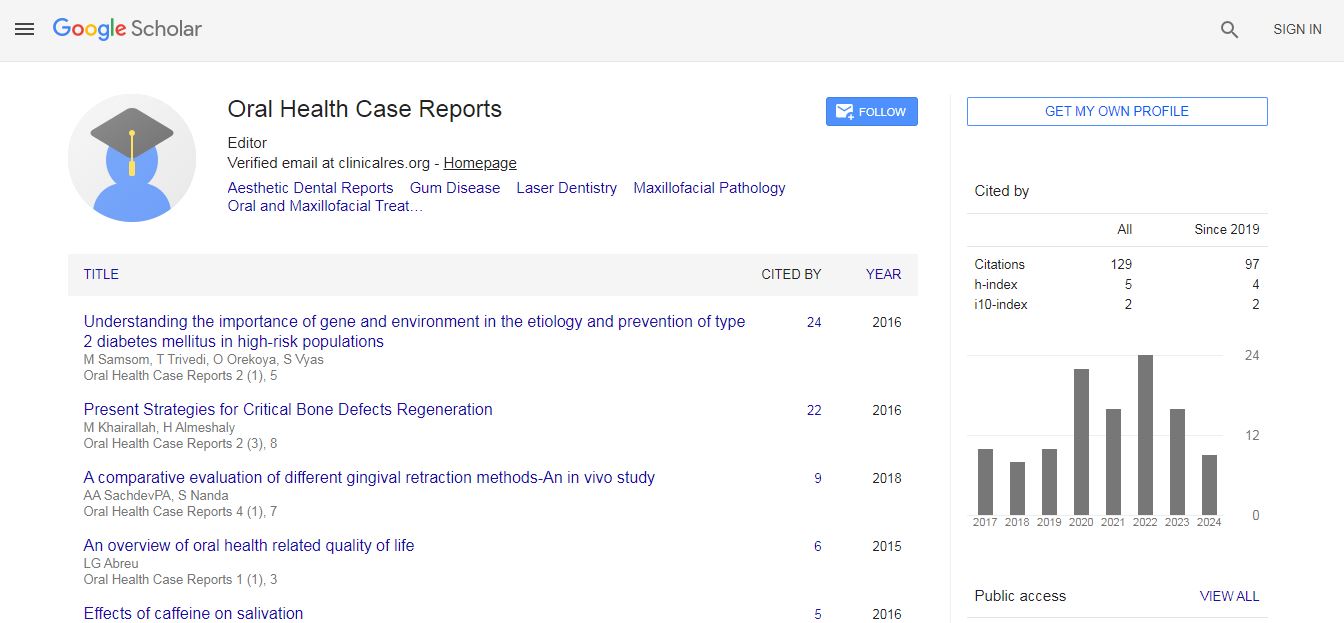
Oral Health Case Reports received 120 citations as per Google Scholar report