Brief Report - (2025) Volume 14, Issue 6
Received: 01-Dec-2025, Manuscript No. jbfa-25-176847;
Editor assigned: 03-Dec-2025, Pre QC No. P-176847;
Reviewed: 17-Dec-2025, QC No. Q-176847;
Revised: 22-Dec-2025, Manuscript No. R-176847;
Published:
29-Dec-2025
, DOI: 10.37421/2161-0673.2025.14.560
Citation: Rosen, Talia. ”Quantitative Economic Models for Policy Insights.” J Bus Fin Aff 14 (2025):560.
Copyright: © 2025 Rosen T. This is an open-access article distributed under the terms of the Creative Commons Attribution License, which permits unrestricted use, distribution and reproduction in any medium, provided the original author and source are credited.
This research details a sophisticated multi-sectoral, multi-regional, multi-household dynamic general equilibrium model, specifically designed to analyze climate change impacts and policy responses within Nigeria. The model offers crucial insights into how different climate policies might affect various economic sectors and household groups, providing a framework for informed decision-making in developing economies facing significant climate vulnerabilities[1].
This article explores the application of Dynamic Stochastic General Equilibrium (DSGE) models to understand monetary policy transmission and inflation dynamics specifically within emerging economies. It highlights how unique structural characteristics of these economies, such as financial market development and exchange rate regimes, necessitate tailored modeling approaches[2].
This study delves into the economic modeling of renewable energy penetration and its implications for grid stability. It uses dynamic economic models to analyze investment decisions in renewable technologies, the integration challenges faced by existing electricity grids, and the policy interventions required to foster a smooth transition to cleaner energy sources[3].
This research examines the profound impact of automation on labor markets using a Computable General Equilibrium (CGE) approach. It models how technological advancements, particularly in automation, reconfigure job roles, wage structures, and overall employment levels across various sectors of the economy[4].
This article offers a quantitative economic analysis of the relationship between global value chains (GVCs) and trade policy. It models how changes in trade agreements, tariffs, and non-tariff barriers affect the structure and efficiency of GVCs, and consequently, national economies[5].
This research builds economic models to simulate disease spread and assess optimal healthcare resource allocation during pandemics. It integrates epidemiological dynamics with economic decision-making, considering factors like intervention costs, economic productivity losses, and the strain on healthcare systems[6].
This study conducts a Dynamic Stochastic General Equilibrium (DSGE) analysis of fiscal policy and public debt sustainability. It models how government spending, taxation, and borrowing decisions affect macroeconomic variables, including growth, inflation, and interest rates, over time[7].
This research develops a macro-financial model to investigate the dynamics of housing markets and their connection to financial stability. It explores how housing prices, mortgage credit, and household debt interact with the broader financial system, identifying channels through which housing market fluctuations can pose systemic risks[8].
This paper presents an endogenous growth model focused on the interplay between innovation, productivity, and long-run economic growth. It theorizes how investments in research and development, human capital, and new technologies drive sustained increases in productivity and living standards, rather than treating technological progress as exogenous[9].
This study employs economic modeling to analyze the effects of environmental regulations on industry competitiveness. It investigates how different regulatory frameworks, such as carbon pricing or emissions standards, impact production costs, innovation incentives, and market structures across various industries[10].
Economic modeling plays a vital role in understanding complex global and regional challenges, particularly in the realm of climate and environmental policy. For instance, a sophisticated multi-sectoral, multi-regional, multi-household dynamic general equilibrium model is specifically designed to analyze climate change impacts and policy responses within Nigeria[1]. This model provides a framework for informed decision-making in developing economies facing significant climate vulnerabilities, emphasizing the complex interplay between environmental policies and socio-economic outcomes, and suggesting that a holistic modeling approach is essential for effective climate action[1]. Similarly, dynamic economic models are used to analyze investment decisions in renewable technologies, the integration challenges faced by existing electricity grids, and the policy interventions required to foster a smooth transition to cleaner energy sources[3]. These findings underscore the importance of market design and regulatory frameworks in balancing the economic viability of renewables with the technical requirements of a reliable power system[3]. Furthermore, economic modeling analyzes the effects of environmental regulations on industry competitiveness, investigating how different regulatory frameworks, such as carbon pricing or emissions standards, impact production costs, innovation incentives, and market structures across various industries. The findings offer critical insights for designing environmental policies that achieve ecological goals while minimizing adverse effects on economic competitiveness and fostering sustainable industrial development[10].
Dynamic Stochastic General Equilibrium (DSGE) models are crucial for understanding macroeconomic policy and dynamics. One article explores the application of DSGE models to understand monetary policy transmission and inflation dynamics specifically within emerging economies[2]. It highlights how unique structural characteristics of these economies, such as financial market development and exchange rate regimes, necessitate tailored modeling approaches. The research provides a deeper understanding of the challenges central banks in emerging markets face when attempting to achieve price stability, offering insights into how policy instruments interact with economic realities in these contexts[2]. Another study conducts a DSGE analysis of fiscal policy and public debt sustainability, modeling how government spending, taxation, and borrowing decisions affect macroeconomic variables, including growth, inflation, and interest rates, over time[7]. This paper provides a rigorous framework for evaluating the long-term implications of fiscal strategies and identifying potential risks to public debt sustainability, which is crucial for sound government finance[7].
The dynamics of labor markets and international trade are also key areas of economic modeling. Research examines the profound impact of automation on labor markets using a Computable General Equilibrium (CGE) approach[4]. This approach models how technological advancements, particularly in automation, reconfigure job roles, wage structures, and overall employment levels across various sectors of the economy. The analysis highlights the potential for both job displacement and creation, emphasizing the need for adaptive policies in education and training to manage the transition and ensure inclusive growth in an increasingly automated world[4]. In the realm of international trade, an article offers a quantitative economic analysis of the relationship between global value chains (GVCs) and trade policy[5]. It models how changes in trade agreements, tariffs, and non-tariff barriers affect the structure and efficiency of GVCs, and consequently, national economies. The study illuminates the complex interdependencies within the global production system and provides a framework for evaluating the welfare implications of various trade policy choices in an era of highly integrated supply chains[5].
Beyond traditional economic sectors, modeling extends to social and financial stability. Research builds economic models to simulate disease spread and assess optimal healthcare resource allocation during pandemics[6]. This integrates epidemiological dynamics with economic decision-making, considering factors like intervention costs, economic productivity losses, and the strain on healthcare systems. The insights gained help policymakers understand the trade-offs involved in various public health strategies, aiming to minimize both health and economic damage during a crisis[6]. Furthermore, a macro-financial model investigates the dynamics of housing markets and their connection to financial stability[8]. It explores how housing prices, mortgage credit, and household debt interact with the broader financial system, identifying channels through which housing market fluctuations can pose systemic risks. The model offers essential tools for regulators and policymakers to monitor and mitigate threats to financial stability originating from the real estate sector, especially important in today's interconnected financial landscape[8].
Finally, the understanding of long-run economic growth is deepened through innovation-focused models. A paper presents an endogenous growth model focused on the interplay between innovation, productivity, and long-run economic growth[9]. It theorizes how investments in research and development, human capital, and new technologies drive sustained increases in productivity and living standards, rather than treating technological progress as exogenous. The model helps to identify policy levers that can foster an environment conducive to continuous innovation and robust economic expansion[9].
This research details a sophisticated multi-sectoral, multi-regional, multi-household dynamic general equilibrium model to analyze climate change impacts and policy responses within Nigeria. This article explores the application of Dynamic Stochastic General Equilibrium (DSGE) models to understand monetary policy transmission and inflation dynamics specifically within emerging economies. This study delves into the economic modeling of renewable energy penetration and its implications for grid stability. This research examines the profound impact of automation on labor markets using a Computable General Equilibrium (CGE) approach. This article offers a quantitative economic analysis of the relationship between global value chains (GVCs) and trade policy. This research builds economic models to simulate disease spread and assess optimal healthcare resource allocation during pandemics. This study conducts a Dynamic Stochastic General Equilibrium (DSGE) analysis of fiscal policy and public debt sustainability. This research develops a macro-financial model to investigate the dynamics of housing markets and their connection to financial stability. This paper presents an endogenous growth model focused on the interplay between innovation, productivity, and long-run economic growth. This study employs economic modeling to analyze the effects of environmental regulations on industry competitiveness.
None
None
Indexed at, Google Scholar, Crossref
Indexed at, Google Scholar, Crossref
Indexed at, Google Scholar, Crossref
Indexed at, Google Scholar, Crossref
Indexed at, Google Scholar, Crossref
Indexed at, Google Scholar, Crossref
Indexed at, Google Scholar, Crossref
Indexed at, Google Scholar, Crossref
Indexed at, Google Scholar, Crossref
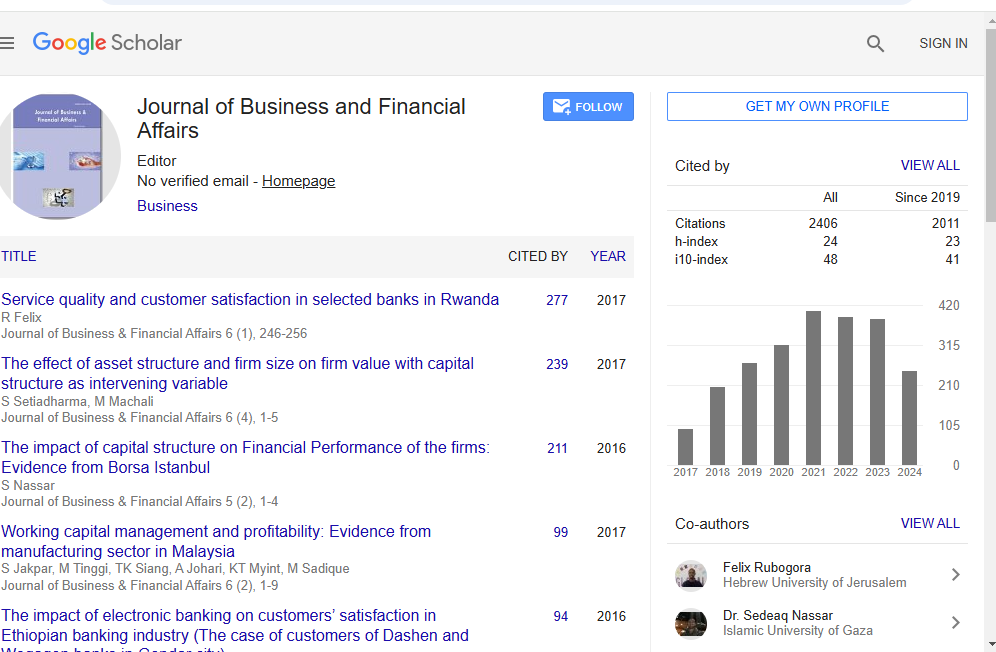
Journal of Business & Financial Affairs received 1726 citations as per Google Scholar report