Opinion - (2025) Volume 14, Issue 5
Received: 01-Sep-2025, Manuscript No. jmmd-26-184699;
Editor assigned: 03-Sep-2025, Pre QC No. P-184699;
Reviewed: 17-Sep-2025, QC No. Q-184699;
Revised: 22-Sep-2025, Manuscript No. R-184699;
Published:
29-Sep-2025
, DOI: 10.37421/2161-0703.2025.14.543
Citation: Costa, Mariana. ”Quality Control and Biosafety in Diagnostic Microbiology.” J Med Microb Diagn 14 (2025):543.
Copyright: © 2025 Costa M. This is an open-access article distributed under the terms of the Creative Commons Attribution License, which permits unrestricted use, distribution and reproduction in any medium, provided the original author and source are credited.
Maintaining stringent quality control and biosafety measures is paramount in diagnostic microbiology to ensure accurate results and protect laboratory personnel and the environment. This involves implementing standardized protocols for specimen handling, reagent validation, instrument calibration, and effective waste management. Adherence to biosafety levels appropriate for the suspected pathogens is crucial for preventing laboratory-acquired infections and environmental contamination [1].
The integration of automation and advanced technologies in diagnostic microbiology laboratories can significantly enhance efficiency and reduce errors in quality control processes. Automation streamlines repetitive tasks, ensuring consistent performance and freeing up skilled personnel for more complex analyses and troubleshooting [2].
Effective biosafety cabinet utilization and personal protective equipment (PPE) compliance are cornerstones of preventing aerosol transmission of infectious agents in microbiology labs. Regular training and reinforcement of these practices are vital for minimizing risks [3].
External quality assessment (EQA) programs are essential for laboratories to monitor and benchmark their performance against established standards. Participation in EQA schemes provides objective feedback on accuracy and identifies areas for improvement in diagnostic microbiology testing [4].
Rapid advancements in molecular diagnostic techniques necessitate continuous updates in quality control protocols. Ensuring the accuracy and reliability of these methods, such as PCR and sequencing, requires specific validation steps and proficiency testing [5].
Proper management of laboratory waste, including biohazardous materials, is a critical component of biosafety. Effective segregation, treatment, and disposal procedures prevent the spread of infections and protect public health [6].
The evolving landscape of antibiotic resistance demands rigorous quality control in antimicrobial susceptibility testing (AST). Accurate AST results are vital for guiding effective treatment strategies and preventing the spread of resistant pathogens [7].
Training and competency assessment of laboratory personnel are critical for both quality control and biosafety. A well-trained workforce is essential for implementing standard operating procedures correctly and responding effectively to unexpected situations [8].
The risk assessment process in biosafety is dynamic and should be revisited regularly, especially with the introduction of new pathogens or laboratory procedures. This proactive approach helps in implementing appropriate containment strategies and safety measures [9].
Accurate and timely reporting of laboratory results is a crucial aspect of quality in diagnostic microbiology. This includes proper documentation, data integrity checks, and clear communication of findings to clinicians to ensure appropriate patient management [10].
Maintaining stringent quality control and biosafety measures is fundamental to the reliable operation of diagnostic microbiology laboratories, ensuring both the accuracy of test results and the safety of laboratory personnel and the surrounding environment. This comprehensive approach requires the strict implementation of standardized protocols across all laboratory activities, from the initial handling of specimens to the validation of reagents, calibration of analytical instruments, and diligent management of laboratory waste. Furthermore, understanding and adhering to the specific biosafety levels mandated for the suspected pathogens is a non-negotiable aspect of preventing laboratory-acquired infections and mitigating the risk of environmental contamination [1].
The incorporation of automation and sophisticated technologies into the daily workflows of diagnostic microbiology laboratories offers substantial improvements in operational efficiency and a marked reduction in errors associated with quality control procedures. Automation is particularly effective in streamlining repetitive and time-consuming tasks, thereby ensuring a higher degree of consistency in laboratory performance. This technological integration also serves to liberate highly skilled laboratory professionals, enabling them to dedicate their expertise to more complex analytical challenges and proactive troubleshooting efforts [2].
At the forefront of preventing the airborne transmission of infectious agents within microbiology laboratory settings is the diligent and correct utilization of biosafety cabinets, coupled with unwavering compliance with personal protective equipment (PPE) guidelines. These measures are recognized as foundational to maintaining a safe laboratory environment. To effectively reinforce their importance, regular and ongoing training programs, alongside consistent reinforcement of these critical practices, are indispensable for minimizing the inherent risks associated with laboratory work [3].
External quality assessment (EQA) programs play an indispensable role in enabling diagnostic laboratories to continuously monitor, evaluate, and benchmark their operational performance against established national and international standards. Active participation in these EQA schemes furnishes laboratories with objective and actionable feedback concerning the accuracy and reliability of their testing methodologies, thereby pinpointing specific areas that may require enhancement or further development within their diagnostic microbiology testing services [4].
The rapid and ongoing evolution of molecular diagnostic techniques in microbiology presents a continuous demand for the timely updating and refinement of existing quality control protocols. Ensuring the unwavering accuracy and consistent reliability of these advanced methodologies, which often include techniques such as polymerase chain reaction (PCR) and genetic sequencing, necessitates the development and implementation of specific, method-appropriate validation steps and rigorous proficiency testing procedures [5].
Effective and responsible management of all laboratory waste, with a particular emphasis on biohazardous materials, constitutes a vital and integral component of an overarching biosafety strategy. The implementation of meticulously designed procedures for the segregation, appropriate treatment, and final disposal of hazardous waste is paramount in preventing the potential spread of infectious diseases and safeguarding broader public health interests [6].
The ever-changing epidemiological landscape, particularly concerning the rise of antibiotic resistance, underscores the critical need for exceptionally stringent quality control measures within the domain of antimicrobial susceptibility testing (AST). The generation of accurate and dependable AST results is directly linked to the ability to formulate effective treatment strategies for infectious diseases and to successfully curb the further dissemination of multidrug-resistant pathogens within healthcare settings and the community [7].
Comprehensive training programs and systematic competency assessments for all laboratory personnel are indispensable elements that contribute significantly to both the maintenance of high-quality control standards and the robust enforcement of biosafety protocols. A proficient and well-educated workforce is fundamentally essential for the accurate implementation of established standard operating procedures and for the capacity to respond adeptly and appropriately to unforeseen or emergent situations that may arise within the laboratory environment [8].
The process of risk assessment within the framework of biosafety is inherently dynamic and necessitates periodic review and re-evaluation, particularly when new infectious agents are introduced into the laboratory or when novel laboratory procedures are being developed or implemented. Adopting this forward-thinking, proactive approach is instrumental in ensuring that the most appropriate containment strategies and effective safety measures are consistently put into practice [9].
Ensuring the accuracy, reliability, and timeliness of laboratory result reporting stands as a critical pillar of overall quality assurance in the field of diagnostic microbiology. This multifaceted process encompasses meticulous documentation practices, rigorous data integrity checks, and the clear and unambiguous communication of all laboratory findings to the attending clinicians, thereby facilitating informed and appropriate patient management decisions [10].
Diagnostic microbiology laboratories rely on robust quality control and biosafety measures to ensure accurate results and protect personnel and the environment. This includes standardized protocols for specimen handling, reagent validation, and waste management, as well as adherence to biosafety levels. Automation and advanced technologies enhance efficiency and reduce errors in quality control. Biosafety cabinets and personal protective equipment are crucial for preventing aerosol transmission, supported by regular training. External quality assessment programs provide objective feedback for performance improvement. Rapid advancements in molecular diagnostics require updated quality control protocols and validation. Proper biohazardous waste management is essential for preventing infection spread. Stringent quality control in antimicrobial susceptibility testing is vital due to rising antibiotic resistance. Competent and well-trained personnel are key to implementing procedures and responding to unexpected situations. Dynamic risk assessment is necessary for implementing effective containment and safety measures. Accurate and timely reporting of results, including data integrity checks and clear communication, is crucial for patient management.
None
None
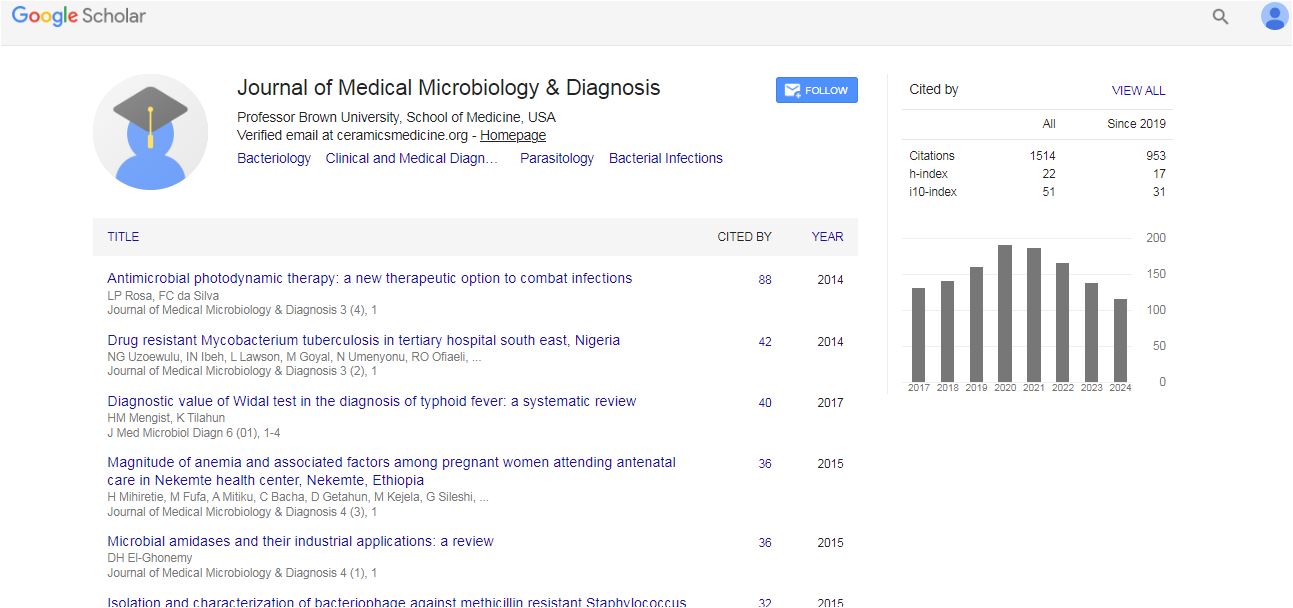
Medical Microbiology & Diagnosis received 14 citations as per Google Scholar report