Brief Report - (2025) Volume 11, Issue 4
Received: 03-Aug-2025, Manuscript No. abp-25-173829;
Editor assigned: 05-Aug-2025, Pre QC No. P-173829;
Reviewed: 19-Aug-2025, QC No. Q-173829;
Revised: 25-Aug-2025, Manuscript No. R-173829;
Published:
30-Aug-2025
, DOI: 10.37421/2472-0496.2025.11.331
Citation: Carolina Mendes. ”PTSD: Multidimensional Insights and Treatment Advances.” Abnorm Behav Psychol 11 (2025):331.
Copyright: © 2025 M. Carolina This is an open-access article distributed under the terms of the Creative Commons Attribution License, which permits unrestricted use, distribution and reproduction in any medium, provided the original author and source are credited.
The landscape of Posttraumatic Stress Disorder (PTSD) treatment is continually evolving, with a robust exploration of both pharmacological and non-pharmacological approaches. A comprehensive overview synthesizes findings from systematic reviews and meta-analyses, underscoring the vital role of evidence-based interventions. What this really means is that a combination of therapies often proves most effective, leading to better outcomes for individuals grappling with the complexities of this disorder [1].
Central to advancing effective treatments is a deeper understanding of PTSD's intricate neurobiological underpinnings. Research delves into how traumatic experiences profoundly impact brain circuits and functions. Grasping these specific biological changes isn't just academic; it's fundamental for developing more targeted and precise treatments that truly address the disorder's root causes [2].
Here's the thing about PTSD and substance use disorder: their frequent co-occurrence presents significant clinical challenges. This body of work illuminates the complex interplay between these conditions, carefully exploring shared vulnerabilities. The focus here is on integrated treatment strategies, designed to concurrently address both issues, which ultimately leads to more holistic and improved patient outcomes [3].
Among specific psychological treatments, Cognitive Processing Therapy (CPT) stands out as a highly effective approach for PTSD. A detailed review elucidates CPT's proven efficacy, its practical effectiveness in real-world clinical settings, and crucial considerations for its widespread implementation. This underscores CPT's strong and indispensable role in the journey of trauma recovery [4].
Let's break down the critical area of early interventions for PTSD prevention. A thorough systematic review and meta-analysis meticulously examines various strategies applied shortly after individuals experience trauma exposure. The insights gleaned from these findings are invaluable, helping us pinpoint which early supports hold the most promise for significantly reducing the likelihood of developing full-blown PTSD [5].
The exciting field of PTSD biomarkers offers a glimpse into personalized medicine. Research explores how specific biological indicators might prove instrumental in enhancing diagnosis, refining prognosis, and even predicting treatment response. What this really means is a future where treatment can be tailored more precisely for trauma survivors, identifying who might respond optimally to particular therapeutic approaches [6].
This paper sheds light on critical gender differences observed in PTSD, meticulously covering both distinct clinical manifestations and their underlying neurobiological mechanisms. Recognizing these crucial distinctions isn't just about awareness; it's absolutely essential for tailoring diagnostic approaches and treatments to better suit the unique experiences and biological profiles of men and women affected by the disorder [7].
Addressing PTSD in younger populations, specifically children and adolescents, requires a distinct and specialized approach compared to adult treatment. A comprehensive review offers a deep dive into how PTSD is effectively assessed, its prevalence (epidemiology), and the range of evidence-based treatments specifically designed for these younger individuals. This ensures that interventions are not only age-appropriate but also profoundly impactful in their developing lives [8].
Moreover, the systematic review investigating the landscape of digital mental health interventions for PTSD highlights a promising frontier. It underscores the immense potential for technology, encompassing applications and online platforms, to dramatically expand access to care and deliver effective support, especially for those who frequently face substantial barriers to accessing traditional in-person therapy [9].
Finally, the concept of Complex PTSD (C-PTSD) remains an important, albeit sometimes debated, topic within the field. An article provides a contemporary review of this specific diagnosis, meticulously differentiating it from traditional PTSD and discussing its unique characteristics, which often arise from prolonged or repeated trauma, informing more nuanced clinical approaches [10].
Posttraumatic Stress Disorder (PTSD) presents as a profoundly challenging mental health condition, driving extensive research across its many dimensions, from the initial causes to sophisticated interventions. Current scholarship offers a robust examination of both pharmacological agents and non-pharmacological therapeutic strategies. These syntheses consistently underscore the critical importance of employing evidence-based interventions, often suggesting that a carefully considered combination of therapies yields the most favorable outcomes for individuals navigating the often-debilitating complexities of trauma recovery [1]. The overarching goal is to foster comprehensive, empathetic care that genuinely addresses the multifaceted and deeply personal nature of healing from trauma.
A deeper scientific understanding of the underlying mechanisms driving PTSD is unequivocally paramount for progress. Research rigorously investigates the intricate neurobiological underpinnings of the disorder, meticulously detailing how traumatic experiences can fundamentally alter delicate brain circuits and their broader functions. Gaining a precise grasp of these specific biological changes is not merely an academic exercise; it forms the bedrock for developing more sophisticated, targeted, and ultimately more effective treatments that can truly address the disorderâ??s root causes at a physiological level [2]. Complementing this biological focus, specific psychological treatments have demonstrated remarkable efficacy, with Cognitive Processing Therapy (CPT) standing out as a prime example. Comprehensive reviews highlight CPT's consistent effectiveness, both in tightly controlled research studies and in diverse, real-world clinical settings, making a strong case for its wider implementation in standard trauma recovery protocols [4].
A crucial and frequently encountered clinical challenge involves the high rate of comorbidity between PTSD and substance use disorder. This significant body of work meticulously explores the deeply intertwined vulnerabilities that link these two pervasive conditions, subsequently proposing integrated treatment approaches. These strategies are specifically designed to address both disorders concurrently, a holistic method that has been shown to lead to significantly better, more sustainable patient outcomes than treating them in isolation [3]. Beyond comorbidity, the unique needs and presentations within specific populations are also receiving careful consideration. Studies keenly examine critical gender differences in PTSD, encompassing both distinct clinical manifestations and nuanced underlying neurobiological responses, a recognition that is absolutely essential for tailoring diagnostic and therapeutic strategies to be optimally effective for men and women [7]. Similarly, the focus on younger individuals is vital; research provides a comprehensive overview of PTSD in children and adolescents, meticulously detailing age-appropriate assessment methods, its epidemiology, and outlining effective treatments specifically calibrated for this developing demographic [8].
Proactive prevention efforts are increasingly gaining significant traction within the field. Early interventions, meticulously applied shortly after an individual experiences trauma exposure, are undergoing rigorous scrutiny through systematic reviews and meta-analyses. The explicit aim here is to identify and validate the most promising strategies for mitigating the likelihood of developing full-blown PTSD, thus altering the trajectory for those at risk [5]. Innovation further extends into advanced diagnostic and prognostic tools, particularly within the burgeoning field of PTSD biomarkers. This area explores how specific biological indicators might prove invaluable for enhancing diagnostic precision, refining prognostic predictions, and even accurately forecasting individual responses to various treatments. This push squarely moves medicine towards a more personalized paradigm, where therapies can be finely tuned to an individual's unique biological and clinical profile [6]. Technology, too, plays an ever-growing role; digital mental health interventions for PTSD are undergoing systematic review for their considerable potential to dramatically expand access to crucial care and deliver effective support, especially for individuals who frequently encounter substantial geographical, financial, or social barriers to accessing traditional in-person therapy [9].
Finally, the discussion surrounding the concept of Complex PTSD (C-PTSD) remains a contemporary, and at times, debated area within clinical psychiatry. This specific diagnosis, which is meaningfully differentiated from traditional PTSD, is often understood to arise from prolonged or repeated traumatic experiences. Research endeavors to clearly delineate its unique characteristics and symptom clusters, which in turn informs more nuanced, patient-centered clinical approaches that explicitly acknowledge the profound and broader impact of chronic traumatization on an individualâ??s development and functioning [10].
This comprehensive collection of research offers a multifaceted overview of Posttraumatic Stress Disorder (PTSD), shedding light on its complex nature and diverse treatment landscape. It critically examines the efficacy of both pharmacological and non-pharmacological interventions, consistently underscoring the vital role of evidence-based approaches. This highlights how a combination of therapies often leads to superior outcomes for individuals experiencing the disorder. A significant portion of the work delves into the intricate neurobiological underpinnings of PTSD, exploring how traumatic experiences profoundly impact brain circuits and functions; this understanding is crucial for developing more targeted and effective treatments that address the disorder at its core. The frequent co-occurrence of PTSD with substance use disorder is thoroughly addressed, with papers emphasizing the need for integrated treatment strategies that concurrently tackle both conditions for improved patient recovery. Specific psychological interventions, such as Cognitive Processing Therapy (CPT), are reviewed extensively for their proven effectiveness, real-world utility, and considerations for wider implementation, solidifying their role in trauma recovery. Beyond existing treatments, the importance of early interventions for PTSD prevention is examined, exploring strategies applied shortly after trauma exposure to reduce the likelihood of full development. Advancements in personalized medicine are also highlighted through the emerging field of PTSD biomarkers, which aim to improve diagnosis, prognosis, and treatment prediction. Moreover, the research explores critical gender differences in PTSD, covering both clinical manifestations and underlying neurobiological mechanisms, essential for tailoring diagnostic and therapeutic approaches. Specialized considerations for younger populations are also presented, detailing effective assessment and treatment strategies for children and adolescents. The potential of digital mental health interventions for PTSD is reviewed, recognizing technology's role in expanding access to care, particularly for those facing traditional therapy barriers. Finally, the collection concludes with a contemporary review of Complex PTSD (C-PTSD), differentiating its unique characteristics from traditional PTSD and informing more nuanced clinical approaches for prolonged or repeated trauma.
None
None
1. Jing C, Ruixia H, Xiaolan C. "Pharmacological and Nonpharmacological Treatments for Posttraumatic Stress Disorder (PTSD): An Overview of Systematic Reviews and Meta-Analyses".Int J Environ Res Public Health 18 (2021):7921.
Indexed at, Google Scholar, Crossref
2. Roger KP, Ann MR, Karestan CK. "Neurobiology of Posttraumatic Stress Disorder".Biol Psychiatry 94 (2023):448-462.
Indexed at, Google Scholar, Crossref
3. Megan AK, Michael EC, John HK. "Comorbidity of PTSD and Substance Use Disorder: Current Understanding and Treatment".Neuropsychopharmacology 48 (2023):31-40.
Indexed at, Google Scholar, Crossref
4. Patricia AR, Jessica SW, Kathleen MC. "Cognitive Processing Therapy for Posttraumatic Stress Disorder: A Review of Efficacy, Effectiveness, and Implementation".Curr Psychiatry Rep 23 (2021):21.
Indexed at, Google Scholar, Crossref
5. Miranda O, Marleen vdM, Ysbrand RvR. "Early Interventions for Prevention of Posttraumatic Stress Disorder: A Systematic Review and Meta-analysis".JAMA Psychiatry 77 (2020):197-206.
Indexed at, Google Scholar, Crossref
6. Meaghan LO, Gabriele A, Patricia AR. "Biomarkers of Posttraumatic Stress Disorder: Current Status and Future Directions".Dialogues Clin Neurosci 22 (2020):289-299.
Indexed at, Google Scholar, Crossref
7. Sharon T, Arieh S, Israel L. "Gender Differences in Posttraumatic Stress Disorder: A Review of Clinical and Neurobiological Perspectives".Biol Psychiatry Cogn Neurosci Neuroimaging 6 (2021):727-738.
Indexed at, Google Scholar, Crossref
8. Michael SS, Christopher FW, Judith AC. "Posttraumatic Stress Disorder in Children and Adolescents: A Review of Assessment, Epidemiology, and Treatment".J Clin Child Adolesc Psychol 50 (2021):327-340.
Indexed at, Google Scholar, Crossref
9. Rishika K, Michael JG, Shivam M. "Digital Mental Health Interventions for Posttraumatic Stress Disorder: A Systematic Review".J Affect Disord 322 (2023):156-170.
Indexed at, Google Scholar, Crossref
10. Marylene C, David WG, Beate W. "Complex Posttraumatic Stress Disorder: A Contemporary Review of a Controversial Diagnosis".Curr Psychiatry Rep 22 (2020):18.
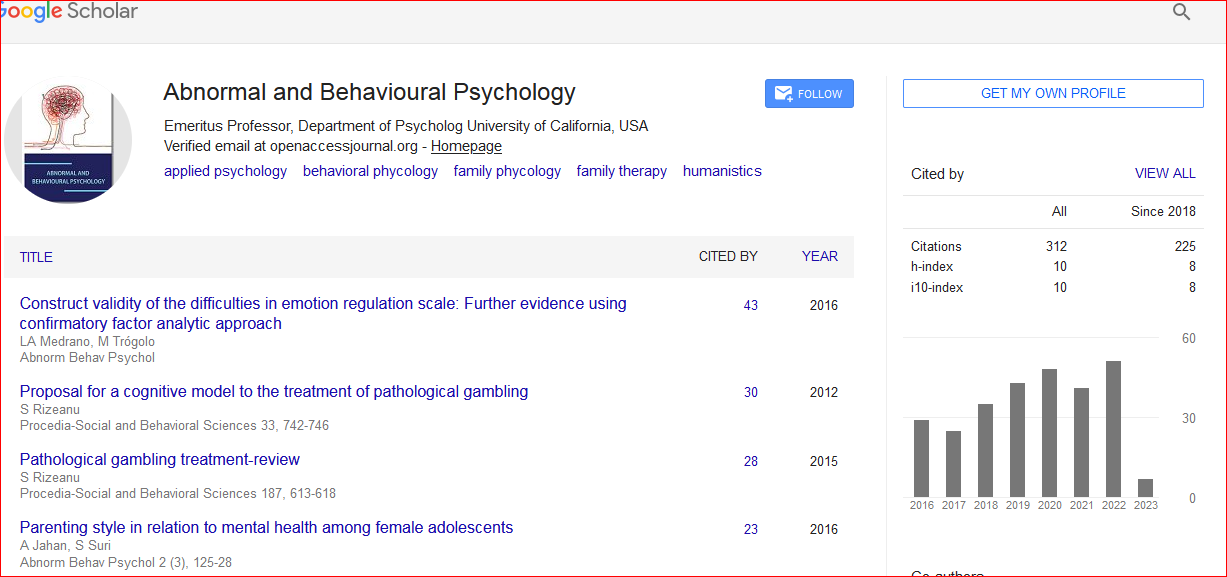
Abnormal and Behavioural Psychology received 361 citations as per Google Scholar report