Commentary - (2025) Volume 16, Issue 6
Received: 01-Dec-2025, Manuscript No. jfr-26-184131;
Editor assigned: 03-Dec-2025, Pre QC No. P-184131;
Reviewed: 17-Dec-2025, QC No. Q-184131;
Revised: 22-Dec-2025, Manuscript No. R-184131;
Published:
29-Dec-2025
, DOI: 10.37421/2157-7145.2025.16.692
Citation: Nikolaou, Andreas. ”Psychological Autopsy: Reconstructing
Deceased Minds In Investigations.” J Forensic Res 16 (2025):692.
Copyright: © 2025 Nikolaou A. This is an open-access article distributed under the terms of the Creative Commons Attribution License, which permits unrestricted use,
distribution and reproduction in any medium, provided the original author and source are credited.
Psychological autopsy (PA) is an indispensable tool in death investigations, particularly for clarifying ambiguous cases such as suicides, accidents, or homicides. It seeks to reconstruct the deceased's mental state and the circumstances leading up to their demise, offering insights into their mindset, motivations, and contributing factors. This interdisciplinary approach merges psychological theories with forensic investigation, utilizing interviews with associates, personal documents, and relevant records to illuminate the deceased's life [1].
The application of PA extends to differentiating between suicide and accidental death, especially when the intent is unclear. Through detailed interviews and the analysis of behavioral patterns, PA can expose pre-existing psychological distress or explicit suicidal ideation, thereby clarifying the cause of death and aiding legal processes [2].
Ethical considerations are paramount in psychological autopsies, involving the respect for the deceased's privacy and the sensitive handling of information to minimize emotional impact on surviving family members. Adherence to principles of informed consent, confidentiality, and careful information management is crucial for maintaining the integrity of the investigative process [3].
PA also plays a vital role in investigating drug overdose deaths, where distinguishing between accidental overdose, intentional suicide, and undetermined intent can be complex. By examining the individual's history and contextual factors, PA can provide critical distinctions to aid in accurate classification [4].
In suspected homicide cases, especially those staged as suicides or accidents, psychological autopsy serves as a crucial investigative tool. It can identify inconsistencies in witness or perpetrator accounts, reveal motives, and provide evidence of premeditation or coercion, thereby assisting law enforcement in criminal investigations [5].
The methodologies underpinning psychological autopsy are subject to critical review, with ongoing efforts to refine various theoretical frameworks and data collection techniques. Evaluating the strengths and limitations of different PA approaches is essential for improving its scientific rigor and standardization within forensic practice [6].
Furthermore, PA is vital for understanding deaths within specific populations, such as adolescents or individuals with pre-existing mental health conditions. It helps identify unique risk factors and contributing elements pertinent to these groups, which is crucial for developing targeted prevention and intervention strategies [7].
The integration of psychological autopsy findings into the legal framework of death investigations is increasingly recognized. PA reports can serve as evidence in court to establish intent, determine liability, or challenge official death certifications, thereby contributing to the broader justice system [8].
Conducting psychological autopsies can present challenges, particularly when information is scarce, as in cases involving unidentified bodies or deaths in isolated settings. In such scenarios, alternative methods and cautious interpretation of limited data are employed to achieve the most accurate assessment possible [9].
Finally, addressing potential biases in psychological autopsy investigations is a critical area of focus. Recognizing and mitigating interviewer bias, informant bias, and confirmation bias are essential steps to enhance the objectivity and reliability of PA findings [10].
Psychological autopsy (PA) serves as a critical methodology in death investigations, primarily by reconstructing the deceased's mental state and the context surrounding their death, particularly in cases where the manner of death is unclear, such as suicides, accidents, or homicides. The aim is to ascertain the deceased's mindset, motivations, and any contributing factors. This method is interdisciplinary, combining psychological theories with forensic investigation, and often involves interviews with individuals close to the deceased, analysis of personal documents, and a thorough review of medical and legal records. Its goal is to provide essential insights that might not be readily available to legal or medical professionals, thereby aiding in the accurate classification of death and understanding its underlying causes [1].
A significant application of psychological autopsy lies in its ability to differentiate between suicide and accidental death when the intent behind the death is ambiguous. Through comprehensive interviews and the meticulous analysis of behavioral patterns, PA can reveal evidence of prior psychological distress or clear suicidal intent, which is instrumental in clarifying the circumstances of death and supporting legal proceedings [2].
Despite its utility, the process of psychological autopsy is accompanied by significant ethical considerations. These concerns primarily revolve around safeguarding the privacy of the deceased and managing the potential emotional impact on surviving family members. Consequently, emphasizing the importance of informed consent, maintaining strict confidentiality, and ensuring the sensitive handling of all information throughout the investigative process are fundamental to the ethical and principled execution of PA [3].
In the context of drug overdose deaths, which frequently pose complex etiological questions, psychological autopsy is employed to investigate the circumstances. This research examines how PA can help distinguish between accidental overdose, intentional overdose (suicide), and overdose with undetermined intent by carefully analyzing the individual's history and relevant contextual factors [4].
When investigating cases of suspected homicide, particularly those that have been made to appear as suicides or accidents, psychological autopsy acts as a vital investigative tool. It can uncover inconsistencies in the narratives provided by witnesses or perpetrators, help establish motive, and provide evidence of premeditation or coercive actions, thereby offering crucial assistance to law enforcement agencies in criminal investigations [5].
The scientific foundation of psychological autopsy rests on the methodologies employed, which are continually undergoing critical review. This process involves examining various theoretical frameworks and data collection techniques to evaluate the strengths and limitations of different PA approaches. Such reviews aim to identify avenues for enhancing its scientific rigor and promoting standardization within forensic practice [6].
Moreover, psychological autopsy is instrumental in understanding deaths within specific demographic groups, such as adolescents or individuals with pre-existing mental health conditions. The application of PA in these contexts can shed light on unique risk factors and contributing elements specific to these populations, which is crucial for the development of targeted prevention and intervention strategies [7].
The integration of findings from psychological autopsies into the existing legal framework of death investigation is another key aspect of its utility. The reports generated through PA can be presented as evidence in court to establish intent, determine legal liability, or challenge official death certifications, thereby playing a role in the administration of justice [8].
Conducting psychological autopsies can be particularly challenging when confronted with limited available information, as is often the case with unidentified bodies or deaths occurring in isolated environments. In such situations, researchers explore alternative methods and emphasize the careful interpretation of scarce data to provide the most accurate assessment possible under difficult circumstances [9].
Finally, a significant area of research and practice in psychological autopsy involves addressing potential biases that might influence investigations. This includes identifying and implementing strategies to mitigate various forms of bias, such as interviewer bias, informant bias, and confirmation bias, with the overarching goal of enhancing the objectivity and reliability of the findings derived from psychological autopsies [10].
Psychological autopsy (PA) is a vital forensic tool used to reconstruct the mental state and circumstances of a deceased individual, particularly in ambiguous death investigations like suicides, accidents, or homicides. It helps determine mindset, motivations, and contributing factors by integrating psychological theories with forensic evidence, including interviews, personal documents, and records [1].
PA is crucial for differentiating suicide from accidental death by analyzing behavioral patterns and psychological distress [2].
Ethical considerations, such as privacy and family sensitivity, are paramount in PA procedures [3].
The method is also applied to drug overdose deaths to distinguish intent [4] and to suspected homicides disguised as other causes of death [5].
Methodologies and their rigor are continuously reviewed to improve standardization [6].
PA also aids in understanding deaths within specific populations like adolescents [7] and its findings are increasingly integrated into legal frameworks [8].
Challenges arise with limited information, requiring alternative methods [9].
Mitigating biases in PA investigations is essential for objectivity and reliability [10].
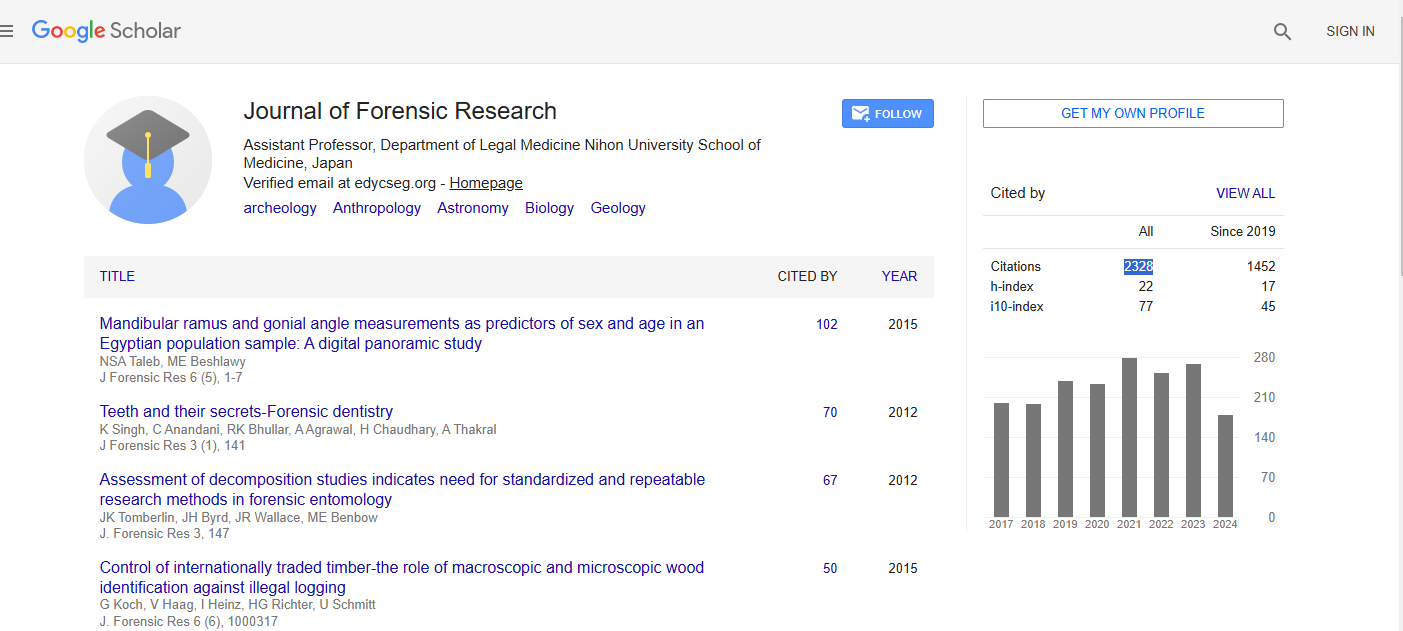
Journal of Forensic Research received 2328 citations as per Google Scholar report