Perspective - (2025) Volume 15, Issue 1
Received: 01-Jan-0205, Manuscript No. Jnt-25-161753;
Editor assigned: 03-Jan-2025, Pre QC No. P-161753;
Reviewed: 17-Jan-2025, QC No. Q-161753;
Revised: 23-Jan-2025, Manuscript No. R-161753;
Published:
31-Jan-2025
, DOI: 10.37421/2161-0959.2025.15.551
Citation: Jose, James. “Progress in Multitarget Therapeutic Strategies for Immune-mediated Glomerular Diseases.” J Nephrol Ther 15 (2025): 551.
Copyright: © 2025 Jose J. This is an open-access article distributed under the terms of the Creative Commons Attribution License, which permits unrestricted use, distribution, and reproduction in any medium, provided the original author and source are credited.
Immune-mediated glomerular diseases encompass a diverse group
of kidney disorders characterized by immune system dysfunction leading
to glomerular inflammation, damage, and eventual loss of renal function.
These diseases include conditions such as lupus nephritis, IgA nephropathy,
membranous nephropathy, and ANCA-associated vasculitis, all of which pose
significant challenges in treatment due to their complex pathophysiology.
Traditional therapeutic approaches have relied on broad immunosuppressive
strategies, but recent advances in multitarget therapy have revolutionized
the management of these conditions by providing more effective and less
toxic treatment options.
Immune-mediated glomerular diseases encompass a diverse group of kidney disorders characterized by immune system dysfunction leading to glomerular inflammation, damage, and eventual loss of renal function. These diseases include conditions such as lupus nephritis, IgA nephropathy, membranous nephropathy, and ANCA-associated vasculitis, all of which pose significant challenges in treatment due to their complex pathophysiology. Traditional therapeutic approaches have relied on broad immunosuppressive strategies, but recent advances in multitarget therapy have revolutionized the management of these conditions by providing more effective and less toxic treatment options. Multitarget therapy involves the simultaneous use of multiple agents that target different pathways involved in the immune-mediated damage to the glomeruli. This approach is designed to enhance therapeutic efficacy while reducing the adverse effects associated with high-dose single-agent immunosuppression. By combining immunosuppressive, antiinflammatory, and protective agents, multitarget therapy aims to achieve better disease control, minimize renal damage, and improve long-term outcomes.
In lupus nephritis, one of the most severe manifestations of systemic lupus erythematosus, multita rget therapy has demonstrated significant benefits. Traditional regimens based on high-dose corticosteroids and cyclophosphamide have been associated with considerable toxicity. More recent studies have explored the combination of mycophenolate mofetil calcineurin inhibitors such as tacrolimus, and low-dose corticosteroids as an alternative. This regimen has shown superior efficacy in inducing and maintaining remission compared to conventional cyclophosphamide-based protocols. The rationale behind this combination is the complementary mechanisms of action: MMF inhibits T and B cell proliferation, CNIs suppress T cell activation and reduce proteinuria, and corticosteroids provide broad immunosuppressive effects. Clinical trials have demonstrated improved renal response rates and lower relapse rates with this approach, making it a preferred strategy in many treatment guidelines. IgA nephropathy, a leading cause of chronic kidney disease, is characterized by immune complex deposition in the glomeruli, leading to inflammation and progressive renal dysfunction. The heterogeneity of IgA nephropathy has necessitated the development of personalized multitarget approaches to optimize treatment. A combination of renin-angiotensin-aldosterone system (RAAS) inhibitors, corticosteroids, and immunomodulatory agents such as MMF or CNIs has been explored. RAAS inhibitors play a crucial role in reducing proteinuria and slowing disease progression, while corticosteroids and immunosuppressive agents help modulate the underlying immune response. The use of sodium-glucose cotransporter-2 (SGLT2) inhibitors as adjunct therapy has also gained interest due to their nephroprotective effects. Recent studies suggest that combining these agents leads to better long-term kidney function preservation compared to monotherapy [1].
Membranous nephropathy, another immune-mediated glomerular disease, has been traditionally treated with immunosuppressants such as cyclophosphamide or rituximab. The identification of phospholipase A2 receptor (PLA2R) antibodies as a key pathogenic factor has led to targeted therapies aimed at depleting autoantibody-producing B cells. Rituximab, an anti-CD20 monoclonal antibody, has been widely used either alone or in combination with other immunosuppressants. More recently, newer agents such as belimumab, a B-cell activating factor (BAFF) inhibitor, and complement inhibitors have been explored as part of multitarget strategies. The rationale behind these combinations is to reduce autoantibody production more effectively while minimizing the risk of relapse. Studies have shown that combining rituximab with other B-cell-targeting agents or RAAS inhibitors results in higher remission rates and better kidney function preservation compared to monotherapy. ANCA-associated vasculitis (AAV) is a group of diseases characterized by small-vessel inflammation mediated by anti-neutrophil cytoplasmic antibodies (ANCAs). Standard treatment has historically relied on high-dose glucocorticoids combined with cyclophosphamide or rituximab. However, long-term use of these agents is associated with significant toxicity. Recent multitarget approaches have focused on reducing glucocorticoid exposure while maintaining disease control. The use of rituximab in combination with avacopan, a complement C5a receptor inhibitor, has shown promising results in minimizing inflammation and preserving renal function. Avacopan acts by blocking the pro-inflammatory effects of C5a, thereby reducing neutrophil activation and tissue damage. Studies have demonstrated that patients receiving this combination experience fewer relapses and lower glucocorticoidrelated adverse effects. Other emerging strategies include the use of Janus kinase (JAK) inhibitors and novel biologics targeting cytokine pathways involved in AAV pathogenesis [2,3].
The success of multitarget therapy in immune-mediated glomerular diseases highlights the importance of personalized medicine in nephrology. Given the variability in disease presentation and progression, tailoring treatment regimens based on individual patient characteristics, biomarker profiles, and genetic predispositions can lead to better outcomes. The use of biomarkers such as PLA2R antibodies in membranous nephropathy, complement activation markers in lupus nephritis, and urinary cytokine profiles in IgA nephropathy allows for more precise disease monitoring and therapy adjustments. While multitarget approaches have demonstrated significant benefits, challenges remain in optimizing treatment regimens. Drug interactions, long-term safety concerns, and the need for individualized dosing require careful consideration. Moreover, access to newer biologics and targeted therapies may be limited in certain regions, impacting the feasibility of widespread implementation. Further research is needed to refine these strategies, identify novel therapeutic targets, and establish standardized protocols for integrating multitarget therapy into routine clinical practice [4,5].
The future of multitarget therapy in immune-mediated glomerular diseases is likely to involve the integration of precision medicine approaches, including the use of artificial intelligence and machine learning to predict treatment responses. Advances in omics technologies, such as genomics, proteomics, and metabolomics, will enable deeper insights into disease mechanisms and facilitate the development of highly personalized treatment strategies. The combination of traditional immunosuppressants with cutting-edge biologics and small-molecule inhibitors will continue to evolve, providing more effective and safer options for patients. In conclusion, multitarget therapeutic strategies have revolutionized the management of immune-mediated glomerular diseases by improving treatment efficacy, reducing toxicity, and offering personalized care. The combination of immunosuppressive, anti-inflammatory, and nephroprotective agents has led to better disease control and improved renal outcomes in conditions such as lupus nephritis, IgA nephropathy, membranous nephropathy, and ANCA-associated vasculitis. While challenges remain in optimizing these approaches, ongoing research and technological advancements are expected to further enhance the precision and effectiveness of multitarget therapy. The continued integration of biomarker-driven treatment strategies and novel therapeutics will play a crucial role in shaping the future of nephrology and improving patient outcomes in immune-mediated glomerular diseases.
None.
None.
Google Scholar, Crossref, Indexed at
Google Scholar, Crossref, Indexed at
Google Scholar, Crossref, Indexed at
Google Scholar, Crossref, Indexed at
Google Scholar, Crossref, Indexed at
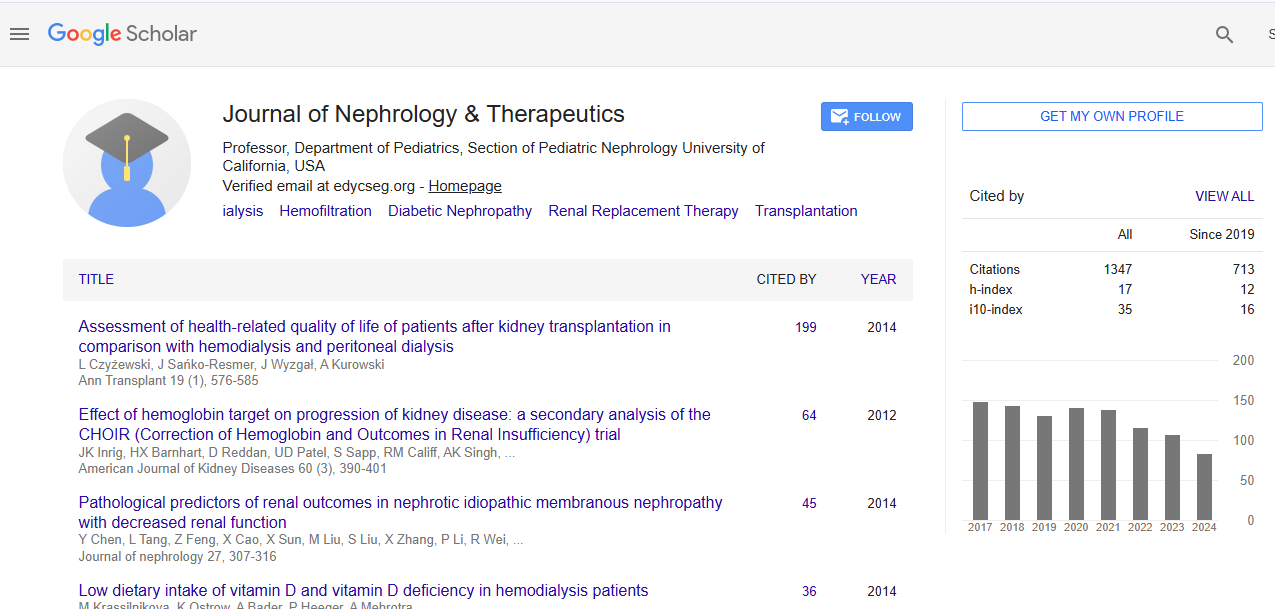
Journal of Nephrology & Therapeutics received 784 citations as per Google Scholar report