Commentary - (2025) Volume 15, Issue 2
Received: 02-Jun-2025, Manuscript No. jpdbd-25-164662;
Editor assigned: 04-Jun-2025, Pre QC No. P-164662;
Reviewed: 16-Jun-2025, QC No. Q-164662;
Revised: 23-Jun-2025, Manuscript No. R-164662;
Published:
30-Jun-2025
, DOI: 10.37421/2153-0769.2025.15.419
Citation: Nuamah, Thomas. “Navigating the Human Metabolome Insights from the Human Metabolome Database.” Metabolomics 14 (2025): 419.
Copyright: © 2025 Nuamah T. This is an open-access article distributed under the terms of the Creative Commons Attribution License, which permits unrestricted use, distribution, and reproduction in any medium, provided the original author and source are credited.
Profiling the human metabolome via the Human Metabolome Database HMDB is a powerful approach that has revolutionized our understanding of the diverse array of small molecules found in the human body. The human metabolome refers to the complete set of metabolites which are the small chemical compounds produced during metabolism. These compounds include amino acids lipids sugars nucleotides organic acids and various other biochemicals that participate in or are produced by biochemical reactions occurring in cells tissues and fluids of the human body. Unlike the genome which is relatively static the metabolome is dynamic and reflects both genetic and environmental influences making it a crucial area of study for understanding health disease and drug interactions. The HMDB provides a comprehensive and curated resource for the analysis and interpretation of the human metabolome and has become a cornerstone in the field of metabolomics.
The HMDB is an open access database that was first released in 2007 and has undergone multiple updates and expansions since then. It is maintained by the Human Metabolome Project based in Canada and is widely used by researchers clinicians and biochemists around the world. The database is designed to provide detailed information about metabolites found in the human body including their chemical properties spectral data biological roles concentrations in different tissues and bio fluids and associated pathways. In addition to this the HMDB links metabolites to diseases enzymes genes and drugs creating a rich network of biochemical knowledge that supports a wide range of applications in research and clinical practice.
One of the key features of the HMDB is its comprehensiveness. As of its most recent version the HMDB contains tens of thousands of metabolite entries including both endogenous compounds produced by the body and exogenous compounds that may come from the diet environment or medications. Each entry typically includes information such as molecular structure molecular weight chemical formula IUPAC name synonyms and identifiers from other chemical databases. This makes it possible for researchers to search and cross reference metabolite information across different platforms and studies. Furthermore the database provides high quality spectral data including NMR MS and GC MS spectra which are critical for the identification and quantification of metabolites in experimental samples [1].
Another important aspect of the HMDB is its biological context. Each metabolite is associated with specific metabolic pathways and physiological functions. The database provides detailed pathway maps that show how metabolites are synthesized transformed and utilized in the body. These maps are curated based on experimental evidence and literature reviews making them reliable tools for interpreting metabolomic data. Moreover the HMDB includes information about the normal concentration ranges of metabolites in different biofluids such as blood urine saliva cerebrospinal fluid and others. This enables researchers and clinicians to compare experimental data against established reference ranges and to identify potential biomarkers of disease or metabolic dysfunction. The HMDB also plays a vital role in the study of metabolite disease associations. Many metabolites are known to be altered in specific diseases and the database includes curated links between metabolites and clinical conditions. For instance elevated levels of certain organic acids may indicate inborn errors of metabolism while changes in lipid profiles can signal cardiovascular disease or diabetes. By integrating metabolomic data with clinical phenotypes the HMDB supports biomarker discovery and the development of diagnostic tools. It also provides insights into the mechanisms of disease by revealing how metabolic pathways are disrupted in pathological states [2].
In addition to disease associations the HMDB supports pharmacometabolomics which is the study of how an individual’s metabolic profile affects their response to drugs. The database includes information about drug metabolism enzymes drug metabolites and drug interactions at the metabolic level. This is particularly useful for understanding adverse drug reactions variability in drug efficacy and the personalization of therapy. For example differences in the activity of cytochrome P450 enzymes which are responsible for metabolizing many drugs can lead to the accumulation or rapid clearance of drug compounds affecting therapeutic outcomes. The HMDB’s integration of genetic enzymatic and metabolic data makes it a powerful tool for pharmacogenomics and precision medicine. The utility of the HMDB extends beyond individual studies as it serves as a reference for standardizing metabolomic research. By providing consistent annotations standardized identifiers and high quality spectral data the HMDB facilitates data sharing and reproducibility in metabolomics. It enables researchers to annotate unknown metabolites by comparing experimental spectra to reference spectra and to place their findings in the context of known metabolic networks. This promotes the generation of new hypotheses and the validation of experimental results across different laboratories and platforms [3].
The HMDB is also a valuable educational resource. It provides tutorials examples and downloadable datasets that help users learn how to interpret metabolomic data and apply it to various biological questions. The user interface is designed to be intuitive with multiple ways to browse search and filter information. Users can explore metabolites by name structure pathway disease or biofluid and can visualize complex data through interactive charts and maps. This accessibility has made the HMDB a go to resource for student’s educators and researchers alike. The development and maintenance of the HMDB require a significant amount of effort including literature mining manual curation software development and collaboration with other databases and research groups. The quality and reliability of the data depend on rigorous curation processes that involve reviewing scientific literature validating data from experimental studies and integrating information from other trusted sources. This ongoing work ensures that the HMDB remains up to date accurate and relevant in the face of rapidly advancing scientific knowledge [4].
One of the exciting aspects of profiling the human metabolome via the HMDB is its potential to uncover novel biomarkers for disease diagnosis prognosis and treatment monitoring. Unlike traditional biomarkers such as proteins or genes metabolites reflect the real time biochemical activity of cells and tissues. This makes them sensitive indicators of physiological and pathological changes. For instance metabolomic profiling can reveal early signs of cancer changes in metabolic fluxes during infection or the effects of diet and lifestyle on health. By comparing the metabolomic profiles of healthy and diseased individuals researchers can identify metabolic signatures that distinguish between conditions or predict disease progression [5].
Google Scholar Cross Ref Indexed at
Google Scholar Cross Ref Indexed at
Google Scholar Cross Ref Indexed at
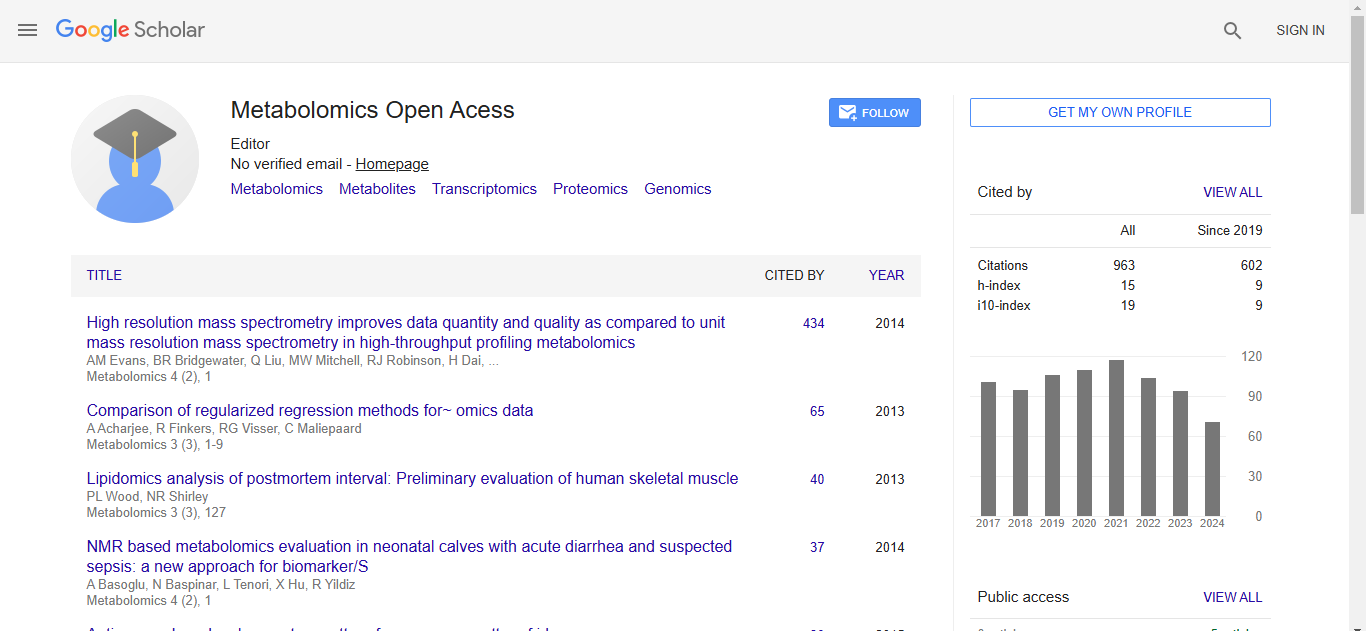
Metabolomics:Open Access received 895 citations as per Google Scholar report