Commentary - (2025) Volume 13, Issue 6
Received: 01-Dec-2025, Manuscript No. JGPR-26-190244;
Editor assigned: 03-Dec-2025, Pre QC No. P-190244;
Reviewed: 17-Dec-2025, QC No. Q-190244;
Revised: 22-Dec-2025, Manuscript No. R-190244;
Published:
29-Dec-2025
, DOI: 10.37421/2329-9126.2025.13.654
Citation: Herrera, Juan. ”Primary Care’s Digital Transformation: Access, Personalization, and Prevention.” J Gen Pract 13 (2025):654.
Copyright: © 2025 Herrera J. This is an open-access article distributed under the terms of the Creative Commons Attribution License, which permits unrestricted use, distribution and reproduction in any medium, provided the original author and source are credited.
The landscape of general practice delivery is undergoing a significant transformation, largely driven by the pervasive integration of digital technologies and evolving care models. Telehealth and remote monitoring are rapidly becoming indispensable tools, fundamentally reshaping how primary care services are accessed and delivered. These advancements are crucial for enhancing patient accessibility, particularly for those residing in remote or underserved regions, and facilitate a more proactive approach to managing chronic conditions. The evolution also emphasizes a more holistic approach through interdisciplinary teams, incorporating allied health professionals to address the multifaceted needs of patients. Furthermore, the advent of personalized medicine, propelled by genetic insights and sophisticated data analytics, is set to revolutionize treatment planning within primary care settings, ushering in an era of tailored healthcare interventions [1].
The accelerated adoption of telehealth in primary care has demonstrably improved access to essential health services, proving especially beneficial for individuals in rural or geographically isolated areas. Concurrently, artificial intelligence (AI) is emerging as a powerful ally, offering potential for diagnostic support and streamlining administrative burdens, thereby enhancing clinical decision-making processes. Despite these advancements, significant hurdles persist, including disparities in digital literacy, ensuring equitable access to technology, and maintaining robust data security protocols. Future healthcare models are anticipated to embrace hybrid approaches, effectively blending traditional in-person consultations with virtual care modalities to optimize patient management [2].
Primary care is witnessing a paradigm shift towards value-based care, placing a premium on preventative services and robust population health management strategies. This necessitates the sophisticated utilization of data analytics to precisely identify patient cohorts at elevated risk and to implement targeted, evidence-based interventions. The escalating prevalence of chronic diseases underscores the urgent need to transition from a reactive, episodic care model to one characterized by continuous, coordinated management. This transition is increasingly facilitated by the synergistic efforts of multidisciplinary teams and the strategic deployment of digital tools designed to foster greater patient engagement [3].
Digital health technologies, encompassing wearable devices and a myriad of mobile health applications, are profoundly empowering individuals to assume a more active and informed role in managing their personal health and well-being. General practitioners are increasingly harnessing these innovative tools to meticulously monitor patient progress, deliver personalized and timely feedback, and foster more effective communication channels. The integration of patient-generated health data into electronic health records presents a dual landscape of significant opportunities for enhanced care coordination alongside inherent challenges for routine clinical practice [4].
A critical and burgeoning trend in general practice is the imperative to integrate mental health services, directly addressing the growing societal burden of mental health conditions. Collaborative care models, wherein primary care physicians and dedicated mental health professionals engage in close collaboration, have demonstrated considerable promise in augmenting both access to and the overall outcomes of mental healthcare services. This integrated approach serves the dual purpose of actively destigmatizing mental health issues and providing comprehensive, accessible support to those in need [5].
The application of big data analytics and predictive modeling is rapidly emerging as an exceptionally powerful instrument for the advancement of general practice. By meticulously analyzing vast datasets, primary care settings can adeptly identify emerging health trends, forecast potential disease outbreaks with greater accuracy, and meticulously personalize patient treatment pathways. This inherently data-driven approach holds the promise of leading to more efficient allocation of healthcare resources and the implementation of proactive, preventative health interventions. Crucially, ongoing consideration of ethical implications and stringent data privacy measures are paramount within this dynamic and evolving technological landscape [6].
The sustained evolution towards the patient-centered medical home (PCMH) model continues to exert a profound influence on the operational framework of general practice. This model fundamentally prioritizes coordinated care delivery, actively promotes patient engagement, and strives to enhance accessibility, all within the established context of a primary care setting. The overarching objective is to consistently provide comprehensive, high-quality care that effectively addresses the vast majority of an individual patient's health needs. Central to the successful implementation and sustained efficacy of PCMH initiatives is robust interprofessional collaboration among diverse healthcare providers [7].
Home-based care strategies and the implementation of remote patient monitoring systems are steadily gaining significant traction, positioning themselves as indispensable components of future general practice delivery models. These approaches are particularly crucial for the effective management of aging populations and individuals grappling with chronic health conditions. Such strategies are designed with the explicit aims of substantially reducing hospital readmission rates, markedly improving patients' overall quality of life, and delivering highly personalized care within the comfort and familiarity of their own homes. The widespread adoption of interconnected devices and the proficient use of virtual consultations are recognized as pivotal enablers for the successful and widespread delivery of these essential services [8].
The judicious integration of genomic information into the practice of general medicine holds immense potential for enabling truly precision-based prevention strategies and the development of highly personalized treatment plans. Primary care physicians will increasingly be required to possess the skills to interpret complex genetic data to effectively guide patient care decisions, accurately identify risks associated with hereditary conditions, and meticulously tailor pharmaceutical choices. To ensure the effective and ethical implementation of these advancements, comprehensive education and specialized training programs for healthcare professionals in this rapidly evolving field are absolutely essential [9].
The vital role and scope of practice for allied health professionals within general practice settings are undergoing significant expansion, specifically to provide enhanced support for patients presenting with complex and multifaceted health needs. Professionals such as pharmacists, physiotherapists, registered dietitians, and mental health counselors are progressively becoming indispensable members of primary care teams. Their contributions are instrumental in fostering a more holistic approach to patient care and improving the overall efficiency of service delivery. This collaborative, interdisciplinary model not only enhances patient outcomes but also serves to alleviate considerable pressure on the primary care physician's workload [10].
The future trajectory of general practice delivery is being profoundly shaped by the pervasive integration of digital technologies. Telehealth platforms and remote patient monitoring systems are steadily transitioning from innovative tools to standard components of care. This fundamental shift is instrumental in improving accessibility to healthcare services, particularly for individuals in geographically remote or underserved areas, and enables a more proactive strategy for managing chronic diseases. Concurrently, there is a discernible emphasis on fostering interdisciplinary teams, which involves the integration of allied health professionals to provide a more comprehensive and holistic approach to managing the complex needs of patients. Furthermore, personalized medicine, fueled by advancements in genetic insights and sophisticated data analytics, is poised to play an increasingly significant role in tailoring individualized treatment plans within the primary care setting [1].
The widespread adoption of telehealth within primary care settings has experienced a remarkable acceleration, clearly demonstrating its capacity to enhance access to critical health services, especially for populations residing in rural or underserved communities. The integration of artificial intelligence (AI) is also on the horizon, offering substantial promise for supporting diagnostic processes and streamlining administrative tasks, thereby optimizing clinical workflows and improving the quality of clinical decision-making. Nevertheless, persistent challenges related to digital literacy, ensuring equitable access to these technologies, and maintaining stringent data security measures remain critical areas of concern. It is anticipated that future healthcare delivery models will likely adopt hybrid approaches, adeptly blending both in-person consultations and virtual care to achieve optimal patient outcomes [2].
The ongoing movement towards value-based care models within general practice underscores the critical importance of prioritizing preventative services and implementing comprehensive population health management strategies. This transition necessitates the strategic utilization of advanced data analytics to accurately identify patient groups at higher risk and to effectively implement targeted interventions. The escalating prevalence of chronic diseases globally further amplifies the need to shift from an episodic care paradigm to one that emphasizes continuous, coordinated management, often facilitated by the synergistic efforts of multidisciplinary teams and the effective deployment of digital tools designed to enhance patient engagement [3].
Digital health technologies, including wearable devices and a wide array of mobile health applications, are playing a pivotal role in empowering patients to actively participate in the management of their own health. Primary care physicians are increasingly leveraging these technologies to meticulously monitor patient progress, provide tailored feedback, and facilitate improved communication. The seamless integration of patient-generated health data into existing electronic health records presents both significant opportunities for improved care and considerable challenges for its routine implementation within clinical practice [4].
A significant and growing trend in general practice is the critical need for integrating mental health services to effectively address the escalating burden of mental health conditions. Collaborative care models, where primary care physicians and mental health professionals work in close partnership, have demonstrated considerable success in improving both the accessibility and the overall outcomes of mental healthcare. This integrated approach aims not only to destigmatize mental health issues but also to provide comprehensive and readily available support to individuals in need [5].
The utilization of big data analytics and predictive algorithms is rapidly emerging as a potent tool for enhancing the capabilities of general practice. By analyzing extensive datasets, primary care providers can gain valuable insights into emerging health trends, predict potential disease outbreaks with greater accuracy, and develop highly personalized treatment pathways. This data-driven approach has the potential to significantly improve resource allocation efficiency and facilitate the implementation of proactive health interventions. It is imperative that ethical considerations and robust data privacy measures remain at the forefront of these developments [6].
The continued emphasis on the patient-centered medical home (PCMH) model is significantly influencing the evolution of general practice. This model is characterized by its focus on coordinated care delivery, active patient engagement, and enhanced access to services, all within the primary care setting. The fundamental goal is to provide comprehensive, high-quality care that addresses the majority of a patient's health requirements. A cornerstone of successful PCMH implementation is the establishment of effective interprofessional collaboration among all healthcare providers involved [7].
Home-based care initiatives and the implementation of remote patient monitoring systems are increasingly recognized as essential components for the future delivery of general practice services. These approaches are particularly relevant for managing the care needs of aging populations and individuals living with chronic conditions. The primary objectives of these strategies include reducing hospital readmission rates, enhancing patients' quality of life, and providing more individualized care within the familiar comfort of their homes. The effective utilization of connected devices and virtual consultations is crucial for enabling the successful provision of these vital services [8].
The integration of genomics into general practice holds substantial promise for enabling precision-based prevention strategies and the development of highly personalized treatment approaches. Primary care physicians will increasingly need to develop the expertise to interpret genetic information effectively, which will aid in guiding patient care, identifying predispositions to hereditary conditions, and tailoring medication regimens. To ensure the successful and ethical implementation of these advancements, comprehensive educational programs and specialized training for healthcare professionals are paramount [9].
The role of allied health professionals within general practice is steadily expanding to better support patients with complex health needs. Professionals such as pharmacists, physiotherapists, dietitians, and mental health counselors are becoming integral members of primary care teams, contributing significantly to a more holistic and efficient delivery of care. This interdisciplinary approach not only improves patient outcomes but also serves to alleviate some of the workload pressures experienced by physicians [10].
General practice is evolving with increased digital integration, including telehealth and remote monitoring, enhancing accessibility and proactive care for chronic conditions. Interdisciplinary teams and personalized medicine driven by genetics are becoming more prominent. Telehealth adoption has accelerated, improving access, while AI assists in diagnostics and administration, though digital literacy and access remain challenges. Value-based care models emphasize prevention and population health management, utilizing data analytics and coordinated care for chronic diseases. Digital health tools empower patients in self-management, with generated data offering opportunities and challenges. Integrating mental health services through collaborative models is crucial for addressing mental health burdens. Big data and predictive analytics are transforming primary care by identifying trends and personalizing treatments, with ethical considerations being paramount. The patient-centered medical home model promotes coordinated, engaging, and accessible care through interprofessional collaboration. Home-based care and remote monitoring are vital for aging populations and chronic conditions, aiming to improve quality of life and reduce hospitalizations. Genomics offers potential for precision prevention and personalized treatments, requiring enhanced training for healthcare professionals. Allied health professionals are increasingly integral to multidisciplinary teams, improving holistic care and efficiency.
None
None
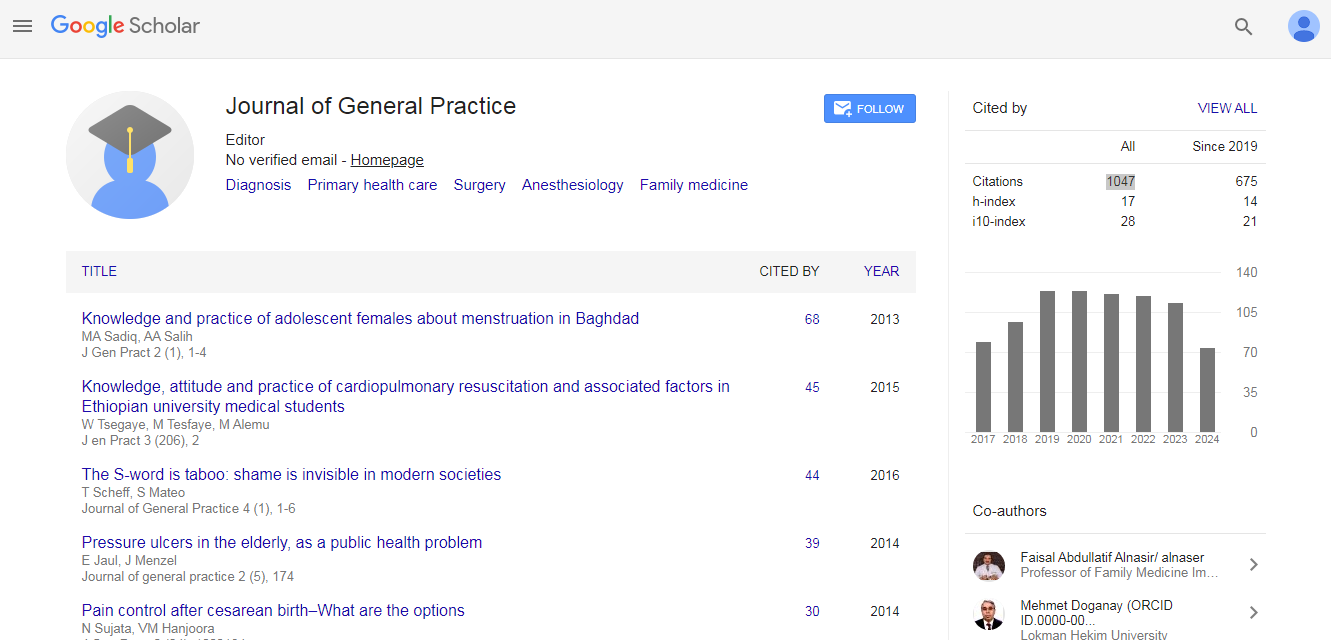
Journal of General Practice received 1047 citations as per Google Scholar report