Short Communication - (2025) Volume 12, Issue 6
Received: 01-Dec-2025, Manuscript No. jreac-26-185811;
Editor assigned: 03-Dec-2025, Pre QC No. P-185811;
Reviewed: 17-Dec-2025, QC No. Q-185811;
Revised: 22-Dec-2025, Manuscript No. R-185811;
Published:
29-Dec-2025
, DOI: 10.37421/2380-2391.2025.12.460
Citation: Novak, Luka. ”Predictive Modeling for Environmental Contaminant Risk Assessment.” J Environ Anal Chem 12 (2025):460.
Copyright: © 2025 Novak L. This is an open-access article distributed under the terms of the Creative Commons Attribution License, which permits unrestricted use, distribution
and reproduction in any medium, provided the original author and source are credited.
The environmental fate and bioavailability of contaminants are critical areas of research, underpinning our understanding of ecological risks and guiding remediation efforts. Predictive models have emerged as indispensable tools in this domain, offering sophisticated ways to forecast how substances will behave in various environmental matrices and their potential to enter biological systems. Recent advancements in modeling approaches are integrating a wide array of factors, from the intrinsic physicochemical properties of contaminants to dynamic environmental conditions and complex biological uptake mechanisms. This integrated approach aims to significantly enhance the accuracy of contaminant fate predictions, which are crucial for comprehensive environmental risk assessments and the development of effective remediation strategies. Key insights emerging from this field include the growing recognition of the importance of multi-stressor models and the strategic integration of high-throughput experimental data to refine and validate model parameters for improved predictive power [1].
In parallel, the development of novel computational frameworks has been a significant focus, particularly for predicting the bioavailability of organic contaminants within soil environments. These frameworks often couple mechanistic models of soil-water partitioning with quantitative structure-activity relationships (QSARs) that characterize microbial degradation processes. Such models have demonstrated efficacy in predicting reduced bioavailability under conditions of high organic matter content and low water availability, thereby offering valuable tools for assessing exposure risks and designing targeted soil remediation processes [2].
The impact of emerging contaminants, such as pharmaceuticals, on aquatic organisms is another pressing concern. Research in this area investigates the utility of in silico models to predict their bioaccumulation potential and subsequent trophic transfer through aquatic food webs. Studies highlight that models incorporating biotransformation rates significantly improve predictions of internal exposure concentrations, a vital factor in understanding their ecological impacts and risks to aquatic life [3].
Furthermore, the challenge of predicting the fate of persistent organic pollutants (POPs) in complex environmental matrices has spurred the development of advanced modeling approaches. These methods often integrate high-resolution geospatial data with multi-compartment fate and transport models. The results from such integrated systems have shown improved spatial accuracy in predicting POP concentrations and their propensity for long-range transport, thereby offering enhanced tools for global environmental management and policy development [4].
Assessing the bioavailability of heavy metals in sediments presents distinct challenges, leading to investigations into the predictive power of machine learning algorithms. By comparing the performance of models like random forest and support vector machines against traditional regression techniques, researchers aim to identify superior predictive capabilities. Findings consistently indicate that machine learning models, when trained on comprehensive datasets encompassing sediment properties and metal speciation, offer enhanced accuracy in predicting metal bioavailability compared to conventional methods [5].
For human health risk assessment, physiologically based pharmacokinetic (PBPK) models are being explored for their ability to predict the uptake and disposition of per- and polyfluoroalkyl substances (PFAS) in the human body. These models are particularly valuable as they can account for significant variations in exposure routes, metabolic pathways, and elimination rates, leading to more precise estimations of internal dose and potential health risks. The authors strongly emphasize the importance of PBPK modeling for robust regulatory risk assessment [6].
In the rhizosphere, the interface between plant roots and soil, the dynamics of contaminant bioavailability are complex and influenced by a myriad of biological and chemical factors. Research in this area employs coupled microbial-chemical models to assess how plant root exudates and microbial activity modulate the mobility and subsequent uptake of organic pollutants. These models have successfully captured instances of enhanced bioavailability within biologically active rhizosphere zones, providing crucial insights for the development of effective phytoremediation strategies [7].
Addressing the bioavailability of legacy contaminants, such as polychlorinated biphenyls (PCBs), in marine sediments requires specialized approaches. An integrated modeling strategy that combines sediment physical properties, organic carbon content, and historical contaminant inputs has been proposed. Validation of such models using field data demonstrates their promise for assessing long-term exposure risks to benthic organisms and informing management decisions for contaminated marine environments [8].
Finally, the environmental behavior and bioavailability of engineered nanomaterials in freshwater ecosystems are areas of growing concern. Studies examine how nanomaterial surface properties and aggregation behavior influence their transport and subsequent uptake by aquatic organisms. The development of multi-scale modeling frameworks allows for the prediction of nanomaterial distribution and bioavailability, offering essential data for assessing their environmental impact and risks [9].
The field of environmental science is increasingly reliant on sophisticated modeling techniques to decipher the complex behaviors of contaminants within diverse ecosystems. Predictive models are at the forefront of this effort, providing crucial insights into how substances migrate, transform, and ultimately become available to organisms. Recent advancements have focused on integrating multiple data streams, including physicochemical properties, environmental parameters, and biological uptake kinetics, to refine these predictive capabilities. This holistic approach is vital for enhancing the accuracy of contaminant fate predictions, which directly inform environmental risk assessments and the design of effective remediation strategies. A significant trend observed is the rising importance of multi-stressor models and the incorporation of high-throughput experimental data to fine-tune model parameters and improve their predictive power [1].
A novel computational framework has been presented for predicting the bioavailability of organic contaminants in soil environments. This innovative framework synergistically combines a mechanistic model describing soil-water partitioning with a quantitative structure-activity relationship (QSAR) model that characterizes microbial degradation. The effectiveness of this coupled approach lies in its ability to accurately predict reduced contaminant bioavailability under conditions typically characterized by high organic matter content and low water availability. Consequently, it offers a powerful tool for assessing exposure risks to soil organisms and for designing more efficient and targeted soil remediation processes [2].
The ecological impact of emerging contaminants, particularly pharmaceuticals, on aquatic organisms is a significant research focus. The utilization of in silico models to predict their potential for bioaccumulation and subsequent transfer through aquatic food webs is gaining traction. These studies underscore the fact that models incorporating specific biotransformation rates yield substantially improved predictions of internal exposure concentrations, which are critical for understanding the ecological risks posed by these substances [3].
Furthermore, significant efforts are directed towards developing advanced modeling approaches for predicting the environmental fate of persistent organic pollutants (POPs) within complex environmental matrices. These sophisticated methodologies integrate high-resolution geospatial data with multi-compartment fate and transport models. The application of these integrated models has led to demonstrably improved spatial accuracy in predicting POP concentrations and their potential for long-range atmospheric transport, thereby equipping environmental managers with enhanced tools for global environmental management initiatives [4].
In the realm of assessing heavy metal bioavailability in sediments, the predictive capabilities of machine learning algorithms are being rigorously examined. Comparative analyses have been conducted to evaluate the performance of various machine learning models, such as random forest and support vector machines, against traditional regression techniques. The findings consistently reveal that machine learning models, when trained on comprehensive datasets that include detailed information on sediment properties and metal speciation, provide superior accuracy in predicting metal bioavailability, offering a significant advantage over conventional methods [5].
For the purpose of human health risk assessment, the application of physiologically based pharmacokinetic (PBPK) models is being explored as a means to predict the uptake, distribution, metabolism, and excretion of per- and polyfluoroalkyl substances (PFAS) in humans. These PBPK models are particularly valuable due to their capacity to account for inter-individual variability in exposure routes, metabolic processes, and elimination kinetics. This leads to more accurate estimations of internal dose and the potential health risks associated with PFAS exposure, highlighting the critical role of PBPK modeling in regulatory risk assessment frameworks [6].
The rhizosphere, a zone of intense biological and chemical activity around plant roots, presents unique challenges for predicting contaminant bioavailability. Research in this area employs coupled microbial-chemical models to investigate how factors such as plant root exudates and microbial activity influence the mobility and uptake of organic pollutants. These models have successfully demonstrated how enhanced bioavailability can occur in biologically active rhizosphere zones, thereby providing valuable insights for the strategic development of phytoremediation techniques [7].
Addressing the complex issue of predicting the bioavailability of legacy contaminants, such as PCBs, within marine sediments necessitates integrated modeling approaches. Such strategies combine essential parameters including sediment physical properties, organic carbon content, and historical contaminant inputs. The validation of these integrated models using extensive field data confirms their potential utility for assessing long-term exposure risks to benthic organisms and for informing management strategies for contaminated marine environments [8].
Finally, the environmental fate and bioavailability of engineered nanomaterials in freshwater ecosystems are areas of increasing scientific and regulatory interest. Studies in this domain investigate how specific surface properties and aggregation behaviors of nanomaterials influence their transport dynamics and their potential for uptake by aquatic organisms. The development of sophisticated multi-scale modeling frameworks enables the prediction of nanomaterial distribution and bioavailability, thereby offering essential tools for assessing their potential environmental impact and associated risks [9].
This collection of research highlights the critical role of predictive modeling in understanding contaminant behavior and bioavailability across diverse environmental settings, including aquatic ecosystems, soils, and marine sediments. Studies explore advanced approaches such as mechanistic-QSAR frameworks, in silico predictions, machine learning algorithms, and physiologically based pharmacokinetic (PBPK) models. These models are essential for assessing risks associated with emerging contaminants, pharmaceuticals, persistent organic pollutants, heavy metals, legacy contaminants, and nanomaterials. The research emphasizes the integration of physicochemical properties, environmental factors, biological uptake, microbial activity, and geospatial data to improve prediction accuracy. Ultimately, these modeling efforts aim to enhance environmental risk assessment, guide remediation strategies, and inform regulatory decisions.
None
None
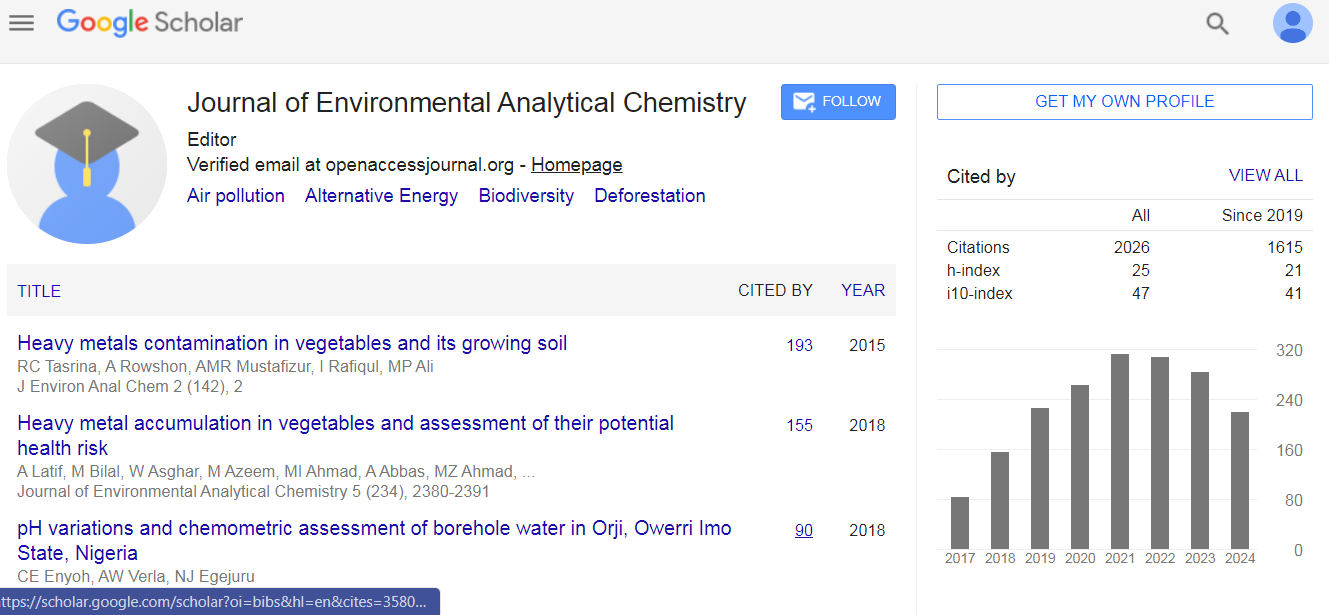
Journal of Environmental Analytical Chemistry received 1781 citations as per Google Scholar report