Brief Report - (2025) Volume 11, Issue 3
Received: 01-May-2025, Manuscript No. aso-26-184605;
Editor assigned: 05-May-2025, Pre QC No. P-184605;
Reviewed: 19-May-2025, QC No. Q-184605;
Revised: 22-May-2025, Manuscript No. R-184605;
Published:
29-May-2025
, DOI: 10.37421/2471-2671.2025.11.166
Citation: Collins, Ethan. ”Precision Surgery Revolutionizes Cancer
Treatment Outcomes.” Arch Surg Oncol 11 (2025):166.
Copyright: © 2025 Collins E. This is an open-access article distributed under the terms of the Creative Commons Attribution License, which permits unrestricted use,
distribution and reproduction in any medium, provided the original author and source are credited.
Advancements in surgical oncology are fundamentally reshaping the landscape of cancer treatment, prioritizing precision and patient-centric care through innovative techniques and technologies. This evolution is characterized by a significant shift towards minimally invasive approaches that aim to reduce patient trauma while maximizing therapeutic efficacy.
Robotic-assisted surgery, for instance, has emerged as a transformative tool, offering surgeons enhanced dexterity and visualization for complex oncological resections. These sophisticated systems allow for greater precision, leading to reduced blood loss and improved functional outcomes for patients undergoing cancer surgery. Minimally invasive surgical techniques, encompassing laparoscopy and thoracoscopy, are now widely adopted for their ability to decrease pain, infection risk, and recovery time compared to traditional open procedures. This paradigm shift reflects a broader trend towards less morbid surgical interventions across a spectrum of cancer types. Furthermore, the integration of image-guided surgery is revolutionizing oncologic procedures by leveraging real-time imaging technologies. This capability ensures unparalleled clarity in visualizing tumors and critical anatomical structures, leading to more accurate resections and minimized damage to surrounding healthy tissues. The application of image-guided surgery has demonstrated substantial improvements in achieving clear surgical margins and enhancing patient safety. Precision medicine further refines surgical oncology by tailoring treatments to individual genetic profiles and tumor molecular characteristics, guiding surgical decisions for more personalized and effective cancer care.The field of surgical oncology is experiencing a profound transformation driven by technological innovation and a deeper understanding of cancer biology. Advances in minimally invasive surgery, including laparoscopic and thoracoscopic techniques, have significantly reduced patient morbidity.
These methods involve smaller incisions, resulting in less pain, a lower risk of infection, and quicker recovery periods when contrasted with conventional open surgical approaches. Robotic surgery represents another significant leap forward, empowering surgeons with enhanced dexterity, magnified 3D visualization, and tremor filtration. These capabilities enable the meticulous execution of complex oncologic resections with a high degree of precision and control. Such precision translates directly into tangible patient benefits, including reduced intraoperative blood loss, shorter hospital stays, and ultimately, improved functional recovery following cancer surgery. Image-guided surgery plays a critical role by incorporating real-time imaging technologies directly into the operative field. This allows for unprecedented visualization of tumors and surrounding vital structures, facilitating more accurate tumor localization and resection while preserving healthy tissues. The impact of image-guided surgery on achieving optimal surgical margins and bolstering patient safety is considerable. Precision medicine is now at the forefront, advocating for a personalized approach to surgical oncology by considering a patient's unique genetic makeup and the molecular profile of their tumor. This granular understanding informs crucial surgical decisions, from determining the extent of resection required to selecting appropriate adjuvant therapies, thereby fostering more individualized and effective cancer management strategies. Artificial intelligence (AI) is also emerging as a powerful adjunct in surgical oncology, aiding in diagnostic accuracy, surgical planning, and intraoperative guidance. AI algorithms can analyze vast datasets to predict patient outcomes and refine surgical strategies, contributing to an overall enhancement in cancer care. Enhanced Recovery After Surgery (ERAS) protocols are increasingly implemented to optimize patient recovery through multimodal pathways that address pre-operative, intra-operative, and post-operative care. These protocols aim to reduce morbidity, shorten hospital stays, and improve patient satisfaction. Advanced surgical navigation systems, integrating augmented reality and intraoperative imaging, are further refining tumor localization and resection precision. These systems assist surgeons in navigating complex anatomy, ensuring optimal margins, and protecting critical structures, thereby improving oncological control. Molecular imaging provides novel insights into tumor biology and aids in the precise identification and resection of malignant tissues, guiding interventions for better outcomes. Finally, the future of surgical oncology is envisioned through the continued refinement of precision techniques and the integration of multidisciplinary approaches, promising further improvements in detection, planning, and treatment efficacy.Surgical oncology is undergoing a revolution driven by precision techniques that enhance cancer treatment. Minimally invasive surgery, robotic-assisted procedures, and image-guided interventions are leading to improved patient outcomes, reduced complications, and faster recovery. Precision medicine tailors treatments based on individual patient and tumor characteristics. Advancements in artificial intelligence and navigation systems are further refining surgical planning and execution. Enhanced recovery protocols are also playing a crucial role in optimizing post-operative care. These innovations collectively aim to improve surgical precision, efficacy, and the overall quality of life for cancer patients.
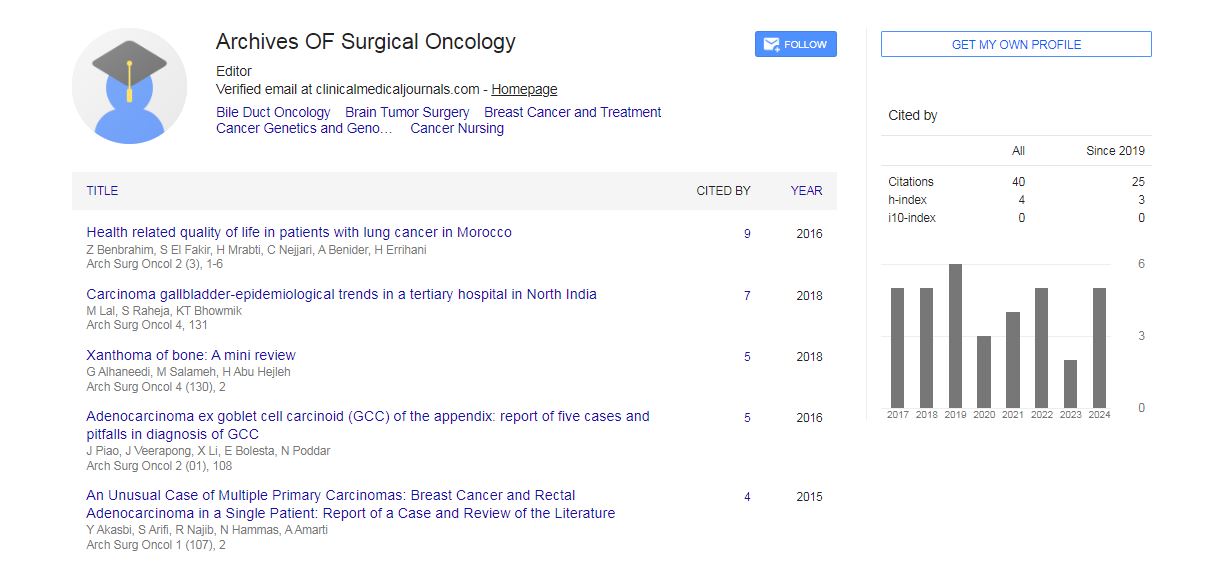
Archives of Surgical Oncology received 37 citations as per Google Scholar report