Commentary - (2025) Volume 11, Issue 3
Received: 01-May-2025, Manuscript No. ohcr-25-174257;
Editor assigned: 05-May-2025, Pre QC No. P-174257;
Reviewed: 19-May-2025, QC No. Q-174257;
Revised: 22-May-2025, Manuscript No. R-174257;
Published:
29-May-2025
, DOI: 10.37421/2471-8726.2025.11.191
Citation: Robertson, Amelia. ”Precision Oral Health: Diagnostics, AI, Early Intervention.” Oral Health Case Rep 11 (2025):191.
Copyright: © 2025 Robertson A. This is an open-access article distributed under the terms of the Creative Commons Attribution License, which permits unrestricted use, distribution and reproduction in any medium, provided the original author and source are credited.
This study delves into the diagnostic accuracy of Artificial Intelligence (AI)-assisted systems in detecting oral potentially malignant disorders and oral squamous cell carcinoma. What this really means is that Artificial Intelligence (AI) holds significant promise for improving early detection, but we still need more high-quality studies to fully validate its routine clinical application and ensure it performs consistently across diverse patient populations. It is about finding that sweet spot between technology and human expertise[1].
Here's the thing: oral squamous cell carcinoma continues to be a major health concern, and this review synthesizes recent insights into its epidemiology, risk factors, and evolving treatment strategies. Understanding these factors is crucial for developing better prevention programs and tailoring therapeutic approaches to improve patient outcomes, highlighting the importance of early intervention and comprehensive care[2].
This article takes a deep dive into the molecular pathology of ameloblastoma, a common odontogenic tumor. Let's break it down: understanding the specific genetic mutations and signaling pathways involved helps us develop more targeted therapies, potentially reducing the need for extensive surgeries and improving the long-term prognosis for patients with this challenging condition. Itâ??s all about precision in treatment[3].
Exploring the role of Epstein-Barr Virus (EBV) in oral diseases, this review highlights its potential involvement in various pathologies, from benign lesions to certain malignancies. What this really means is that while Epstein-Barr Virus (EBV) is widely present, its specific pathogenic mechanisms in oral tissues are still being uncovered, prompting further research into its diagnostic and therapeutic implications[4].
This systematic review evaluates novel biomarkers for the early detection of oral potentially malignant disorders and oral cancer. The critical takeaway here is that identifying reliable biomarkers can revolutionize screening programs, allowing for earlier and less invasive detection, which ultimately leads to better prognoses and improved quality of life for patients. It is about shifting from late diagnosis to proactive management[5].
Understanding the histopathological features and clinical presentation of oral lichen planus is crucial for accurate diagnosis and effective management. This article provides a comprehensive overview, emphasizing the diverse manifestations of this chronic inflammatory condition and the importance of differentiating it from other oral lesions, especially those with malignant potential. It is a complex puzzle that requires careful clinical and pathological correlation[6].
This research investigates the latest developments in imaging techniques for diagnosing and staging oral cancers. Let's break it down: advanced imaging offers more precise visualization of tumor extent and nodal involvement, which directly impacts treatment planning and surgical outcomes. Getting a clear picture internally makes all the difference in tackling these aggressive diseases[7].
Looking at the genetic landscape of oral submucous fibrosis (OSF), this article explores the molecular mechanisms driving this debilitating, precancerous condition. The key insight is that by identifying specific genetic alterations, we can better understand disease progression and potentially develop targeted interventions to halt its transformation into oral cancer. It is about unraveling the cellular roots of the problem[8].
This study focuses on the prevalence and risk factors associated with oral candidiasis in specific patient populations, like those who are immunocompromised. What this really means is that understanding these dynamics helps clinicians identify at-risk individuals and implement appropriate preventive and therapeutic strategies, which is crucial for managing oral health in vulnerable groups. It is about tailored care[9].
Let's break down the diagnostic challenges in differentiating between benign and malignant salivary gland lesions. This review highlights the complexities pathologists face, emphasizing the importance of a multidisciplinary approach and the use of adjunct diagnostic techniques to ensure accurate diagnoses. It is a field where subtle histological differences can have profound clinical implications, demanding precision[10].
This study delves into the diagnostic accuracy of Artificial Intelligence (AI)-assisted systems in detecting oral potentially malignant disorders and oral squamous cell carcinoma. What this really means is that Artificial Intelligence (AI) holds significant promise for improving early detection, but we still need more high-quality studies to fully validate its routine clinical application and ensure it performs consistently across diverse patient populations. It is about finding that sweet spot between technology and human expertise. [1] Oral squamous cell carcinoma remains a major health concern, and understanding its epidemiology, risk factors, and evolving treatment strategies is crucial for developing better prevention and tailored therapeutic approaches. [2] Identifying reliable novel biomarkers can revolutionize screening programs for oral potentially malignant disorders and oral cancer, leading to earlier, less invasive detection and improved prognoses. [5]
In the realm of specific pathologies, this article delves into the molecular pathology of ameloblastoma, a common odontogenic tumor. Understanding its genetic mutations and signaling pathways helps develop more targeted therapies, potentially reducing extensive surgeries and improving prognosis. [3] Accurate diagnosis and effective management of oral lichen planus hinge on understanding its histopathological features and diverse clinical presentation, differentiating it from other oral lesions, especially those with malignant potential. [6] Examining the genetic landscape of oral submucous fibrosis (OSF) reveals molecular mechanisms driving this debilitating, precancerous condition. Identifying specific genetic alterations offers insight into disease progression and potential targeted interventions to halt its transformation into oral cancer. [8]
Exploring the role of Epstein-Barr Virus (EBV) in oral diseases highlights its potential involvement in various pathologies, from benign lesions to certain malignancies, prompting further research into its diagnostic and therapeutic implications. [4] Additionally, research investigates the latest developments in imaging techniques for diagnosing and staging oral cancers. Advanced imaging provides more precise visualization of tumor extent and nodal involvement, directly impacting treatment planning and surgical outcomes. [7]
This study focuses on the prevalence and risk factors associated with oral candidiasis, particularly in immunocompromised patient populations. Understanding these dynamics helps clinicians identify at-risk individuals and implement appropriate preventive and therapeutic strategies, which is crucial for managing oral health in vulnerable groups. [9] Diagnostic challenges in differentiating between benign and malignant salivary gland lesions underscore the importance of a multidisciplinary approach and adjunct diagnostic techniques to ensure accurate diagnoses, as subtle histological differences can have profound clinical implications. [10]
This collection of studies highlights critical advancements and ongoing challenges in oral health diagnostics and management. There's significant promise for Artificial Intelligence (AI) in detecting oral potentially malignant disorders and oral squamous cell carcinoma, though more validation is needed for routine clinical use. Oral squamous cell carcinoma itself remains a major concern, with continuous research into its epidemiology, risk factors, and treatment strategies. Early detection is a recurring theme, emphasized by the evaluation of novel biomarkers for oral potentially malignant disorders and oral cancer, aiming for proactive management over late diagnosis. Molecular insights are crucial, as seen in the deep dive into ameloblastoma's pathology, seeking targeted therapies, and the exploration of genetic susceptibility in oral submucous fibrosis to halt its precancerous progression. The role of infectious agents like Epstein-Barr Virus (EBV) in oral diseases is also being uncovered, prompting further diagnostic and therapeutic research. Understanding specific conditions like oral lichen planus, including its diverse manifestations, is vital for accurate differentiation from malignant potential. Advances in imaging techniques are transforming oral cancer diagnosis and staging, providing clearer pictures for treatment planning. Moreover, studies address the prevalence and risk factors of oral candidiasis in vulnerable populations for tailored care, and underscore the diagnostic complexities of salivary gland lesions, demanding precision through multidisciplinary approaches. Overall, these works stress the importance of early intervention, precise diagnostics, and understanding underlying molecular and pathological mechanisms to improve patient outcomes in oral health.
None
None
1. Arjun SM, Kavitha PS, Rajesh PS. "Artificial Intelligence in the Diagnosis of Oral Potentially Malignant Disorders and Oral Squamous Cell Carcinoma: A Systematic Review and Meta-analysis".J Oral Maxillofac Pathol 27 (2023):1-10.
Indexed at, Google Scholar, Crossref
2. Sangeeta S, Smita S, Anjana S. "Oral Squamous Cell Carcinoma: An Overview".J Pharm Bioallied Sci 14 (2022):S161-S166.
Indexed at, Google Scholar, Crossref
3. Daniele DR, Maria CFFG, PatrÃcia CLS. "Molecular Pathology of Ameloblastoma".Oral Maxillofac Surg Clin North Am 34 (2022):255-265.
Indexed at, Google Scholar, Crossref
4. Shubhangi K, Shubhangi PS, Anjali R. "Epstein Barr Virus in Oral Diseases: An Update".J Maxillofac Oral Surg 20 (2021):443-448.
Indexed at, Google Scholar, Crossref
5. Amal AA, Zaid MA, Ali HA. "Novel Biomarkers for Early Detection of Oral Potentially Malignant Disorders and Oral Cancer: A Systematic Review".J Oral Maxillofac Pathol 25 (2021):198-204.
Indexed at, Google Scholar, Crossref
6. Riyazullah, Mohammad RHA, Syed AH. "Oral Lichen Planus: An Update".J Oral Maxillofac Pathol 24 (2020):225-231.
Indexed at, Google Scholar, Crossref
7. Arvind K, S. SSK, Preetha S. "Recent Advances in Imaging for Oral Cancer".J Clin Imaging Sci 10 (2020):42.
Indexed at, Google Scholar, Crossref
8. Archana S, Pooja S, Rahul S. "Genetic Susceptibility to Oral Submucous Fibrosis: An Update".J Maxillofac Oral Surg 19 (2020):408-412.
Indexed at, Google Scholar, Crossref
9. Priya RK, Reshma UP, Pooja SS. "Prevalence of Oral Candidiasis and Its Associated Risk Factors in a Tertiary Care Hospital".J Oral Maxillofac Pathol 23 (2019):28-33.
Indexed at, Google Scholar, Crossref
10. Neha S, Preeti S, Garima K. "Salivary Gland Tumors: An Overview".J Pharm Bioallied Sci 11 (2019):S2-S8.
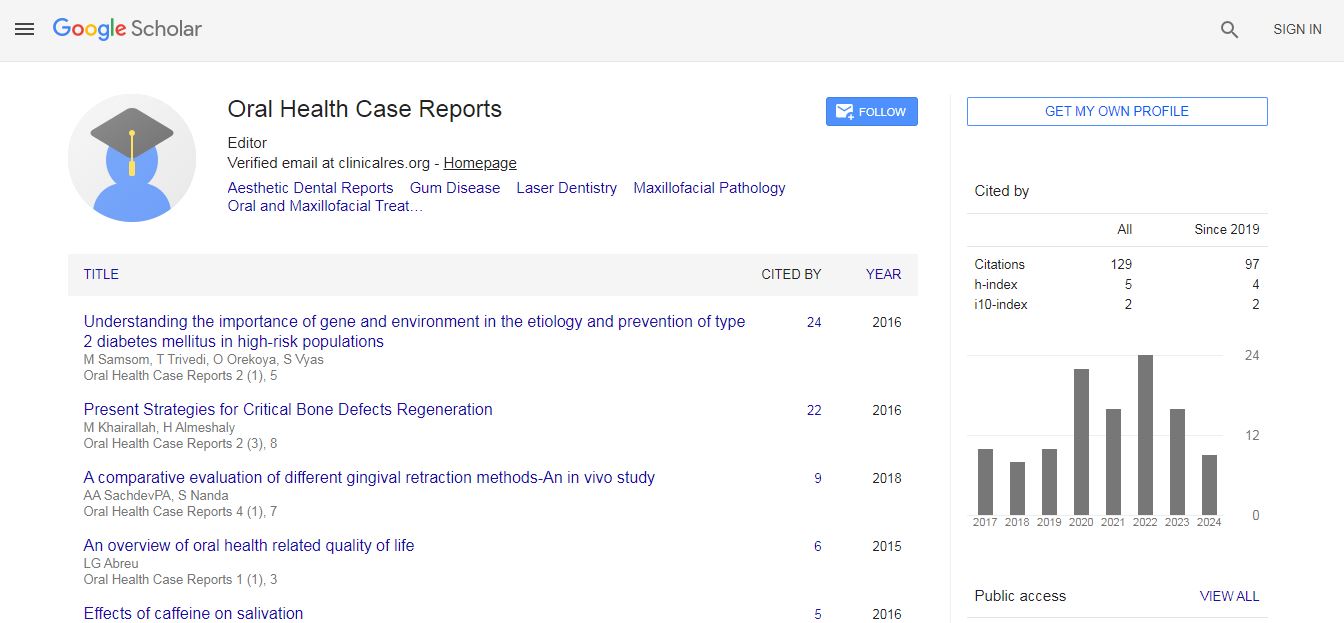
Oral Health Case Reports received 120 citations as per Google Scholar report