Brief Report - (2025) Volume 11, Issue 2
Received: 31-Mar-2025, Manuscript No. cdp-25-165834;
Editor assigned: 02-Apr-2025, Pre QC No. P-165834;
Reviewed: 16-Apr-2025, QC No. Q-165834;
Revised: 24-Apr-2025, Manuscript No. R-165834;
Published:
30-Apr-2025
, DOI: 10.37421/2572-0791.2025.11.164
Citation: Vieta, Michele. “Postpartum Depression and Smartphone-based Behavioral Monitoring: A Digital Phenotyping Study.” Clin Depress 11 (2025): 164.
Copyright: © 2025 Vieta M. This is an open-access article distributed under the terms of the Creative Commons Attribution License, which permits unrestricted use, distribution and reproduction in any medium, provided the original author and source are credited.
Postpartum Depression (PPD) is a pervasive and often underdiagnosed mood disorder that affects a significant proportion of new mothers worldwide. It is estimated that between 10% and 20% of women experience some form of depressive symptoms within the first year after childbirth, with many going undetected or untreated. PPD not only disrupts maternal well-being but can also impair mother-infant bonding, interfere with child development, and place strain on familial relationships. Traditional diagnostic tools, such as clinical interviews and paper-based screening instruments like the Edinburgh Postnatal Depression Scale (EPDS), are helpful but limited in their reach, especially in under-resourced or culturally stigmatized settings. These methods also fail to capture the temporal fluctuations and daily stressors that characterize the postpartum period. In light of these challenges, digital phenotyping-defined as the moment-by-moment quantification of individual behavior through data collected by personal digital devices-offers a compelling alternative for the detection and monitoring of postpartum depression [1].
Smartphones, now ubiquitous across much of the global population, are uniquely positioned to serve as passive sensors of mental health. They continuously collect data on physical activity, social interaction, sleep patterns, mobility, and communication-all of which are behavioral domains known to be disrupted by depressive symptoms. For postpartum individuals, whose schedules are unpredictable and whose emotional states may shift rapidly in response to physiological, hormonal, and environmental changes, this method of passive, continuous monitoring offers a way to detect signs of distress early, objectively, and non-invasively. The current study explores the potential of smartphone-based digital phenotyping to identify behavioral markers associated with postpartum depression, and to evaluate how these markers correspond to self-reported symptom severity [2].
In this observational study, we recruited a cohort of 150 postpartum women within the first three months of childbirth. Participants were asked to install a secure, research-grade smartphone application capable of collecting a range of passive behavioral data, including GPS location, screen usage duration, call and text frequency, ambient light exposure, and accelerometer data. All participants provided informed consent and completed baseline psychological assessments, including the EPDS and the PHQ-9 (Patient Health Questionnaire-9). Behavioral data were collected passively over an eight-week period, during which participants also completed weekly mood check-ins and sleep quality surveys via the app. This dual approach allowed us to compare objective behavioral data with subjective reports, and to identify any emerging discrepancies between the two [3].
Data analysis focused on key behavioral domains that prior literature has associated with depressive symptoms: mobility patterns, sleep regularity, communication behavior, and daily activity rhythms [4]. For example, GPS-derived mobility entropy was used to measure the predictability and diversity of movement-a low entropy value typically reflects limited travel and spatial withdrawal, often linked with depressive states. Accelerometer data were used to estimate sleep onset and wake times, while screen-on events helped infer nighttime phone usage, a proxy for sleep disruption. Communication logs, including the frequency and duration of calls and messages, were analyzed to gauge social connectivity and engagement, both of which tend to diminish in individuals experiencing depressive symptoms [5,6].
In conclusion, this study demonstrates the viability and promise of smartphone-based digital phenotyping as a tool for monitoring postpartum depression. Through continuous, passive observation of behavioral rhythms, mobility, sleep, and social engagement, it is possible to detect subtle changes that may precede or accompany depressive symptoms in new mothers. This approach offers a novel, scalable method for supporting mental health during a critical period, and represents a shift toward more proactive, personalized psychiatric care. With ethical design and equitable deployment, digital phenotyping has the potential to transform how we detect and respond to postpartum mental health challenges-bridging the gap between lived experience and clinical insight, and enabling earlier, more compassionate intervention for mothers navigating the complex landscape of the postpartum period.
None.
None.
Google Scholar Cross Ref Indexed at
Google Scholar Cross Ref Indexed at
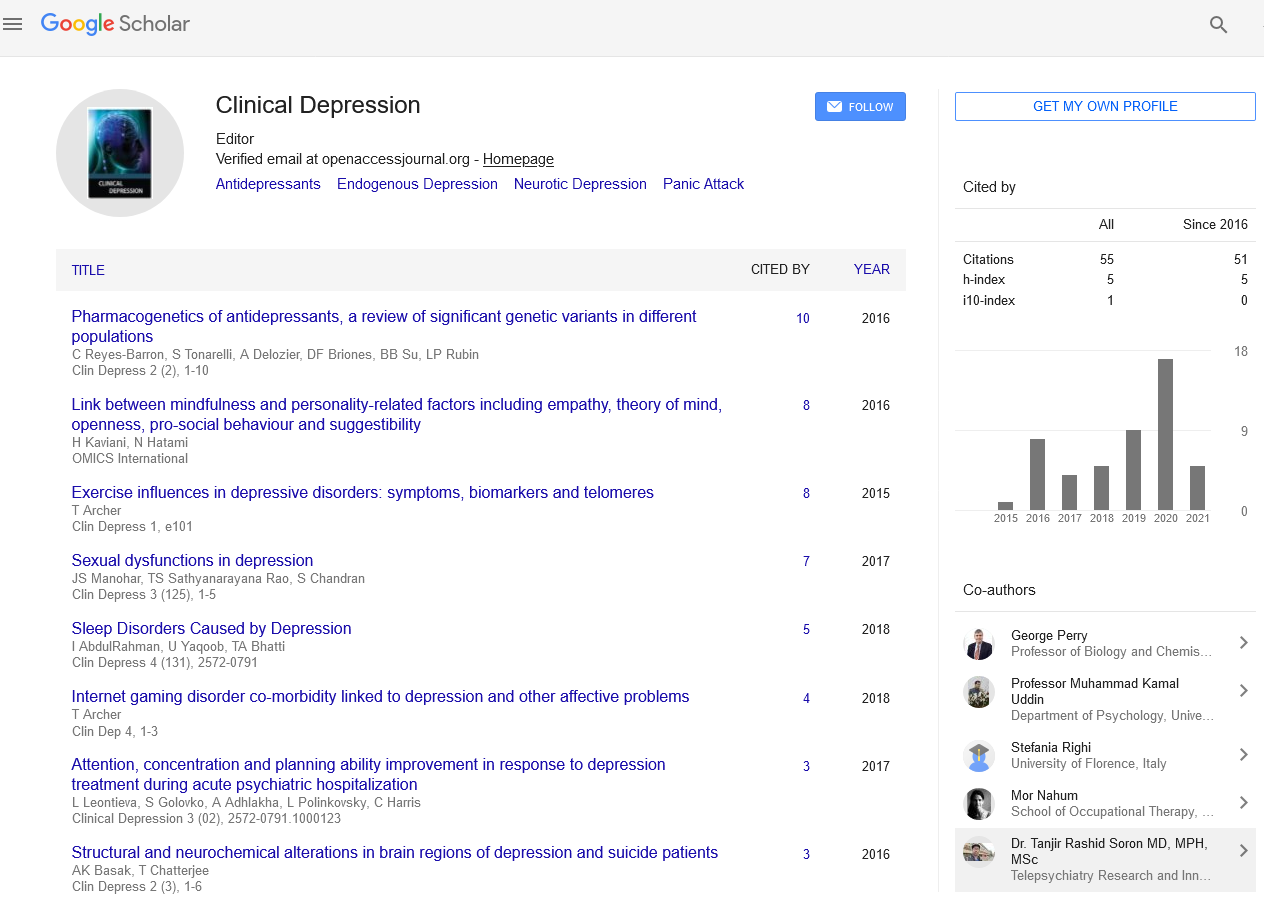
Clinical Depression received 89 citations as per Google Scholar report