Opinion - (2025) Volume 16, Issue 3
Received: 01-Aug-2025, Manuscript No. hgec-25-174740;
Editor assigned: 04-Aug-2025, Pre QC No. P-174740;
Reviewed: 18-Aug-2025, QC No. Q-174740;
Revised: 22-Aug-2025, Manuscript No. R-174740;
Published:
29-Aug-2025
, DOI: 10.37421/2161-0436.2025.16.294
Citation: Mwangi, Elias. ”Population Genetics: Broad Insights, Global Impact.” Human Genet Embryol 16 (2025):294.
Copyright: © 2025 Mwangi E. This is an open-access article distributed under the terms of the Creative Commons Attribution License, which permits unrestricted use, distribution and reproduction in any medium, provided the original author and source are credited.
The field of population genetics continues to evolve, providing profound insights across diverse biological domains. One significant area of study involves tracing ancient human history and migrations; for example, ancient genome sequencing has been critically used to identify genetic shifts during the Neolithic transition in the northern Fertile Crescent. This approach clarifies population movements, admixture events, and the spread of early farming practices, ultimately revealing how distinct ancestral components have shaped the genetic makeup of modern populations in the region [1].
Furthermore, genomic tools are proving revolutionary in addressing contemporary challenges such as climate change. They enhance our ability to predict and comprehend species' adaptive responses to environmental shifts. This includes advanced methods for identifying specific adaptive genetic variations and projecting future evolutionary trajectories, which are undeniably crucial for crafting effective conservation strategies in our rapidly changing world [2].
Understanding human disease is another vital application. Population genetics plays an expanding role, particularly with the proliferation of large-scale genomic datasets now available. Insights derived from human ancestry and population structure are shown to be essential for accurate disease gene mapping, improved risk prediction, and the development of more equitable precision medicine approaches tailored to diverse populations [3].
Beyond human health, genomics is actively transforming conservation biology. It supplies detailed information regarding genetic diversity, population structure, and the adaptive potential of endangered species. These precise genomic insights are fundamental for developing targeted, effective conservation strategies aimed at preventing extinction and managing vulnerable populations successfully [4].
The mechanisms behind the evolution and spread of drug resistance in both pathogens and cancer cells are also critically illuminated by population genetic principles. This involves examining how factors such as mutation rates, natural selection pressures, and migration patterns influence resistance dynamics. Such understanding is invaluable for designing more sustainable and effective therapeutic strategies against evolving threats [5].
In agriculture, population genetics contributes significantly to modern plant breeding efforts. Here, genomic tools combined with advanced statistical models are employed to improve crucial agricultural traits like crop yields, disease resistance, and overall adaptation to various environmental stresses. Future research directions emphasize accelerating breeding cycles to develop even more resilient and productive crops [6].
The evolutionary genomics of microbial populations offers an incredibly high-resolution view into their dynamic changes. Whole-genome sequencing, for instance, provides unprecedented detail for studying pathogen transmission, the rapid evolution of antibiotic resistance, and adaptation to new hosts or environments. This work vividly demonstrates the real-time nature of microbial evolution [7].
Ancient DNA (aDNA) technology, in particular, has had a truly transformative impact on population genetics. Reviews highlight how aDNA has yielded unparalleled insights into human evolutionary history, revealing ancient migration routes and the genetic adaptations of past populations. This technological advancement has fundamentally reshaped our understanding of historical population dynamics across the globe [8].
Cancer research also benefits immensely from population genetic perspectives, treating tumors as complex, evolving populations of cells. This framework helps dissect how concepts like mutation rates, clonal selection, and population bottlenecks drive key aspects of cancer, including tumor heterogeneity, the development of drug resistance, and metastasis. These insights are directly informing innovative therapeutic strategies [9].
Finally, the analysis of these vast datasets necessitates sophisticated computational methods for population genetic analysis. These essential techniques cover demographic inference, the detection of natural selection, and the reconstruction of intricate evolutionary histories. Such tools are pivotal, enabling deeper insights into the complex forces that shape genetic diversity across all forms of life [10].
Population genetics provides a crucial framework for understanding the forces that shape genetic diversity within and among species. Modern research, greatly bolstered by ancient DNA (aDNA) technology, has ushered in a new era for studying evolutionary history. aDNA offers unprecedented insights into human evolutionary history, revealing ancient migrations and genetic adaptations of past populations, fundamentally reshaping our understanding of historical population dynamics [8]. For instance, ancient genome sequencing has been utilized to trace genetic shifts during the Neolithic transition in the northern Fertile Crescent, providing granular details on population movements, admixture events, and the spread of early farming practices. This work vividly illuminates how distinct ancestral components contributed to the genetic makeup of modern populations in the region [1].
The implications of population genetics extend significantly into human health, particularly with the advent of large-scale genomic datasets. This field critically examines how human ancestry and population structure are essential for accurate disease gene mapping, improving risk prediction, and developing more equitable precision medicine approaches tailored to diverse genetic backgrounds [3]. Beyond inherited diseases, population genetic principles are also fundamental for understanding the evolution and spread of drug resistance. This includes resistance in pathogens and cancer cells, where factors like mutation, selection, and migration influence resistance dynamics, offering crucial understanding for designing more sustainable therapeutic strategies [5]. In a focused application, the population genetics of cancer evolution specifically treats tumors as evolving populations of cells, discussing how concepts such as mutation rates, clonal selection, and population bottlenecks drive tumor heterogeneity, drug resistance, and metastasis, thereby informing new therapeutic strategies [9].
Genomic approaches are revolutionizing our ability to predict and understand species' adaptive responses to the pressing challenge of climate change. These methods involve identifying adaptive genetic variation and projecting evolutionary trajectories, which are crucial for effective conservation strategies in a rapidly changing world [2]. Similarly, genomics is transforming conservation biology more broadly by providing detailed information on genetic diversity, population structure, and the adaptive potential of endangered species. These genomic insights are critical for developing targeted conservation strategies to prevent extinction and manage populations effectively, safeguarding biodiversity against various threats [4].
The principles of population genetics also play a significant role in modern agricultural practices, particularly in plant breeding. Here, genomic tools and advanced statistical models are being increasingly used to improve essential traits like crop yields, enhance disease resistance, and bolster adaptation to environmental stresses. This research emphasizes future directions for accelerating breeding cycles and developing resilient crops that can withstand changing global conditions [6]. Concurrently, the evolutionary genomics of microbial populations demonstrates how whole-genome sequencing offers unparalleled resolution to study critical biological phenomena. This includes pathogen transmission, the rapid evolution of antibiotic resistance, and adaptation to new hosts or environments, showcasing the dynamic and real-time nature of microbial evolution [7].
Underpinning all these advancements are sophisticated computational methods essential for analyzing the increasingly large and complex population genetic datasets. Reviews in this area cover a range of techniques, including demographic inference, the detection of natural selection, and the reconstruction of evolutionary histories. These powerful computational tools are paramount, enabling deeper and more nuanced insights into the diverse forces shaping genetic diversity across all life forms, pushing the boundaries of what is discoverable in evolutionary biology [10].
Population genetics and genomics are rapidly advancing fields, providing crucial insights across a broad spectrum of biological and health sciences. These disciplines are fundamentally reshaping our understanding of human history, as seen through ancient genome sequencing that traces Neolithic transitions, population movements, and genetic contributions to modern populations. They are also vital for addressing contemporary global challenges. For instance, genomic tools are revolutionizing conservation biology by predicting species' adaptive responses to climate change and informing targeted strategies for endangered species by detailing their genetic diversity and adaptive potential. In the realm of human health, population genetics is indispensable for understanding disease, leveraging large-scale genomic datasets to improve gene mapping, risk prediction, and equitable precision medicine. It further illuminates the complex evolution and spread of drug resistance in pathogens and cancer cells, treating tumors as evolving populations to inform new therapeutic strategies. Beyond human applications, these genetic principles are transforming agriculture by guiding plant breeding efforts to improve crop yields and stress resistance, and they offer high-resolution views into the dynamic evolution of microbial populations, including antibiotic resistance. The analytical backbone for these discoveries comes from sophisticated computational methods, which are essential for processing vast datasets, inferring demographics, detecting selection, and reconstructing evolutionary histories, thus continuously deepening our understanding of the forces shaping genetic diversity.
None
None
Indexed at, Google Scholar, Crossref
Indexed at, Google Scholar, Crossref
Indexed at, Google Scholar, Crossref
Indexed at, Google Scholar, Crossref
Indexed at, Google Scholar, Crossref
Indexed at, Google Scholar, Crossref
Indexed at, Google Scholar, Crossref
Indexed at, Google Scholar, Crossref
Indexed at, Google Scholar, Crossref
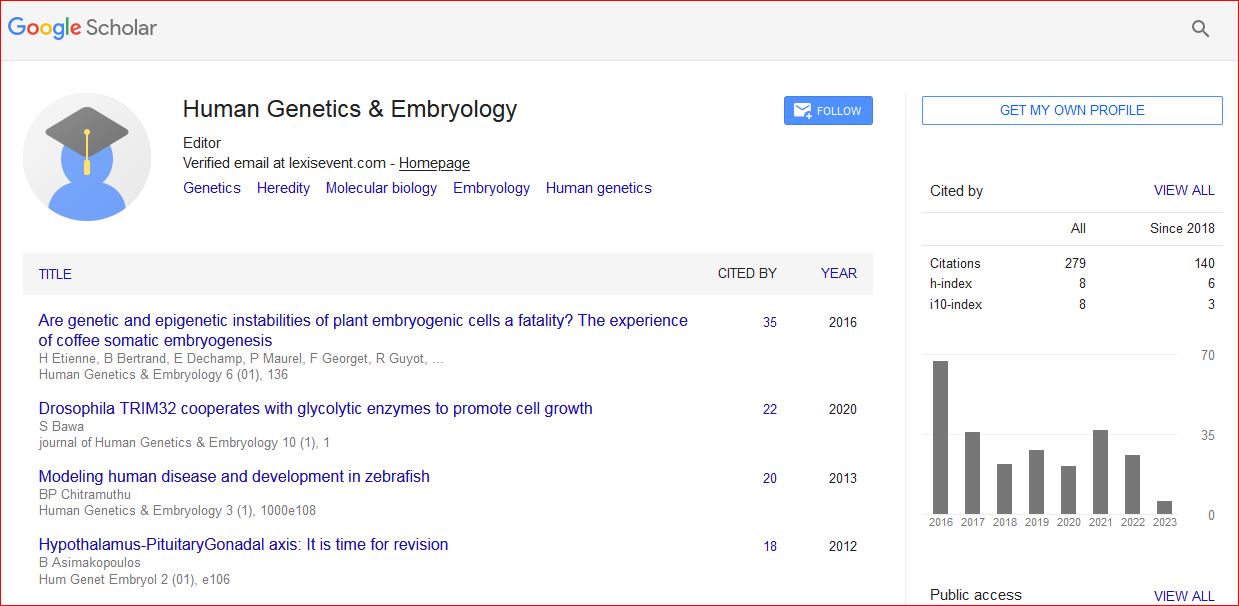
Human Genetics & Embryology received 309 citations as per Google Scholar report