Commentary - (2025) Volume 9, Issue 3
Received: 30-May-2025, Manuscript No. fsb-26-189947;
Editor assigned: 05-May-2025, Pre QC No. P-189947;
Reviewed: 19-May-2025, QC No. Q-189947;
Revised: 22-May-2025, Manuscript No. R-189947;
Published:
29-May-2025
, DOI: 10.37421/2577-0543.2025.9.233
Citation: Bianchi, Luca. ”Polymeric Nanoparticles: Enhanced Drug Delivery And Therapeutics.” J Formul Sci Bioavailab 09 (2025):233.
Copyright: © 2025 Bianchi L. This is an open-access article distributed under the terms of the Creative Commons Attribution License, which permits unrestricted use, distribution and reproduction in any medium, provided the original author and source are credited.
Polymeric nanoparticles have emerged as indispensable tools in the realm of advanced drug delivery, significantly enhancing therapeutic efficacy and mitigating adverse side effects through sophisticated controlled release mechanisms. Their inherent biocompatibility and biodegradability render them exceptionally suitable for the encapsulation of a diverse array of drugs, thereby improving both solubility and bioavailability. Recent breakthroughs in the design of nanoparticle systems have focused on targeted delivery strategies, stimuli-responsive release functionalities, and overcoming various biological barriers. The Department of Medicinal Chemistry at Verona Biomedical University has made substantial contributions to elucidating the physicochemical properties that govern nanoparticle performance within in vivo environments, thereby laying the groundwork for the development of next-generation therapeutics [1].
The precise regulation of drug release kinetics is a fundamental aspect of effective nanomedicine, directly influencing therapeutic outcomes. This paper meticulously examines how the selection of polymer type, particle dimensions, and surface modifications of polymeric nanoparticles exert a direct impact on drug release profiles. Strategies for achieving sustained, pulsatile, or triggered release are explored, aiming to optimize therapeutic efficacy and patient adherence. The paramount importance of formulation parameters in realizing desired bioavailability is strongly emphasized within this research [2].
A persistent and significant challenge in pharmaceutical development is the enhancement of oral bioavailability for poorly soluble drugs. Polymeric nanoparticles offer a highly promising avenue for addressing this issue by effectively boosting drug solubility, providing protection against degradation within the gastrointestinal tract, and facilitating improved absorption. This review consolidates recent advancements in the application of various polymeric nanoparticulate systems, including solid lipid nanoparticles and nanostructured lipid carriers, specifically for oral drug delivery. The potential of these systems to circumvent first-pass metabolism and enhance systemic exposure is a key focus [3].
The bio-distribution characteristics and targeting efficiency of polymeric nanoparticles are critically important for their successful therapeutic application. Surface modification, particularly the conjugation of specific targeting ligands, plays a crucial role in directing nanoparticles to designated tissues or cells. This strategy serves to minimize off-target effects and concentrate the drug at the intended disease site. This article investigates the most recent strategies employed for surface functionalization to achieve both active and passive targeting, with a direct impact on drug bioavailability and overall efficacy [4].
Intelligent, stimuli-responsive polymeric nanoparticles are designed to exhibit dynamic drug release capabilities, triggered by specific internal or external cues such as changes in pH, temperature, or enzymatic activity. This adaptive release mechanism facilitates localized drug delivery, thereby reducing systemic exposure to healthy tissues. This research scrutinizes the fundamental design principles and potential therapeutic applications of such intelligent nanoparticles for treating diseases where precise drug targeting is of utmost importance, leading to a significant improvement in bioavailability at the site of action [5].
The creation of biodegradable and biocompatible polymeric nanoparticles is absolutely essential for ensuring the safety and effectiveness of drug delivery systems. This particular study centers on novel polymeric materials, including polyesters and polyurethanes, which are known to degrade into non-toxic byproducts. Comprehensive evaluation of their performance, both in vitro and in vivo, has demonstrated their considerable potential to enhance drug bioavailability while simultaneously minimizing immunogenicity and toxicity, aligning perfectly with the established goals of controlled drug release [6].
Characterization of nanoparticles represents a critical stage in the process of ensuring the reproducibility and ultimate efficacy of drug delivery systems. This article provides a detailed account of advanced techniques utilized for the evaluation of key parameters such as size, morphology, surface charge, and drug encapsulation efficiency of polymeric nanoparticles. A thorough understanding of these physicochemical properties is indispensable for accurately predicting their behavior in vivo and for optimizing drug release profiles, which collectively influence bioavailability [7].
Encapsulating sensitive therapeutic agents, including vital proteins and nucleic acids, within polymeric nanoparticles presents a unique set of challenges that require innovative solutions. This research explores various strategies specifically designed to protect these biomolecules from degradation during both the formulation process and the subsequent release phase, thereby preserving their inherent biological activity. The overarching objective is to enhance their stability and facilitate targeted delivery, ultimately leading to improved therapeutic outcomes and enhanced bioavailability [8].
The successful translation of polymeric nanoparticle-based drug delivery systems from the laboratory bench to clinical practice necessitates rigorous assessment of their safety and efficacy. This study undertakes an investigation into the pharmacokinetic and pharmacodynamic profiles of a range of polymeric nanoparticle formulations within preclinical models. It underscores the critical importance of comprehending how variations in nanoparticle design influence drug release, distribution, metabolism, and excretion â?? all factors that are paramount for achieving optimal bioavailability and a robust therapeutic response [9].
The utilization of polymeric nanoparticles for combination drug delivery presents an exciting opportunity to achieve synergistic therapeutic effects and to effectively combat drug resistance. This article delves into various strategies for co-encapsulating multiple therapeutic agents within a single nanoparticle system, meticulously controlling their individual release rates to achieve optimal therapeutic synergy. A primary focus is placed on the potential for enhancing the overall bioavailability and efficacy of such combination therapies, offering a promising approach for treating complex and challenging disease states [10].
Polymeric nanoparticles play a pivotal role in the advancement of drug delivery systems, offering substantial improvements in therapeutic outcomes and a reduction in side effects through their capacity for controlled drug release. Their intrinsic biocompatibility and biodegradability make them ideal carriers for a wide spectrum of drugs, leading to enhanced solubility and bioavailability. This body of work highlights recent progress in the design of nanoparticle systems for targeted delivery, stimuli-responsive release mechanisms, and effective navigation of biological barriers. The Department of Medicinal Chemistry at Verona Biomedical University has significantly contributed to the understanding of the physicochemical properties that govern nanoparticle performance in vivo, paving the way for the development of next-generation therapeutics [1].
The precise control over the kinetics of drug release is a cornerstone of successful nanomedicine. This paper thoroughly investigates how the choice of polymer, particle size, and surface modification of polymeric nanoparticles directly influences their drug release profiles. Specifically, it explores various strategies aimed at achieving sustained, pulsatile, or triggered release patterns, which are essential for optimizing therapeutic results and improving patient compliance. The research prominently emphasizes the critical role of formulation parameters in attaining the desired bioavailability [2].
Enhancing the oral bioavailability of drugs with poor solubility remains a substantial hurdle in pharmaceutical science. Polymeric nanoparticles present a highly promising strategy by improving drug solubility, shielding drugs from degradation in the gastrointestinal tract, and facilitating their absorption. This review synthesizes the latest advancements in the use of diverse polymeric nanoparticulate systems, such as solid lipid nanoparticles and nanostructured lipid carriers, for oral drug delivery, emphasizing their potential to overcome first-pass metabolism and increase systemic exposure [3].
Crucial for the therapeutic success of polymeric nanoparticles is their bio-distribution and targeting efficiency. Surface modification, including the attachment of targeting ligands, is indispensable for guiding nanoparticles to specific tissues or cells, thereby minimizing unintended off-target effects and concentrating the drug at the disease site. This article examines the newest strategies for surface functionalization designed to achieve both active and passive targeting, ultimately impacting drug bioavailability and therapeutic efficacy [4].
Stimuli-responsive polymeric nanoparticles are engineered to enable dynamic drug release triggered by specific internal or external signals, such as variations in pH, temperature, or the presence of enzymes. This adaptive release mechanism allows for highly localized drug delivery and minimizes systemic exposure to non-target tissues. This research explores the design principles and potential clinical applications of these intelligent nanoparticles for the treatment of diseases where precise drug targeting is paramount, significantly enhancing bioavailability at the site of action [5].
The development of polymeric nanoparticles that are both biodegradable and biocompatible is fundamental for safe and effective drug delivery. This study focuses on novel polymeric materials, including polyesters and polyurethanes, which are designed to degrade into non-toxic byproducts. The evaluation of their performance both in vitro and in vivo demonstrates their capacity to enhance drug bioavailability while ensuring minimal immunogenicity and toxicity, aligning with the principles of controlled drug release [6].
Thorough characterization of nanoparticles is an essential step to guarantee the reproducibility and effectiveness of drug delivery systems. This article details advanced methodologies for assessing the size, morphology, surface charge, and drug encapsulation efficiency of polymeric nanoparticles. A comprehensive understanding of these physicochemical properties is key to predicting their in vivo behavior and optimizing drug release profiles, which directly influences bioavailability [7].
The encapsulation of delicate therapeutic agents, such as proteins and nucleic acids, within polymeric nanoparticles poses significant challenges. This research investigates various strategies for protecting these biomolecules from degradation during both formulation and release, thereby preserving their biological activity. The ultimate goal is to improve their stability and enable targeted delivery, leading to enhanced therapeutic outcomes and increased bioavailability [8].
Translating polymeric nanoparticle-based drug delivery systems from the laboratory to clinical application requires meticulous evaluation of their safety and efficacy. This study examines the pharmacokinetic and pharmacodynamic profiles of different polymeric nanoparticle formulations in preclinical models. It highlights the importance of understanding how nanoparticle design impacts drug release, distribution, metabolism, and excretion, all of which are critical for achieving optimal bioavailability and therapeutic response [9].
The application of polymeric nanoparticles for combination drug delivery holds the potential for synergistic therapeutic effects and for overcoming mechanisms of drug resistance. This article explores strategies for co-encapsulating multiple drugs within a single nanoparticle system, controlling their release rates to achieve optimal therapeutic synergy. The potential to enhance the overall bioavailability and efficacy of combination therapies is a central theme, addressing the complexities of treating challenging diseases [10].
Polymeric nanoparticles are crucial for advanced drug delivery, improving therapeutic efficacy and reducing side effects through controlled release. Their biocompatibility and biodegradability enhance drug solubility and bioavailability. Research focuses on targeted delivery, stimuli-responsive release, and overcoming biological barriers. Key aspects include tailoring drug release kinetics through formulation design, improving oral bioavailability of poorly soluble drugs, and optimizing bio-distribution and targeting via surface modification. Stimuli-responsive nanoparticles offer dynamic, localized drug release. Biodegradable and biocompatible materials are essential for safety and efficacy. Comprehensive characterization is vital for predicting in vivo performance and optimizing release. Encapsulating biologics like proteins and nucleic acids requires strategies to protect their activity. Preclinical evaluation is necessary for translating these systems to clinical use, assessing pharmacokinetics and pharmacodynamics. Combination drug delivery using polymeric nanoparticles can lead to synergistic effects and overcome resistance.
None
None
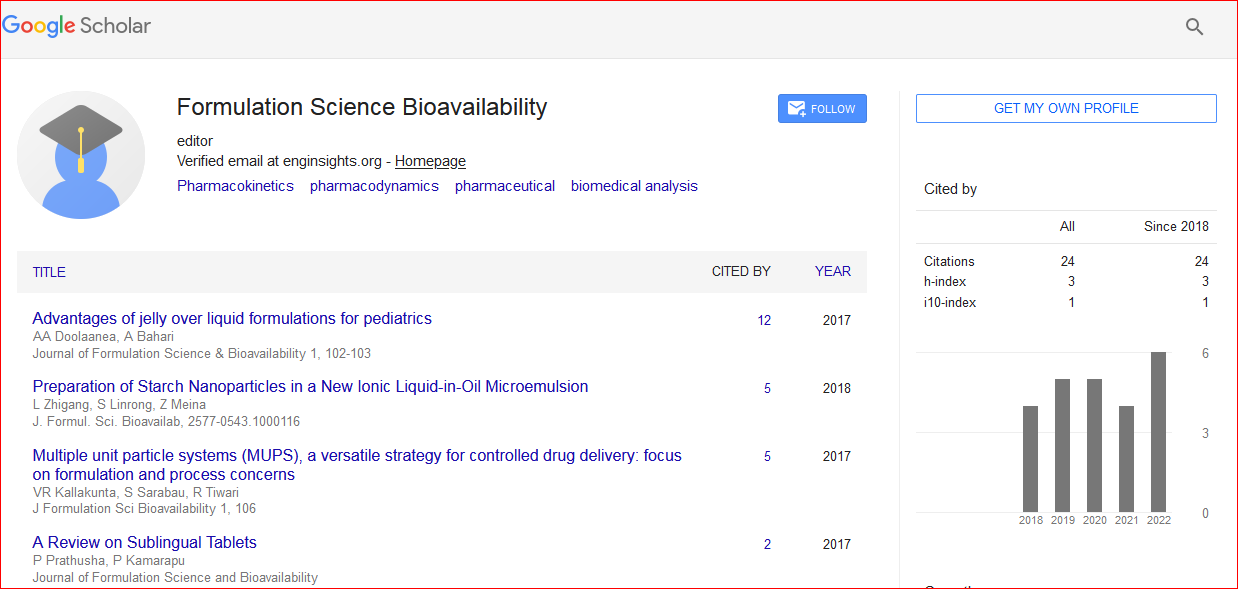
Journal of Formulation Science & Bioavailability received 23 citations as per Google Scholar report