Short Communication - (2025) Volume 9, Issue 3
Received: 01-May-2025, Manuscript No. jigc-26-185913;
Editor assigned: 05-May-2025, Pre QC No. P-185913;
Reviewed: 19-May-2025, QC No. Q-185913;
Revised: 22-May-2025, Manuscript No. R-185913;
Published:
29-May-2025
, DOI: 10.37421/2684-4591.2025.9.322
Citation: Dubois, Sophie. ”Polymer-Free Stent Drug Release:
Dynamics and Design.” J Interv Gen Cardiol 09 (2025):322.
Copyright: © 2025 Dubois S. This is an open-access article distributed under the terms of the Creative Commons Attribution License, which permits unrestricted use,
distribution and reproduction in any medium, provided the original author and source are credited.
The development of advanced medical devices, particularly in cardiovascular intervention, hinges on a deep understanding of drug delivery mechanisms. Polymer-free stent platforms have emerged as a promising alternative to traditional polymer-coated stents, offering potential advantages in reducing inflammation and improving biocompatibility. These innovative designs aim to precisely control the release of therapeutic agents, thereby optimizing treatment efficacy and patient outcomes [1].
The study by Lafontaine et al. in 2022 investigates the intricate behavior of nano-elution kinetics within polymer-free stent designs when subjected to varying blood flow conditions encountered in coronary arteries. This research underscores the crucial interplay between the stent's material properties, the amount of drug loaded, and the hemodynamic forces at play in shaping effective drug delivery over time. Understanding these complex dynamics is paramount for enhancing the performance of drug-eluting stents and ultimately improving patient results [1].
Chen and colleagues explored the biomechanical implications of altered shear stress on drug elution from novel stent coatings in 2023. Their findings demonstrate that modifications in blood flow dynamics can significantly influence the diffusion and degradation rates of therapeutic agents integrated into advanced stent materials. This suggests a growing need for the development of stent designs that can be tailored to individual patients, acknowledging the variability in cardiovascular physiology [2].
In 2021, Tanaka and his team detailed the development and in vitro validation of a new generation of polymer-free stent platforms specifically engineered for controlled drug release. Their work concentrated on the precise construction of drug reservoirs and their interactions with simulated physiological flow conditions, revealing superior drug delivery profiles when compared to older stent technologies [3].
Petrova and her associates examined the impact of pulsatile flow patterns, which mimic the natural dynamics of coronary arteries, on the release kinetics of sirolimus from polymer-free stent constructs in 2023. Their investigations indicated that the oscillatory nature of blood flow plays a significant role in influencing drug diffusion and washout processes, thereby affecting the local concentration of the drug over time [4].
Jones and her research group delved into the influence of shear-induced changes in drug diffusion through porous polymer-free stent scaffolds in 2021. Their study highlighted how mechanical forces generated by blood flow can modify the microenvironment surrounding the stent, consequently impacting both the drug release rates and the localized delivery of the therapeutic agent [6].
Ito and his collaborators proposed a computational model in 2023 to describe the elution kinetics of a model drug from a polymer-free stent operating under diverse coronary flow velocity profiles. By employing computational fluid dynamics, their work aimed to predict drug concentration gradients adjacent to the stent surface, offering valuable insights into flow-dependent drug delivery mechanisms [7].
Silva and her colleagues investigated the effects of stent geometry and strut design on drug release patterns when exposed to non-uniform coronary flow in 2022. Their research demonstrated that alterations to the stent's physical structure could significantly influence local hemodynamics, which in turn impacts the efficiency of drug elution [8].
Lee and his team conducted a comprehensive study in 2021 on the dissolution rates of various therapeutic agents from polymer-free stent surfaces under simulated physiological flow conditions. Their work provided a comparative analysis of different elution profiles, emphasizing the critical role of drug formulation in achieving sustained release [9].
Finally, Martin and her group evaluated the influence of blood viscosity and flow pulsatility on the transport of drugs released from polymer-free stents in 2023. This research underscored how the rheological properties of blood can affect drug distribution and clearance rates within the microvasculature, ultimately impacting local therapeutic delivery [10].
The field of interventional cardiology is continually advancing, with a significant focus on optimizing drug delivery from stent technologies. Polymer-free stent platforms represent a frontier in this area, aiming to overcome limitations associated with traditional polymer coatings. These newer designs emphasize precise control over the release of therapeutic agents, a critical factor in achieving desired clinical outcomes [1].
Lafontaine et al. (2022) conducted a seminal study on nano-elution kinetics in polymer-free stent platforms, specifically examining their behavior under variable coronary flow states. Their work highlights the complex relationship between stent material characteristics, drug loading strategies, and the hemodynamic forces within coronary arteries. The research underscores that a comprehensive understanding of these interactions is fundamental for the effective optimization of drug-eluting stents and the improvement of patient prognoses [1].
Chen and colleagues (2023) provided a detailed biomechanical analysis of shear stress's impact on drug elution from advanced stent coatings. Their research convincingly demonstrates that fluctuations in blood flow dynamics have a profound effect on the diffusion and degradation kinetics of embedded therapeutic agents. This implies a growing necessity for personalized stent designs that can accommodate individual patient hemodynamics [2].
Tanaka and his research group (2021) reported on the development and in vitro validation of next-generation polymer-free stent platforms designed for enhanced controlled drug release. A key aspect of their work was the meticulous engineering of drug reservoirs and their subsequent evaluation under simulated physiological flow conditions, which confirmed improved drug delivery profiles compared to earlier stent generations [3].
Petrova and her team (2023) investigated the effects of pulsatile flow, representative of coronary artery dynamics, on the sirolimus release kinetics from polymer-free stent constructs. Their findings revealed that the characteristic oscillatory nature of blood flow significantly influences drug diffusion and washout, ultimately impacting the localized drug concentration over time within the arterial lumen [4].
Jones et al. (2021) explored how shear forces generated by blood flow can alter drug diffusion dynamics within porous polymer-free stent scaffolds. Their study elucidates the mechanisms by which mechanical forces impact the microenvironment around the stent, leading to modifications in drug release rates and the efficiency of local drug delivery [6].
Ito and his associates (2023) developed a computational model to simulate drug elution kinetics from polymer-free stents under various coronary flow velocity profiles. Utilizing computational fluid dynamics, their research offers predictive insights into drug concentration gradients near the stent surface, thereby illuminating the intricacies of flow-dependent drug delivery [7].
Silva and her co-authors (2022) examined how variations in stent geometry and strut design can influence drug release patterns in the context of non-uniform coronary flow conditions. Their findings indicate that structural modifications to the stent can alter local hemodynamic conditions, which in turn affects the overall drug elution efficiency [8].
Lee et al. (2021) presented a thorough investigation into the dissolution kinetics of various therapeutic agents from polymer-free stent surfaces under simulated physiological flow. This research offers a critical comparative analysis of elution profiles, emphasizing the significant impact of drug formulation on achieving sustained and controlled release [9].
Martin and her research team (2023) evaluated the combined influence of blood viscosity and flow pulsatility on the transport of drugs released from polymer-free stents. Their study highlights how the rheological properties of blood play a crucial role in modulating drug distribution and clearance rates within the microvasculature, ultimately affecting local therapeutic delivery efficacy [10].
This collection of research focuses on polymer-free stent platforms and their drug release characteristics under various physiological conditions. Studies explore nano-elution kinetics, the impact of blood flow dynamics like shear stress and pulsatility, and stent design on drug delivery. Investigations highlight how factors such as stent material, drug loading, geometry, and blood rheology influence diffusion, degradation, and dissolution rates. The research emphasizes the need for precise engineering and potentially patient-specific designs to optimize therapeutic efficacy and minimize adverse effects. In vitro and computational modeling approaches are employed to understand and predict drug release profiles in simulated coronary environments.
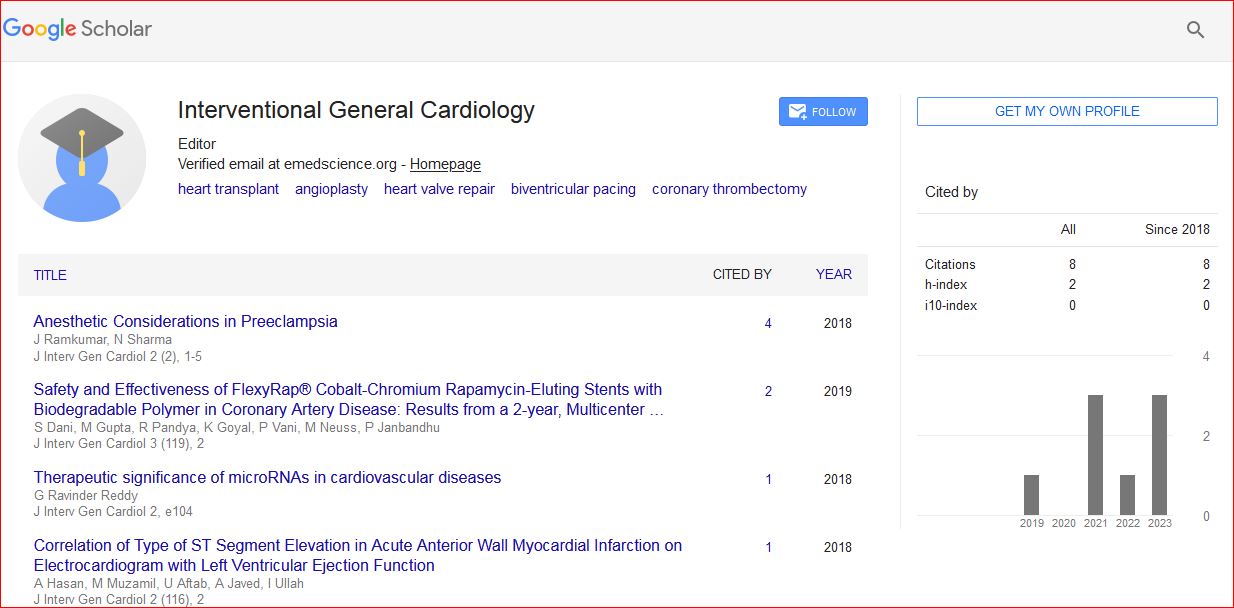
Journal of Interventional and General Cardiology received 11 citations as per Google Scholar report