Commentary - (2025) Volume 13, Issue 4
Received: 01-Aug-2025, Manuscript No. jaat-26-183164;
Editor assigned: 04-Aug-2025, Pre QC No. P-183164;
Reviewed: 18-Aug-2025, QC No. Q-183164;
Revised: 22-Aug-2025, Manuscript No. R-183164;
Published:
29-Aug-2025
, DOI: 10.37421/2329-6542.2025.13.363
Citation: Carter, Michael J.. ”Plasma Physics: From Sun To Stars.” J Astrophys Aerospace Technol 13 (2025):363.
Copyright: © 2025 Carter J. Michael This is an open-access article distributed under the terms of the Creative Commons Attribution License, which permits unrestricted use, distribution and reproduction in any medium, provided the original author and source are credited.
Plasma physics serves as a cornerstone for comprehending a vast array of intricate space and astrophysical phenomena. This fundamental state of matter, often termed the fourth state, plays a governing role in numerous celestial processes, from the outward flow of the solar wind and the complex dynamics of planetary magnetospheres to the fiery interiors of stars and the diffuse interstellar medium itself. Understanding these plasma behaviors is paramount for unraveling the mysteries of the cosmos. One area of profound interest is the mechanism of magnetic reconnection, a process by which magnetic field lines break and reconfigure, releasing vast amounts of energy and driving particle acceleration. This phenomenon is critical for understanding energetic particle events observed throughout space and the dynamic changes in Earth's magnetosphere. Wave propagation within these extreme environments is another area of intense study, as waves can transport energy and momentum, influencing the overall evolution of plasma structures and their observable characteristics. The interaction of these waves with particles is a key driver of many observed phenomena, including the acceleration of particles to very high energies. The solar wind, a continuous stream of charged particles emanating from the Sun, is a prime example of a plasma in constant motion. Its interaction with planetary magnetospheres, including Earth's, creates dynamic and often spectacular displays like the aurora, while also posing challenges for space technology and human exploration. Cosmic rays, high-energy particles originating from outside the solar system, are also deeply intertwined with astrophysical plasmas. Their transport and acceleration are significantly influenced by turbulence within the interstellar medium, impacting our understanding of galactic evolution and the life cycle of stars, particularly in supernova remnants. The heliosphere, the vast region of space dominated by the Sun's magnetic field and solar wind, is a laboratory for studying magnetized plasma. Turbulence within the solar wind dictates its expansion and interaction with planets, carrying crucial information about solar activity and its potential impact on space weather. Predicting space weather, which encompasses a range of solar and geomagnetic disturbances, is heavily reliant on understanding these plasma processes. Events like solar flares and coronal mass ejections can send energetic particles and magnetic disturbances towards Earth, with potential consequences for satellite operations, communication systems, and even power grids on the ground. The magnetospheres of giant planets, such as Jupiter and Saturn, are particularly active plasma environments. Here, intense magnetic fields trap and accelerate particles, leading to complex wave-particle interactions and micro-instabilities that shape their atmospheric chemistry and generate vibrant auroral displays. Beyond our solar system, the extreme conditions found in pulsar magnetospheres, regions dominated by incredibly strong magnetic fields and relativistic plasma, offer unique insights into particle acceleration and radiation generation. These processes are directly responsible for the observable emission from these rapidly rotating neutron stars. Furthermore, astrophysical jets, powerful outflows of plasma launched from the vicinity of black holes and young stars, are shaped and guided by plasma instabilities. Understanding these instabilities is key to comprehending the collimation and propagation of these jets, which play a significant role in galaxy evolution and star formation. Finally, the magnetohydrodynamics of accretion disks surrounding compact objects like black holes and neutron stars are central to understanding phenomena like X-ray binaries and quasars. These disks are rife with turbulence and magnetic field generation, processes driven by the complex behavior of magnetized plasma. This exploration into the fundamental role of plasma physics in understanding complex space and astrophysical phenomena underscores its pervasive influence across diverse cosmic environments. The research details how plasma, as the fourth state of matter, governs critical processes that shape the universe as we know it. From the outward flow of the solar wind and the dynamic interactions within planetary magnetospheres to the energetic cores of stellar interiors and the vast expanse of the interstellar medium, plasma is the unifying medium. Key insights have emerged regarding the mechanisms of magnetic reconnection, a pivotal process for energy release and particle acceleration, particularly relevant in solar flares and magnetospheric substorms. The study of particle acceleration in these extreme environments is crucial for understanding the origins and impacts of cosmic rays. Turbulence in astrophysical plasmas, as detailed in investigations of cosmic-ray transport, profoundly influences the motion and energy of these high-energy particles, affecting the observable properties of galaxies and supernova remnants. This understanding is vital not only for fundamental astrophysics but also for assessing radiation hazards in space. The dynamics of magnetized plasmas within the heliosphere, particularly solar wind turbulence, have significant consequences for planetary systems. Plasma waves and instabilities meticulously govern the solar wind's expansion from the Sun, influencing planetary magnetospheres and the propagation of energetic solar particles, thereby contributing to our ability to predict space weather. Magnetic reconnection, a fundamental plasma physics process, is actively examined in astrophysical contexts such as solar flares and magnetospheric substorms. The associated particle energization and plasma outflow contribute significantly to our comprehension of energetic particle events and the phenomenon of aurora, highlighting its broad implications. In planetary magnetospheres, especially those of gas giants, kinetic plasma processes are of paramount importance. Wave-particle interactions and micro-instabilities within these complex systems dictate particle energization and transport, directly impacting atmospheric chemistry and the generation of auroral displays, showcasing the intricate link between plasma dynamics and planetary environments. The physics of pulsar magnetospheres presents a unique domain characterized by extreme magnetic fields and relativistic plasma phenomena. Mechanisms for particle acceleration and radiation generation in these environments provide critical insights into the observable emissions from pulsars and the dynamics of their surrounding plasma, pushing the boundaries of our understanding of compact objects. Furthermore, plasma instabilities play a critical role in the formation and evolution of astrophysical jets, powerful outflows emanating from active galactic nuclei and young stellar objects. Understanding these instabilities is essential for explaining the collimation, propagation, and emission properties of these outflows, which in turn influence galaxy evolution and star formation rates. The magnetohydrodynamics of accretion disks around compact objects are a key area of research, involving intricate processes like turbulence and magnetic field generation. These plasma dynamics within accretion disks are fundamental to understanding phenomena observed in X-ray binaries and quasars, revealing the energetic processes powering some of the universe's most luminous objects. The properties of dusty plasmas in space, found in environments like cometary tails and planetary rings, are also actively investigated. The presence of dust grains significantly alters plasma behavior through charging, collective interactions, and wave phenomena, offering a more comprehensive view of these complex celestial settings. Finally, the interaction between the solar wind and Earth's magnetosphere is a subject of ongoing study, focusing on the dynamics of magnetospheric substorms and auroral phenomena. Understanding the transfer of energy and particles from the solar wind into Earth's magnetic shield is crucial for space weather forecasting and protecting our technological infrastructure. The collective body of research presented here underscores the unifying power of plasma physics in explaining a wide spectrum of astrophysical observations and phenomena, from the smallest scales of particle interactions to the grandest structures in the cosmos.
This article delves into the fundamental role of plasma physics in understanding complex space and astrophysical phenomena, detailing how the fourth state of matter governs processes in the solar wind, magnetospheres, stellar interiors, and the interstellar medium. It highlights key insights into magnetic reconnection, particle acceleration, and wave propagation in extreme environments and their impact on space weather and cosmic structure evolution [1].
The dynamics of cosmic rays and their interaction with astrophysical plasmas are investigated, emphasizing how interstellar plasma turbulence influences the transport and acceleration of energetic particles. This process is crucial for astrophysics and for predicting space radiation hazards [2].
Research on the dynamics of magnetized plasmas in the heliosphere focuses on solar wind turbulence and its consequences. It elucidates how plasma waves and instabilities govern the solar wind's evolution from the Sun, affecting planetary magnetospheres and solar energetic particle propagation, offering insights into space weather prediction [3].
Magnetic reconnection, a fundamental process in plasma physics, is examined in astrophysical contexts like solar flares and magnetospheric substorms. The article details particle energization and plasma outflow associated with reconnection, contributing to the understanding of energetic particle events and aurora [4].
The study investigates kinetic plasma processes in the magnetospheres of gas giants, such as Jupiter and Saturn. It highlights how wave-particle interactions and micro-instabilities dictate particle energization and transport within these complex systems, influencing atmospheric chemistry and aurorae [5].
This paper focuses on the physics of pulsar magnetospheres, where extreme magnetic fields and relativistic plasma phenomena are prevalent. It examines mechanisms for particle acceleration and radiation generation, providing critical insights into observable pulsar emission and surrounding plasma dynamics [6].
The research explores the role of plasma instabilities in the formation and evolution of astrophysical jets emanating from active galactic nuclei and young stellar objects. It details how plasma physics governs the collimation, propagation, and emission properties of these powerful outflows, impacting galaxy evolution and star formation [7].
This article discusses the application of plasma physics principles to understand the formation and behavior of accretion disks around compact objects like black holes and neutron stars. It covers magnetohydrodynamic processes, turbulence, and magnetic field generation within these disks, which are crucial for phenomena such as X-ray binaries and quasars [8].
The study examines the properties of dusty plasmas in space, such as in cometary tails and planetary rings. It explores how dust grains affect plasma behavior through charging, collective interactions, and wave phenomena, offering a more complete picture of these complex astrophysical environments [9].
Finally, this paper investigates the role of space plasma physics in understanding the interactions between the solar wind and Earth's magnetosphere. It focuses on the dynamics of magnetospheric substorms, auroral phenomena, and the transfer of energy and particles from the solar wind into Earth's protective magnetic shield [10].
This collection of research explores the pervasive influence of plasma physics across space and astrophysical phenomena. It details how plasma, the fourth state of matter, governs processes from solar wind dynamics and planetary magnetospheres to stellar interiors and the interstellar medium. Key areas of investigation include magnetic reconnection, particle acceleration, wave propagation, and plasma turbulence. Specific applications are examined in the context of cosmic rays, the heliosphere, pulsar magnetospheres, astrophysical jets, accretion disks, and dusty plasmas. The research highlights the importance of understanding these plasma behaviors for predicting space weather, assessing radiation hazards, and comprehending the evolution of cosmic structures and phenomena like auroras and energetic particle events.
None
None
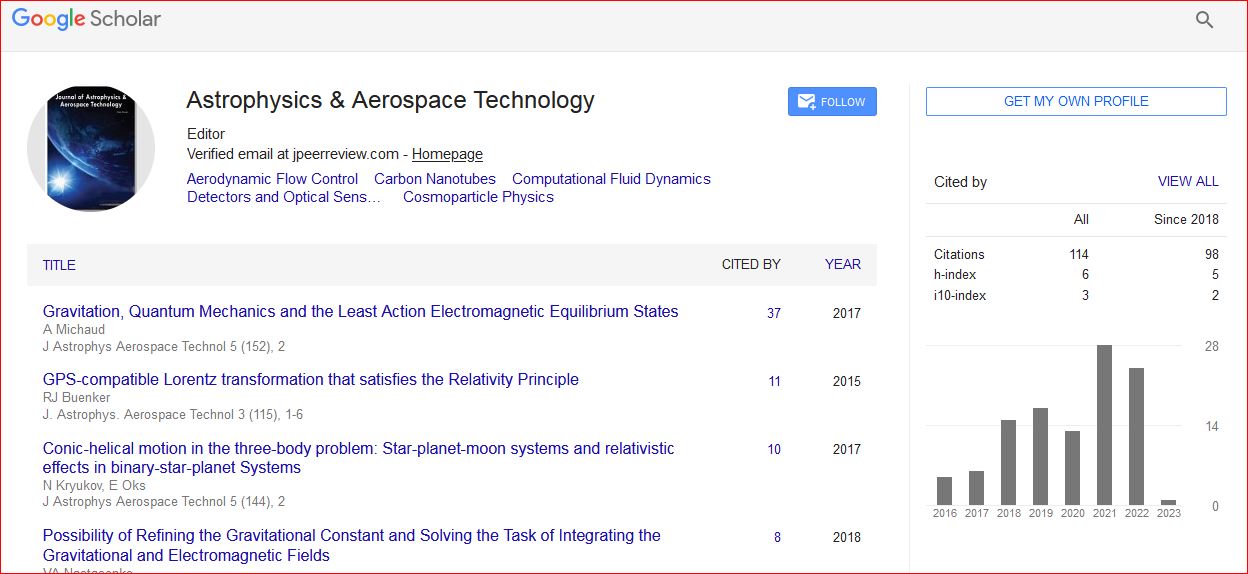
Astrophysics & Aerospace Technology received 114 citations as per Google Scholar report