Opinion - (2025) Volume 9, Issue 5
Received: 02-Oct-2025, Manuscript No. jgge-25-174646;
Editor assigned: 06-Oct-2025, Pre QC No. P-174646;
Reviewed: 20-Oct-2025, QC No. Q-174646;
Revised: 23-Oct-2025, Manuscript No. R-174646;
Published:
30-Oct-2025
, DOI: 10.37421/2684-4567.2025.9.193
Citation: Kibet, Jelani M.. ”Pharmacogenomics: Personalizing Drug Therapy, Facing Challenges.” J Genet Genom 09 (2025):193.
Copyright: © 2025 Kibet M. Jelani This is an open-access article distributed under the terms of the Creative Commons Attribution License, which permits unrestricted use,
distribution and reproduction in any medium, provided the original author and source are credited.
This paper gives us a broad overview of how pharmacogenomics is actively used in hospitals and clinics globally. It highlights common clinical pharmacogenomic guidelines and discusses how different regions handle implementation and education. Essentially, this work shows the current global standing of personalized drug therapy based on genetics, providing a foundational understanding of the field[1].
This paper thoroughly investigates the challenges faced when integrating pharmacogenomics into everyday clinical care. It addresses issues such as complex data interpretation, gaining clinician acceptance, and ensuring information is readily usable at the point of care. Concurrently, it identifies significant opportunities, charting a clear path forward for achieving truly personalized medicine, acknowledging both obstacles and potential[2].
This article questions the widespread readiness of pharmacogenomics in treating heart conditions. It reviews the existing evidence for genetic testing guiding therapies for drugs like antiplatelet agents and statins. While acknowledging promising aspects, it emphasizes the ongoing need for more robust clinical trials and clearer guidelines to solidify its place as a standard practice in cardiovascular medicine[3].
This article details how pharmacogenomics is profoundly transforming cancer treatment. It outlines current applications, including predicting patient responses to chemotherapy and targeted therapies based on genetic markers, which significantly minimizes side effects and improves outcomes. The paper also projects the future trajectory of oncology pharmacogenomics, anticipating even more personalized strategies on the horizon for enhanced cancer care[4].
This article makes a strong case for better education in pharmacogenomics as an absolute necessity for its widespread adoption in patient care. It underscores the critical need for healthcare professionals to comprehend genetic testing results and their direct application to prescribing decisions. Fundamentally, it advocates for integrating pharmacogenomics into medical school curricula and ongoing education programs to build a competent workforce[5].
This article explores the significant impact pharmacogenomics can have on prescribing psychiatric medications. It explains how genetic information can predict patient responses to antidepressants and antipsychotics, potentially leading to fewer side effects and more effective treatments. The paper outlines current evidence and the practical steps required to incorporate this personalized approach into routine psychiatric care practices[6].
This article delves into the evolving role of pharmacogenomics in pain management. It specifically examines how genetic variations influence a patient's response to opioid and non-opioid pain medications, enabling clinicians to make more informed decisions. The goal is to enhance pain relief and reduce adverse drug reactions by precisely tailoring pain treatment to an individual's unique genetic makeup[7].
This article focuses on how genetic differences impact individual responses to drugs used for infectious diseases, particularly HIV and Hepatitis C. It clarifies how understanding a patient's genetic profile is crucial for optimizing antiviral therapies, effectively minimizing side effects, and improving treatment success rates for these complex conditions, moving towards more targeted infectious disease management[8].
This paper provides a systematic review of how pharmacogenomics is currently integrated into major clinical practice guidelines, with a specific focus on drug dosing recommendations. It evaluates the extent to which genetic information is used to personalize drug dosages, highlighting both progress and areas where more consistent guidelines are essential to improve patient safety and therapeutic efficacy[9].
This paper offers a forward-looking perspective on the evolution of pharmacogenomics beyond single-gene testing. It explores the considerable potential of utilizing comprehensive genomic data, such as whole-exome or whole-genome sequencing, to predict drug responses more accurately and broadly. This vision emphasizes leveraging richer genetic information for achieving more profound and truly personalized medicine in the future[10].
Pharmacogenomics stands as a pivotal advancement in modern healthcare, delivering a global perspective on how individual genetic makeup influences drug therapy in diverse clinical environments [1]. This innovative approach integrates genetic information directly into medication selection processes, aiming to maximize treatment effectiveness while concurrently minimizing the risk of adverse drug reactions. Despite its immense promise, the widespread integration of pharmacogenomics into routine clinical practice is not without its hurdles [2]. Key challenges include the intricate task of interpreting complex genetic data, ensuring broad acceptance and engagement from healthcare providers, and crucially, making sure genetic insights are both easily accessible and actionable at the moment of patient care. Nevertheless, overcoming these identified obstacles unlocks significant opportunities for developing and implementing truly personalized and patient-centered treatment strategies, marking a transformative shift in therapeutic approaches.
The practical utility of pharmacogenomics is evident across a spectrum of critical medical disciplines. In the realm of cardiovascular disease, it offers compelling insights for customizing therapies, particularly for patients requiring antiplatelet drugs and statins. While promising, the field still anticipates further robust research and clearer, more consistent guidelines for its routine integration [3]. Oncology, in particular, has seen a profound transformation; genetic markers are now routinely used to predict patient responses to chemotherapy and targeted therapies, a practice that not only minimizes debilitating side effects but also significantly enhances overall treatment outcomes [4]. Similarly, in psychiatric care, pharmacogenomics provides valuable predictions for how patients will respond to antidepressants and antipsychotics, paving the way for more effective and individualized mental health interventions [6]. Pain management also significantly benefits from this approach, as understanding genetic variations can inform prescribing decisions for both opioid and non-opioid medications, optimizing pain relief while mitigating risks [7]. Beyond these areas, for complex infectious diseases such as HIV and Hepatitis C, leveraging genetic profiles helps to fine-tune antiviral therapies, ultimately leading to improved success rates and a reduction in undesirable drug reactions [8].
The successful and ethical implementation of pharmacogenomics is inextricably linked to the development of robust clinical guidelines and sustained educational initiatives. A comprehensive systematic review confirms that pharmacogenomics is progressively being integrated into major clinical practice guidelines, particularly in areas concerning precise drug dosing recommendations [9]. This review not only showcases the strides made in utilizing genetic information to personalize drug dosages but also underscores the persistent need for more uniform and comprehensive guidelines to further bolster patient safety and therapeutic efficacy across a wider range of treatments. Crucially, enhancing education in pharmacogenomics for all healthcare professionals is identified as an absolute imperative for its widespread and effective adoption [5]. This educational imperative encompasses ensuring that practitioners deeply understand genetic testing results and possess the skills to directly apply this knowledge to informed prescribing decisions. It strongly advocates for the integration of pharmacogenomics into core medical curricula and into continuous professional development programs to cultivate a highly competent and adaptable healthcare workforce.
Peering into the future, the field of pharmacogenomics is poised for an exciting evolution, moving decisively beyond the limitations of single-gene testing [10]. There is immense potential in harnessing comprehensive genomic data, including advanced techniques like whole-exome or whole-genome sequencing, to achieve drug response predictions that are both far more accurate and broadly applicable. This forward-thinking paradigm promises to leverage a richer tapestry of genetic information, thereby paving the way for even more profound and truly individualized precision medicine. As scientific understanding deepens and technological capabilities advance, pharmacogenomics is perfectly positioned to offer increasingly bespoke and highly effective drug therapies, fundamentally transforming how patient care is delivered and experienced.
Pharmacogenomics is increasingly vital in modern healthcare, enabling personalized drug therapy worldwide. This approach integrates genetic information to optimize medication choices, minimize adverse reactions, and enhance treatment efficacy across diverse medical fields. We see its application in cardiovascular disease, helping tailor therapies for conditions requiring antiplatelet drugs and statins. In oncology, pharmacogenomics guides chemotherapy and targeted therapies by predicting patient response and reducing side effects. For psychiatric conditions, genetic insights inform the prescription of antidepressants and antipsychotics, aiming for better outcomes. It also plays a role in pain management, where genetic variations influence responses to opioid and non-opioid medications. The data underscores its utility in infectious diseases, particularly for optimizing antiviral treatments for HIV and Hepatitis C. Despite these advancements, significant hurdles remain, including challenges in data interpretation, clinical integration, and the need for robust educational programs for healthcare professionals. Efforts are underway to standardize pharmacogenomics-guided dosing recommendations within clinical guidelines to ensure patient safety and effectiveness. Looking ahead, the field is moving beyond single-gene tests, exploring comprehensive genomic data like whole-exome or whole-genome sequencing to unlock even deeper levels of personalized medicine, promising a future where drug therapy is even more precisely aligned with individual genetic profiles.
None
None
Kelly EC, Kristin S, Michelle W. "Pharmacogenomics in clinical practice: a global perspective".Pharmacogenomics 25 (2024):115-128.
Indexed at, Google Scholar, Crossref
Mary VR, Michelle W, Teri EK. "Clinical Pharmacogenomics: Challenges and Opportunities for Implementation".Clin Pharmacol Ther 111 (2022):379-389.
Indexed at, Google Scholar, Crossref
Julie AJ, Kristen LT, Nita AL. "Pharmacogenomics in Cardiovascular Disease: Ready for Prime Time?".Circ Genom Precis Med 14 (2021):e003185.
Indexed at, Google Scholar, Crossref
Urs A, Carlo RL, Markus J. "Pharmacogenomics in Oncology: Current Applications and Future Directions".Pharmacogenomics 21 (2020):1007-1025.
Indexed at, Google Scholar, Crossref
Kenneth WW, Michelle W, Mia RM. "Education in Pharmacogenomics: A Call to Action for Clinical Implementation".Clin Pharmacol Ther 114 (2023):504-508.
Indexed at, Google Scholar, Crossref
Joanna MB, Larisa HC, Todd EJ. "Pharmacogenomics of Psychiatric Drugs: Clinical Utility and Implementation".Mol Psychiatry 27 (2022):1993-2007.
Indexed at, Google Scholar, Crossref
Dustin MS, David RS, Jason RS. "Clinical Pharmacogenomics in Pain Management".Pain Physician 24 (2021):49-62.
Indexed at, Google Scholar, Crossref
Antonella N, Michele DF, Massimo P. "Pharmacogenomics of anti-infective agents: a focus on HIV and hepatitis C".Pharmacogenomics 24 (2023):107-124.
Indexed at, Google Scholar, Crossref
Jesse JS, Michelle W, Kelly EC. "Pharmacogenomics-Guided Dosing Recommendations in Major Clinical Guidelines: A Systematic Review".Clin Pharmacol Ther 115 (2024):569-580.
Indexed at, Google Scholar, Crossref
David BG, Michelle W, Teri EK. "The Future of Pharmacogenomics: Moving Beyond Single-Gene Tests".N Engl J Med 380 (2019):1163-1171.
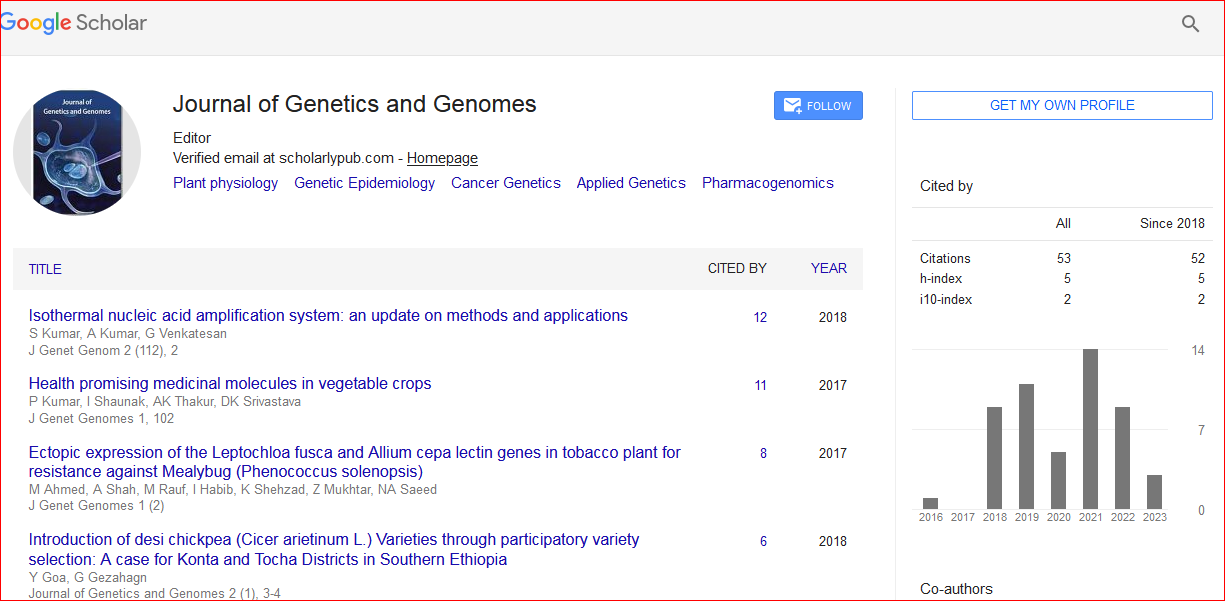
Journal of Genetics and Genomes received 65 citations as per Google Scholar report