Perspective - (2025) Volume 12, Issue 3
Received: 01-Jun-2025, Manuscript No. jreac-26-185788;
Editor assigned: 03-Jun-2025, Pre QC No. P-185788;
Reviewed: 17-Jun-2025, QC No. Q-185788;
Revised: 23-Jun-2025, Manuscript No. R-185788;
Published:
30-Jun-2025
, DOI: 10.37421/2380-2391.2025.12.430
Citation: Johnson, Samuel. ”Pharmaceutical Contamination in Wastewater: A Research Review.” J Environ Anal Chem 12 (2025):430.
Copyright: © 2025 Johnson S. This is an open-access article distributed under the terms of the Creative Commons Attribution License, which permits unrestricted use, distribution and reproduction in any medium, provided the original author and source are credited.
The pervasive presence of pharmaceuticals in aquatic ecosystems has emerged as a significant environmental concern, necessitating a comprehensive understanding of their occurrence, removal, and potential ecological impact. Studies have extensively documented the discharge of a wide array of pharmaceuticals, including antibiotics, antidepressants, and analgesics, into wastewater influent and effluent across numerous treatment facilities. Advanced analytical techniques, such as liquid chromatography-mass spectrometry (LC-MS/MS), are crucial for their sensitive detection and quantitation, revealing that conventional wastewater treatment processes often fall short in their complete removal, leading to their continuous release into receiving waters [1].
Monitoring these pharmaceutical residues in complex matrices like wastewater presents considerable analytical challenges. Traditional methods often exhibit limitations in sensitivity and selectivity, underscoring the growing importance of hyphenated techniques. The rigorous validation of analytical methods and robust quality assurance protocols are paramount to ensure the reliability of data, which is essential for environmental risk assessments and the establishment of regulatory frameworks. The development of novel detection platforms and standardized monitoring protocols across different laboratories remains an active area of research [2].
Advanced oxidation processes (AOPs) have shown promise as tertiary treatment strategies for the removal of recalcitrant pharmaceutical compounds that are poorly degraded by conventional biological treatments. Ozone-based AOPs, in particular, have demonstrated effectiveness in degrading a range of common pharmaceuticals. Quantifying degradation rates and identifying potential transformation products, along with their environmental implications, are critical aspects of assessing the efficacy of AOPs in achieving higher effluent quality and mitigating the environmental burden of pharmaceuticals [3].
Activated carbon adsorption has been investigated as a viable method for reducing the concentration of various pharmaceutical residues in wastewater. The effectiveness of different types of activated carbon and the influence of operational parameters, such as contact time and initial concentration, have been evaluated. While activated carbon can significantly reduce pharmaceutical levels, the extent of removal varies considerably depending on the specific compound and the adsorbent's properties, highlighting the need for optimized adsorption-based treatment systems [4].
The occurrence and potential ecological impact of antibiotics in wastewater treatment plant effluents warrant particular attention. Frequently detected antibiotics, when assessed against predicted no-effect concentrations (PNECs) for aquatic organisms, reveal a significant environmental risk. The presence of sub-inhibitory concentrations of antibiotics in the environment raises concerns about the development and spread of antimicrobial resistance (AMR), underscoring the necessity of monitoring these residues to protect aquatic ecosystems and public health [5].
Membrane bioreactors (MBRs) have demonstrated superior performance in removing a broad spectrum of pharmaceutical compounds from municipal wastewater compared to conventional activated sludge processes. MBRs exhibit significantly higher removal efficiencies for many pharmaceuticals, with their effectiveness influenced by membrane characteristics and operational parameters. This evidence supports the suitability of MBR technology as an advanced treatment option for reducing pharmaceutical pollution in wastewater [6].
The fate and removal of analgesics and anti-inflammatory drugs in municipal wastewater treatment plants are critical for understanding their environmental exposure. While biological processes contribute to some removal, a substantial fraction of these widely used pharmaceuticals can persist and be discharged into the environment. Investigating their removal pathways and potential for transformation during treatment is vital for assessing their environmental implications [7].
UV-based disinfection plays a complex role in the transformation and removal of pharmaceuticals in wastewater. While UV irradiation can degrade certain drug compounds, it may also lead to the formation of more persistent or toxic byproducts. Quantifying removal rates and analyzing the formation of transformation products are essential for understanding the multifaceted effects of UV disinfection on pharmaceutical residues and their subsequent environmental consequences [8].
Endocrine-disrupting pharmaceuticals (EDPs) represent a specific class of compounds that pose a considerable environmental risk. Studies focusing on their occurrence, removal efficiency during treatment, and potential ecological impact have identified key EDPs and highlighted their ability to escape conventional treatment. This underscores the need for targeted treatment strategies to effectively remove these compounds and mitigate their risks to aquatic life [9].
Understanding the sources, pathways, and environmental fate of pharmaceutical residues in wastewater is crucial for effective pollution control. Contributions from domestic wastewater, hospital effluent, and pharmaceutical manufacturing all add to the overall load of these contaminants. The complex degradation and transformation processes within treatment plants and the environment, coupled with challenges in monitoring and regulation, call for integrated approaches to manage pharmaceutical pollution [10].
The investigation into the presence and distribution of pharmaceuticals in wastewater influent and effluent highlights the persistent challenge of their removal by conventional treatment plants. Key compounds such as antibiotics, antidepressants, and analgesics are frequently detected, with their incomplete removal leading to discharge into aquatic environments. The reliance on advanced analytical methods, like LC-MS/MS, is essential for accurate identification and quantification, providing critical data on the efficacy of existing treatment processes and the need for enhanced strategies to mitigate environmental risks associated with these emerging contaminants [1].
The analytical methodologies employed for monitoring pharmaceutical residues in wastewater are continuously evolving to meet the demands of sensitivity and selectivity. Traditional methods face inherent limitations, driving the adoption of hyphenated techniques and emphasizing the critical role of method validation and quality assurance in generating reliable data for risk assessments and regulatory compliance. The pursuit of novel detection platforms and standardized protocols aims to improve consistency and comparability of monitoring efforts across different laboratories [2].
Advanced oxidation processes (AOPs) represent a significant advancement in wastewater treatment, particularly for recalcitrant pharmaceutical compounds that elude conventional biological degradation. Ozone-based AOPs have demonstrated a notable capacity to degrade a wide array of pharmaceuticals. Research in this area focuses on quantifying degradation kinetics, identifying transformation products, and assessing their environmental safety, thereby providing essential data for developing advanced tertiary treatment systems to reduce pharmaceutical pollution loads [3].
The application of activated carbon adsorption as a tertiary treatment option for pharmaceutical removal from wastewater is a subject of ongoing research. Studies evaluating different types of activated carbon and the impact of operational parameters reveal its potential efficacy, though performance varies significantly based on the specific pharmaceutical compound and adsorbent characteristics. This information is invaluable for optimizing the design and operation of adsorption-based systems for pharmaceutical containment [4].
The ecological risks posed by antibiotics present in wastewater treatment plant effluents are a focal point of concern. The identification of prevalent antibiotics and their concentration relative to predicted no-effect concentrations (PNECs) for aquatic organisms underscores the potential for detrimental impacts. A significant implication is the exacerbation of antimicrobial resistance (AMR) due to the environmental release of antibiotics, highlighting the imperative for vigilant monitoring to protect both aquatic ecosystems and public health [5].
Membrane bioreactors (MBRs) have emerged as a highly effective technology for the removal of a diverse range of pharmaceutical compounds from municipal wastewater. Comparative studies consistently show MBRs outperforming conventional activated sludge processes in achieving higher removal efficiencies for many pharmaceuticals. The influence of membrane properties and operating conditions on this removal efficacy is a key area of investigation, solidifying the role of MBRs as an advanced treatment solution for pharmaceutical pollution reduction [6].
The investigation into the fate and removal of analgesics and anti-inflammatory drugs within municipal wastewater treatment plants provides critical insights into their environmental persistence. While biological treatment contributes to their reduction, a considerable portion of these widely consumed pharmaceuticals can survive and enter the environment. Understanding their transformation pathways during treatment is essential for a comprehensive assessment of their environmental exposure and impact [7].
The interaction of UV-based disinfection with pharmaceutical residues in wastewater is a complex phenomenon. UV irradiation can effectively degrade certain pharmaceutical compounds, but it also carries the potential to generate more persistent or toxic byproducts. Research in this domain aims to quantify removal rates and characterize transformation products to elucidate the intricate effects of UV disinfection on pharmaceutical contaminants and their environmental implications [8].
Endocrine-disrupting pharmaceuticals (EDPs) are a class of particular concern due to their potential to interfere with hormonal systems in aquatic organisms. Studies examining the occurrence, removal efficiency, and ecological risks associated with EDPs in wastewater treatment plants reveal their capacity to evade conventional treatment. This necessitates the development and implementation of specialized treatment strategies to ensure their effective removal and safeguard aquatic environments from their adverse effects [9].
A holistic perspective on pharmaceutical residues in wastewater encompasses their diverse sources, transport pathways, and ultimate environmental fate. The combined contributions from domestic wastewater, hospital effluents, and pharmaceutical manufacturing sites create a complex pollution landscape. Addressing this challenge requires integrated management approaches that consider the intricate degradation processes in treatment plants and natural environments, alongside the inherent difficulties in monitoring and regulating these emerging contaminants [10].
This collection of research explores the critical issue of pharmaceutical contamination in wastewater. Studies highlight that conventional treatment processes are insufficient for the complete removal of many pharmaceuticals, leading to their discharge into aquatic environments. Advanced analytical techniques are essential for monitoring these contaminants, with ongoing research focusing on improving their sensitivity and selectivity. Advanced oxidation processes, activated carbon adsorption, and membrane bioreactors (MBRs) are identified as promising tertiary treatment methods for enhanced pharmaceutical removal. Specific concerns are raised regarding the ecological risks of antibiotics and endocrine-disrupting pharmaceuticals, as well as the transformation products formed during UV disinfection. Understanding the sources, fate, and removal pathways of pharmaceuticals is crucial for developing effective pollution control strategies.
None
None
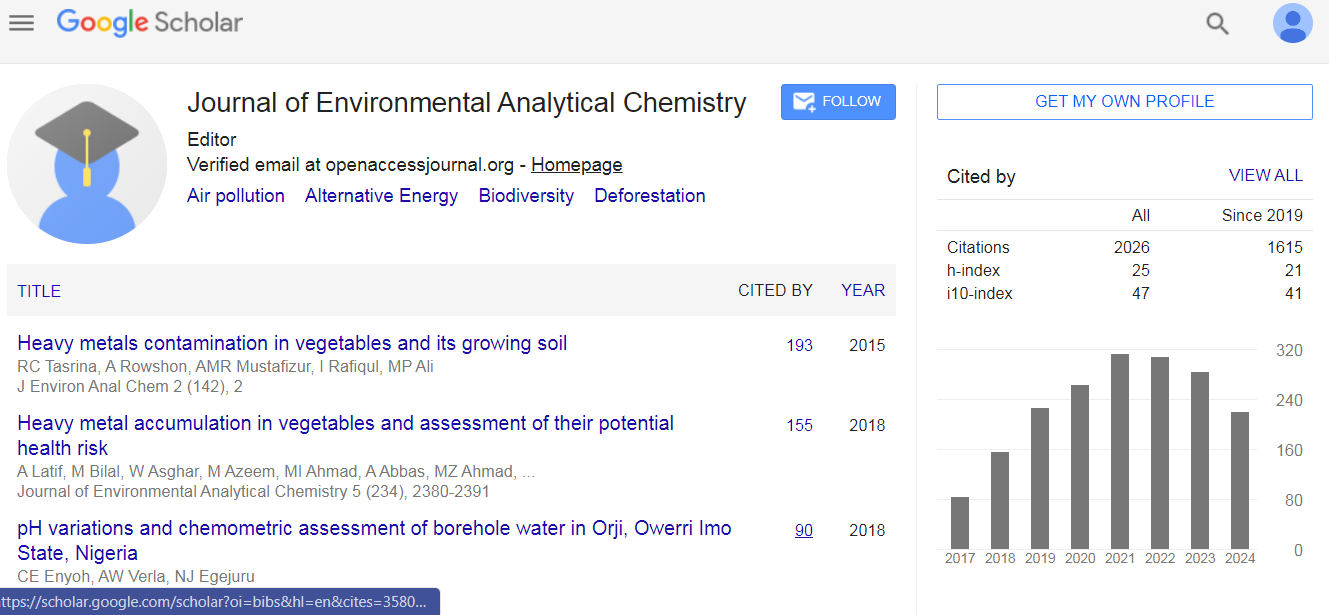
Journal of Environmental Analytical Chemistry received 1781 citations as per Google Scholar report