Commentary - (2025) Volume 13, Issue 3
Received: 01-Jun-2025, Manuscript No. JCMG-26-185536;
Editor assigned: 03-Jun-2025, Pre QC No. P-185536;
Reviewed: 17-Jun-2025, QC No. Q-185536;
Revised: 23-Jun-2025, Manuscript No. R-185536;
Published:
30-Jun-2025
, DOI: 10.37421/2472-128X.2025.13.339
Citation: Nandakumar, Priya. ”Personalized Medicine: A New Era of Healthcare.” J Clin Med Genomics 13 (2025):339.
Copyright: © 2025 Nandakumar P. This is an open-access article distributed under the terms of the Creative Commons Attribution License, which permits unrestricted use, distribution and reproduction in any medium, provided the original author and source are credited.
Personalized medicine represents a paradigm shift in healthcare, moving away from a one-size-fits-all approach to one that tailors medical decisions and practices to the individual patient. This bespoke approach leverages an individual's unique genetic makeup, environmental factors, and lifestyle choices to achieve more precise diagnoses, targeted therapies, and improved preventative strategies. For instance, at the Department of Clinical & Medical Genomics at the Indian Center for Genomic Medicine, the focus is on integrating genomic data into routine clinical workflows to identify genetic predispositions to diseases and to predict individual responses to specific treatments, thereby optimizing patient outcomes and minimizing adverse drug reactions. [1] The integration of pharmacogenomics is a cornerstone of this personalized medicine revolution. By understanding how an individual's genetic variations influence their response to drugs, clinicians can select the most effective medications and appropriate dosages, significantly reducing the risk of adverse drug events and improving therapeutic efficacy. This necessitates the development and utilization of robust databases and clinical decision support systems capable of translating complex genomic information into actionable insights for healthcare providers. [2] Advancements in whole-genome sequencing (WGS) and whole-exome sequencing (WES) have made comprehensive genomic analysis increasingly accessible. These technologies provide an in-depth view of a patient's genetic landscape, enabling the identification of predispositions to a wide range of diseases. Furthermore, they can inform diagnostic pathways for rare genetic disorders and guide treatment strategies, particularly in oncology where tumor genomics plays a critical role in therapy selection. [3] However, the proliferation of personalized medicine is accompanied by substantial ethical considerations. Issues such as data privacy, the potential for genetic discrimination in employment and insurance, and ensuring equitable access to advanced genomic testing and therapies require careful navigation. Establishing clear guidelines and robust regulatory frameworks is paramount to ensure that the benefits of personalized medicine are realized responsibly and ethically. [4] Implementing personalized medicine effectively requires significant advancements in bioinformatics and data analytics. The vast quantities of genomic and clinical data generated necessitate sophisticated computational tools for storage, processing, interpretation, and integration with electronic health records. This infrastructure is vital for identifying meaningful patterns and supporting evidence-based clinical decision-making. [5] Precision oncology, a prominent application of personalized medicine, exemplifies the power of genomic profiling. By leveraging the genomic profile of tumors, oncologists can guide the selection of targeted therapies. Identifying specific molecular alterations driving cancer growth allows for the choice of treatments that are more likely to be effective and less toxic than traditional chemotherapy, ultimately leading to improved patient survival and quality of life. [6] The role of germline genetic testing in risk assessment and prevention is also expanding within the personalized medicine framework. Identifying individuals with inherited predispositions to conditions such as hereditary cancers or cardiovascular diseases enables proactive surveillance, lifestyle modifications, and targeted preventative interventions, thereby significantly mitigating disease risk. [7] The development and refinement of robust clinical decision support systems (CDSS) are critical for the widespread adoption of personalized medicine. These systems are designed to integrate patient-specific genomic data with clinical guidelines, evidence-based literature, and drug information databases. This integration provides real-time recommendations to clinicians, ensuring that personalized approaches are implemented safely and effectively. [8] The evolution of diagnostic technologies, including next-generation sequencing (NGS) and liquid biopsies, is accelerating the implementation of personalized medicine. These technologies facilitate rapid and cost-effective genomic analysis of both germline and somatic DNA, providing essential information for diagnosis, prognosis, and treatment selection across various diseases, especially in the field of oncology. [9] Finally, a critical step for the successful integration of personalized medicine into clinical practice is the training of healthcare professionals in genomic literacy and the application of these new approaches. A workforce equipped with the knowledge and skills to interpret genomic data and apply it to patient care is essential for realizing the full potential of this transformative medical approach. [10]
Personalized medicine is fundamentally reshaping clinical practice by tailoring healthcare decisions and practices to individual patients based on their unique genetic makeup, environment, and lifestyle. This innovative approach moves beyond a generalized, one-size-fits-all model, enabling more precise diagnoses, targeted therapies, and improved preventative strategies. In the Department of Clinical & Medical Genomics at the Indian Center for Genomic Medicine, Bangalore, India, the primary focus is on integrating genomic data into routine clinical workflows. This integration aims to identify genetic predispositions to diseases and to predict individual responses to specific treatments, thereby optimizing patient outcomes and minimizing adverse drug reactions. [1] The integration of pharmacogenomics into clinical practice is a cornerstone of personalized medicine. By thoroughly understanding how an individual's genetic variations influence their response to various drugs, clinicians can more effectively select the most efficacious medications and appropriate dosages. This precision in drug selection is crucial for reducing the risk of adverse drug events and improving overall therapeutic efficacy. Such a sophisticated approach necessitates the development and implementation of robust databases and advanced clinical decision support systems to effectively translate complex genomic information into actionable insights for healthcare providers. [2] Whole-genome sequencing (WGS) and whole-exome sequencing (WES) represent increasingly accessible technologies that provide a comprehensive and detailed view of an individual's genetic landscape. This deep dive into a patient's genome has the profound capability to uncover predispositions to a wide range of diseases. Furthermore, it can significantly inform diagnostic pathways for rare genetic disorders and guide treatment strategies, particularly in the complex field of oncology where tumor genomics plays a critical role in therapy selection. [3] The ethical considerations that surround the advancement and implementation of personalized medicine are substantial and multifaceted. Key issues include ensuring data privacy, preventing genetic discrimination in areas such as employment and insurance, and guaranteeing equitable access to advanced genomic testing and therapies. Careful navigation and thoughtful consideration of these issues are essential. Establishing clear guidelines and robust regulatory frameworks is paramount to ensure that the profound benefits of personalized medicine are realized in a manner that is both responsible and ethically sound. [4] The successful implementation of personalized medicine hinges on significant advancements in bioinformatics and data analytics. The sheer volume of genomic and clinical data that is being generated necessitates the development and deployment of sophisticated computational tools for efficient storage, processing, interpretation, and seamless integration with electronic health records. This technological infrastructure is vital for identifying meaningful patterns within the data and supporting evidence-based clinical decision-making processes. [5] Precision oncology, recognized as a leading example of personalized medicine in action, leverages the comprehensive genomic profiling of tumors to guide the selection of targeted therapies. By accurately identifying specific molecular alterations that are driving cancer growth, oncologists can select treatments that are demonstrably more likely to be effective and possess a lower toxicity profile compared to traditional chemotherapy. This targeted approach leads to improved patient survival rates and enhanced quality of life. [6] The role of germline genetic testing in the assessment and prevention of disease risk is continuously expanding within the evolving landscape of personalized medicine. Identifying individuals who carry inherited predispositions to specific conditions, such as hereditary cancers or cardiovascular diseases, allows for the implementation of proactive surveillance protocols, necessary lifestyle modifications, and the application of targeted preventative interventions, thereby significantly mitigating the risk of developing these diseases. [7] The development of robust and user-friendly clinical decision support systems (CDSS) is absolutely critical for the widespread adoption and successful integration of personalized medicine into everyday clinical practice. These advanced systems are designed to integrate a patient's specific genomic data with established clinical guidelines, the latest evidence-based literature, and comprehensive drug information databases. This integration provides real-time, actionable recommendations to clinicians, ensuring that personalized treatment approaches are implemented safely and effectively. [8] The ongoing evolution of diagnostic technologies, such as next-generation sequencing (NGS) and the emerging field of liquid biopsies, is significantly accelerating the practical implementation of personalized medicine. These cutting-edge technologies allow for rapid and increasingly cost-effective genomic analysis of both germline and somatic DNA. This detailed genomic information is essential for accurate diagnosis, prognosis, and informed treatment selection across a broad spectrum of diseases, with a particular impact in the field of oncology. [9] Finally, a critical and often overlooked step for the successful and widespread integration of personalized medicine into clinical practice involves the comprehensive training of healthcare professionals. This training must encompass genomic literacy and the practical application of personalized medicine principles. A workforce that is proficient in interpreting genomic data and effectively applying it to patient care is absolutely essential for realizing the full transformative potential of this revolutionary approach to medicine. [10]
Personalized medicine revolutionizes healthcare by tailoring treatments to individual genetic, environmental, and lifestyle factors, moving beyond generalized approaches. This involves precise diagnostics, targeted therapies, and proactive prevention. Key to this shift are pharmacogenomics for optimizing drug selection and reducing adverse events, and advanced sequencing technologies like WGS and WES for identifying disease predispositions and guiding treatment, especially in oncology. However, ethical challenges related to data privacy and equitable access must be addressed. Successful implementation relies on sophisticated bioinformatics, data analytics, and clinical decision support systems to interpret vast genomic data. Precision oncology utilizes tumor profiling for targeted therapies, while germline genetic testing aids in risk assessment and prevention. Training healthcare professionals in genomic literacy is crucial for realizing the full potential of this transformative medical field.
None
None
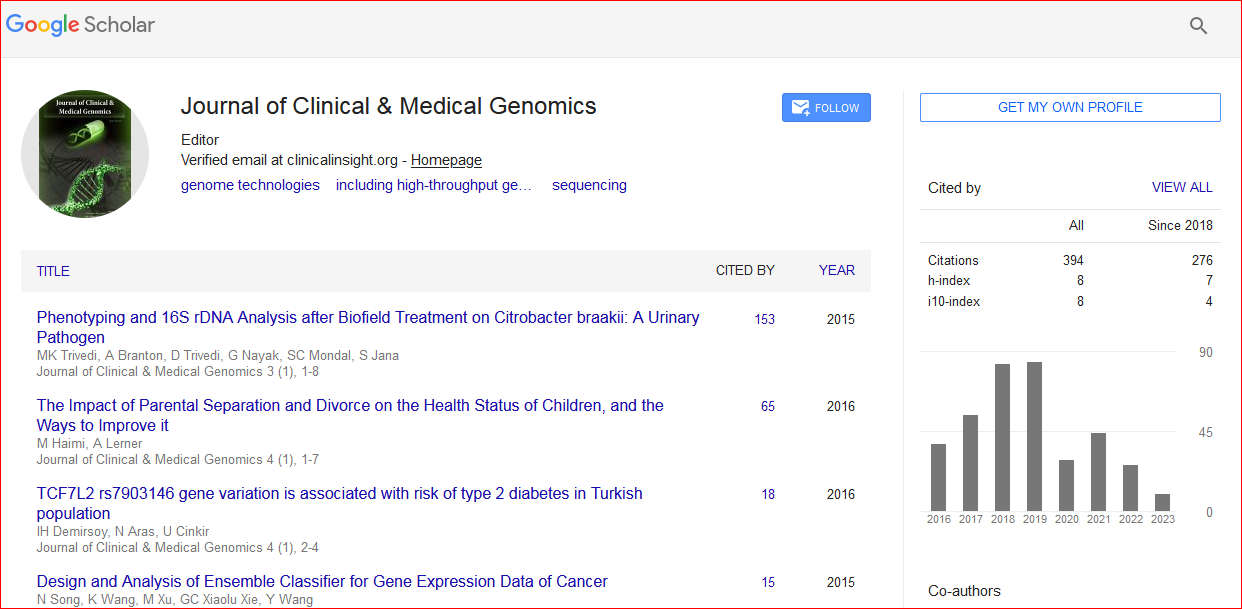
Journal of Clinical & Medical Genomics received 391 citations as per Google Scholar report