Perspective - (2025) Volume 15, Issue 6
Received: 01-Nov-2025, Manuscript No. jnt-26-178984;
Editor assigned: 03-Nov-2025, Pre QC No. P-178984;
Reviewed: 17-Nov-2025, QC No. Q-178984;
Revised: 24-Nov-2025, Manuscript No. R-178984;
Published:
29-Nov-2025
, DOI: 10.37421/2161-0959.2025.15.598
Citation: Stoica, Alina. ”Personalized Immunosuppression: Optimizing Kidney Transplant Outcomes.” J Nephrol Ther 15 (2025):598.
Copyright: © 2025 Stoica A. This is an open-access article distributed under the terms of the Creative Commons Attribution License, which permits unrestricted use, distribution and reproduction in any medium, provided the original author and source are credited.
Optimizing immunosuppression in kidney transplantation is a critical endeavor, fundamentally linked to the long-term survival of the transplanted graft and the overall well-being of the patient. This intricate process necessitates a personalized approach, tailoring drug regimens based on a multifaceted understanding of individual patient risk factors, their unique genetic predispositions, and their specific immunological profiles. The ultimate aim of these personalized strategies is to strike a delicate balance: providing sufficient immunosuppression to effectively prevent graft rejection while simultaneously minimizing the risks associated with drug toxicity and increased susceptibility to infections. The evolving landscape of immunosuppressive agents presents exciting opportunities for enhancing the precision of patient management in kidney transplantation. Early and accurate identification of patients who are at a higher risk of experiencing graft rejection or developing infections allows for proactive and timely adjustments to their immunosuppressive therapy. The increasing traction of biomarkers and novel monitoring techniques is instrumental in guiding these personalized approaches, marking a significant departure from the erstwhile one-size-fits-all protocols that characterized earlier treatment paradigms. Minimizing the long-term side effects stemming from immunosuppressive therapy is an equally critical goal in kidney transplantation. These side effects can manifest in various forms, including the increased incidence of cardiovascular disease, a higher risk of developing malignancies, and the progressive deterioration of remaining kidney function. Personalized strategies are therefore increasingly focused on utilizing the lowest effective doses of calcineurin inhibitors and employing other agents judiciously to mitigate these adverse outcomes. The exploration of newer therapeutic agents and the potential implementation of de-intensification strategies represent active and promising areas of ongoing research. The application of pharmacogenomics in the field of kidney transplantation holds substantial promise for refining and personalizing the dosing of immunosuppressive drugs. Genetic variations among individuals can profoundly influence the metabolism and efficacy of these medications, thereby enabling the development of tailored therapeutic regimens. Such personalization is key to improving patient outcomes and concurrently reducing the occurrence of adverse events. Specifically, the identification of patients who are rapid or poor metabolizers of these drugs can significantly inform and guide initial dosing decisions. Monitoring drug levels, particularly for key immunosuppressants such as calcineurin inhibitors and mycophenolic acid, continues to be a cornerstone of personalized immunosuppression strategies in kidney transplantation. Therapeutic drug monitoring (TDM) plays a vital role in ensuring that drug concentrations are maintained within the established therapeutic window. This careful monitoring helps to reduce the risk of both graft rejection and drug-related toxicity. Further advancements in TDM, including the development of more frequent testing protocols and point-of-care testing capabilities, have the potential to further enhance its utility and impact. The role of alloantibody monitoring and its impact on the personalization of immunosuppression is an area of rapidly developing interest and clinical application within kidney transplantation. The precise detection and quantification of donor-specific antibodies (DSAs) can effectively identify patients who are at an elevated risk of developing antibody-mediated rejection. This information is crucial for guiding necessary adjustments to immunosuppressive regimens and may also inform the potential addition of specific therapies aimed at depleting or neutralizing these problematic antibodies. Beyond standard therapeutic drug monitoring and donor-specific antibody screening, a broader spectrum of immune monitoring is being actively explored to further personalize immunosuppression strategies in kidney transplantation. Assays designed to measure T-cell activation, assess regulatory T-cell function, or provide a comprehensive evaluation of overall immune cell populations are under investigation. These advanced monitoring techniques have the potential to offer a more complete understanding of a patient's immune status, thereby facilitating more dynamic and individually tailored immunosuppressive strategies. The emergence and development of novel immunosuppressive agents represent new and significant avenues for the implementation of personalized therapeutic approaches in kidney transplantation. These newer agents, often designed to target specific immune pathways such as B-cell depletion or cytokine blockade, can be strategically employed in combination with conventional immunosuppressants. This combination approach allows for more refined treatment protocols and the effective management of more challenging clinical cases. Strategies focused on the de-intensification of immunosuppression in kidney transplant recipients who have achieved a stable graft function are increasingly gaining prominence. The primary objective behind these de-intensification strategies is to reduce the long-term exposure of patients to immunosuppressive medications and, consequently, to mitigate the associated toxicities. This approach, however, necessitates careful patient selection based on robust clinical criteria and requires rigorous and ongoing monitoring to ensure both the safety and the efficacy of the reduced immunosuppressive regimen. The overarching development of personalized immunosuppression in the context of kidney transplantation is fundamentally driven by the persistent desire to enhance long-term graft survival rates and to significantly improve the quality of life for transplant recipients. By meticulously considering individual patient characteristics, their specific immunological responses, and their unique genetic makeup, clinicians are progressively moving towards more precise, effective, and patient-centered therapeutic approaches. This shift aims to minimize both the incidence of graft rejection and the occurrence of treatment-related complications, ultimately leading to better patient outcomes.
The optimization of immunosuppression in kidney transplantation stands as a cornerstone for ensuring graft survival and promoting patient well-being. This process is increasingly individualized, involving the careful tailoring of drug regimens to align with a patient's specific risk factors, genetic predispositions, and immunological profile. The core objective of these personalized strategies is to achieve a crucial equilibrium: providing adequate immunosuppression to prevent rejection while concurrently minimizing the risks of drug toxicity and infection. The dynamic evolution of immunosuppressive agents provides enhanced opportunities for precise patient management in kidney transplantation. The early identification of individuals at high risk for rejection or infection enables proactive modifications to their immunosuppressive therapy. Biomarkers and advanced monitoring techniques are becoming integral to guiding these personalized strategies, steering away from generalized treatment protocols. A critical aim in kidney transplantation is the reduction of long-term side effects associated with immunosuppression, such as cardiovascular disease, malignancy, and chronic kidney disease progression. Personalized strategies prioritize the use of the lowest effective doses of calcineurin inhibitors and judicious application of other agents to mitigate these risks. The role of novel agents and potential de-intensification strategies are key areas of ongoing research. Pharmacogenomics offers a powerful tool for personalizing immunosuppressive drug dosing in kidney transplantation. Genetic variations can significantly impact drug metabolism and efficacy, paving the way for tailored regimens that improve outcomes and reduce adverse events. Identifying patients as rapid or poor metabolizers can inform initial dosing decisions. Therapeutic drug monitoring (TDM) of immunosuppressant levels, particularly for calcineurin inhibitors and mycophenolic acid, remains essential for personalized immunosuppression. TDM helps maintain drug concentrations within the therapeutic window, lowering the risk of both rejection and toxicity. Advancements in TDM, including more frequent and point-of-care testing, further enhance its effectiveness. The monitoring of alloantibodies and their influence on personalized immunosuppression is a rapidly advancing field. Detecting and quantifying donor-specific antibodies (DSAs) can identify patients at high risk for antibody-mediated rejection, guiding adjustments in immunosuppressive regimens and potentially the addition of therapies to target these antibodies. Beyond TDM and DSA screening, immune monitoring is being explored to further personalize immunosuppression. Assays measuring T-cell activation, regulatory T-cell function, or overall immune cell populations can offer a more comprehensive view of a patient's immune status, enabling more dynamic and individualized immunosuppressive strategies. Novel immunosuppressive agents are opening new pathways for personalized therapy in kidney transplantation. Agents that target specific immune pathways, such as B-cell depletion or cytokine blockade, can be strategically used alongside conventional immunosuppressants to manage complex cases and refine treatment protocols. De-intensification of immunosuppression in stable kidney transplant recipients is an emerging strategy. The goal is to reduce long-term drug exposure and associated toxicities while preserving graft tolerance. This requires careful patient selection and diligent monitoring to ensure safety and efficacy. The overarching development of personalized immunosuppression in kidney transplantation is driven by the pursuit of improved long-term graft survival and enhanced patient quality of life. By considering individual patient characteristics, immunological responses, and genetic makeup, clinicians are moving toward more precise and effective therapies, minimizing both rejection and treatment-related complications.
Personalized immunosuppression in kidney transplantation is vital for graft survival and patient well-being, tailoring drug regimens to individual risk factors, genetics, and immune profiles. This approach aims to balance rejection prevention with minimizing toxicity and infection. Advances in monitoring, including therapeutic drug monitoring, donor-specific antibody detection, and broader immune assays, are crucial for refining personalized strategies. Pharmacogenomics can guide drug dosing based on genetic variations. Novel immunosuppressive agents offer new therapeutic options, and de-intensification strategies are being explored in stable recipients to reduce long-term drug exposure and its associated risks. The ultimate goal is to achieve better long-term outcomes and improve patient quality of life through precise and individualized care.
None
None
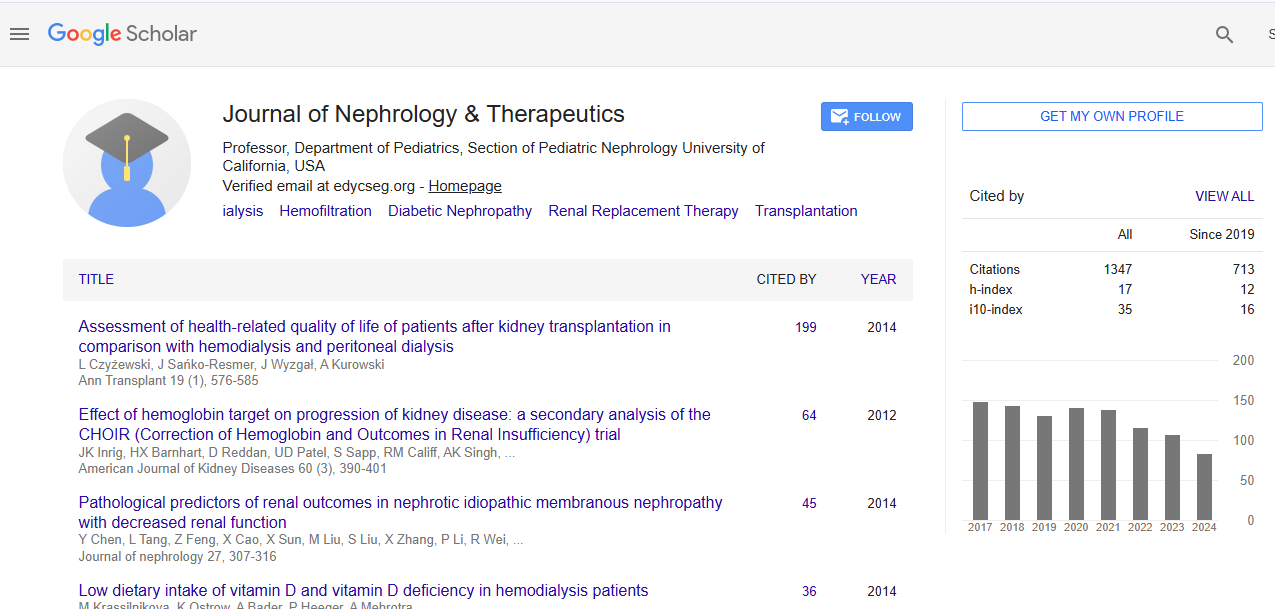
Journal of Nephrology & Therapeutics received 784 citations as per Google Scholar report