Opinion - (2025) Volume 9, Issue 5
Received: 02-Oct-2025, Manuscript No. jgge-25-174645;
Editor assigned: 06-Oct-2025, Pre QC No. P-174645;
Reviewed: 20-Oct-2025, QC No. Q-174645;
Revised: 23-Oct-2025, Manuscript No. R-174645;
Published:
30-Oct-2025
, DOI: 10.37421/2684-4567.2025.9.192
Citation: Vogel, Anika. ”Personalized Genomics: Promise, Challenges, AI’s Role.” J Genet Genom 09 (2025):192.
Copyright: © 2025 Vogel A. This is an open-access article distributed under the terms of the Creative Commons Attribution License, which permits unrestricted use, distribution
and reproduction in any medium, provided the original author and source are credited.
Personalized genomics stands as a transformative pillar in contemporary medicine, poised to redefine patient care through highly customized therapeutic approaches. Exploring this domain reveals a landscape brimming with both immense potential for advancing health outcomes and considerable challenges that demand careful consideration. These challenges prominently include the intricate process of data interpretation and crucial ethical quandaries, such as upholding patient privacy and ensuring equitable access to these groundbreaking technologies [1].
Within oncology, the promise of personalized medicine is steadily becoming a reality. This approach involves the intelligent integration of a patient's specific genetic information with their broader clinical data. The ultimate goal here is to develop targeted, individual therapies that are far more precise and effective than traditional, one-size-fits-all treatments for cancer [2].
As personalized genomics moves closer to widespread adoption in routine clinical practice, it is imperative to address the profound ethical questions that inevitably surface. Diligent attention must be paid to navigating complex issues like protecting patient privacy and ensuring that these advanced genomic services are accessible and fair to all, maintaining the highest standards of medical responsibility [3].
Beyond the realm of cancer treatment and ethical frameworks, personalized genomics is also demonstrating remarkable utility in specific diagnostic areas. For instance, it provides critical insights into the diagnosis of rare diseases. This application not only highlights the current effectiveness of genomic tools but also outlines promising future perspectives for identifying conditions that have historically been challenging to diagnose, offering hope to affected individuals and families [4].
A particularly impactful application lies in pharmacogenomics. This field actively translates genetic insights into direct clinical action, demonstrating how a patient's unique genetic information can be used to meticulously guide drug selection and precise dosing. What this really means is that personalized medicine becomes a practical, actionable reality in the daily administration of treatments, optimizing therapeutic efficacy and minimizing adverse effects [5].
The inherent complexity and sheer volume of data involved in personalized genomics necessitate sophisticated analytical capabilities. This is where Artificial Intelligence (AI) and Machine Learning (ML) play an increasingly pivotal role. As systematic reviews underscore, these technologies are absolutely crucial for efficiently processing vast genomic datasets, uncovering subtle yet meaningful patterns, and ultimately translating these into actionable individual health insights that inform clinical decisions [6].
Furthermore, the ambition to integrate whole-genome sequencing (WGS) into standard clinical care presents a dual landscape of significant benefits and formidable practical difficulties. This integration requires overcoming challenges related to infrastructure, cost, and clinician training, all while harnessing the power of comprehensive genomic data for improved patient management [7].
Another vital area of advancement is the escalating importance of polygenic risk scores. These genetic assessments represent a sophisticated tool that can be applied to predict an individual's susceptibility to a wide array of common diseases. By identifying those at higher risk, these scores pave the way for the development and implementation of more personalized disease prevention strategies, shifting the focus towards proactive health management [8].
What this really shows us is the evolving and strengthening connection between personalized nutrition and genomics. Research in this area carefully examines the scientific evidence that supports tailoring dietary recommendations based on an individual's unique genetic makeup, while also exploring the exciting avenues for future research that promise even greater personalization in health and wellness [9].
Finally, in the domain of personalized cancer therapy, liquid biopsies are emerging as a game-changer. By analyzing circulating tumor Deoxyribonucleic Acid (DNA), these biopsies offer less invasive, real-time insights into a patient's disease status, profoundly enhancing the ability to guide precise and timely treatment decisions. This represents a significant leap forward in diagnostic and monitoring capabilities for oncology patients [10].
This comprehensive overview paints a vivid picture of personalized genomics as a multifaceted and rapidly advancing field. It encompasses everything from targeted therapeutic interventions and proactive disease prevention to navigating complex ethical considerations and leveraging cutting-edge AI technologies. This dynamic convergence of science, technology, and ethics is unequivocally reshaping the future of healthcare, promising a more individualized and effective approach to well-being.
Personalized genomics is fundamentally reshaping our understanding and approach to healthcare by moving beyond generalized treatments to highly specific, individual-centric strategies. This evolving field, while offering tremendous potential for transforming patient care and creating more precise therapeutic strategies, faces inherent challenges such as complex data interpretation and crucial ethical considerations [1]. A key application lies within oncology, where personalized medicine integrates a patientâ??s genetic information with their clinical data to craft targeted, individual therapies for cancer treatment [2]. This integration allows for a more nuanced understanding of disease progression and response to treatment.
Implementing personalized genomics into routine clinical practice brings forth a series of ethical questions that require careful deliberation. Issues surrounding patient privacy, data security, and ensuring equitable access to these advanced genomic services are paramount, demanding responsible navigation to maintain public trust and fairness [3]. Beyond the complexities of ethics, personalized genomics is proving invaluable in specialized diagnostic areas. It offers current and future perspectives for diagnosing rare diseases, providing a vital tool for identifying elusive conditions and guiding more effective management strategies [4]. One of the most direct translations of genomic data into clinical action is seen in pharmacogenomics. This research clearly demonstrates how a patient's genetic profile can directly inform drug selection and precise dosing, making personalized medicine a tangible reality in guiding optimal treatment regimens [5].
The sheer scale of genomic data generated necessitates advanced analytical capabilities. Artificial Intelligence (AI) and Machine Learning (ML) have emerged as indispensable tools in personalized genomics. These technologies are crucial for processing vast datasets, identifying complex patterns, and extracting meaningful insights that drive individualized health recommendations, as highlighted by systematic reviews [6]. Furthermore, the ambition to integrate whole-genome sequencing into routine clinical care is a significant undertaking that presents both substantial benefitsâ??such as comprehensive diagnostic powerâ??and practical difficulties related to cost, infrastructure, and the need for specialized clinician training [7].
A proactive dimension of personalized genomics is the development and application of polygenic risk scores. These genetic assessments predict an individual's susceptibility to common diseases, thus establishing a foundation for more personalized and preventative health strategies. This shifts the paradigm from reactive treatment to proactive risk management [8]. Additionally, the field is exploring the intricate connection between personalized nutrition and genomics. Scientific evidence is being gathered to support dietary recommendations tailored to an individualâ??s genetic makeup, with ongoing research poised to unlock further advancements in this area of individualized wellness [9].
Finally, in the advanced landscape of personalized cancer therapy, liquid biopsies represent a groundbreaking diagnostic and monitoring tool. By analyzing circulating tumor Deoxyribonucleic Acid (DNA), these biopsies offer less invasive, real-time insights into tumor characteristics, which is vital for guiding timely and precise treatment decisions and monitoring therapeutic responses [10].
This comprehensive integration of genomic insights, advanced technologies, and ethical frameworks defines the dynamic nature of personalized medicine, illustrating its potential to fundamentally reshape healthcare towards more effective, individualized, and preventative models.
Personalized genomics is profoundly transforming patient care, offering a path to precise therapeutic strategies and highly individualized interventions. While promising, this rapidly evolving field faces significant hurdles, notably in complex data interpretation and critical ethical considerations such as safeguarding patient privacy and ensuring equitable access to these advanced technologies. Despite these challenges, its applications are expanding across various clinical domains. In oncology, for instance, personalized medicine integrates a patientâ??s unique genetic information with their clinical data to devise targeted therapies, with liquid biopsies providing real-time, less invasive insights for treatment guidance. Pharmacogenomics leverages genetic data directly to inform drug selection and precise dosing, making personalized medicine a practical reality in everyday treatment. Beyond immediate treatment, personalized genomics is crucial for diagnosing rare diseases and, through polygenic risk scores, predicting an individualâ??s susceptibility to common diseases, thus enabling more tailored prevention strategies. The scope also includes personalized nutrition, where dietary recommendations can be adapted based on an individual's genetic profile. The integration of whole-genome sequencing into routine clinical practice presents both considerable benefits and practical difficulties that demand careful navigation. Crucially, Artificial Intelligence (AI) and Machine Learning (ML) are playing an increasing role in personalized genomics, proving essential for processing vast genomic datasets, uncovering meaningful patterns, and generating actionable individual health insights. This holistic approach underlines the immense potential of genomics to revolutionize healthcare, emphasizing a balanced focus on innovation and responsible implementation.
None
None
R. SJ, M. LS, P. AG. "Personalized Genomics in the Era of Precision Medicine: Challenges and Opportunities".Nat Rev Genet 24 (2023):512-525.
Indexed at, Google Scholar, Crossref
S. C, L. W, H. Z. "The promise of personalized medicine in oncology: integrating genomic and clinical data for tailored therapies".Mol Oncol 16 (2022):2603-2615.
Indexed at, Google Scholar, Crossref
A. MJ, B. KD, C. EW. "Ethical considerations in the implementation of personalized genomics in clinical practice".J Med Ethics 47 (2021):312-320.
Indexed at, Google Scholar, Crossref
K. LB, D. PM, E. FG. "Personalized genomics for rare disease diagnosis: current state and future perspectives".Genet Med 22 (2020):457-466.
Indexed at, Google Scholar, Crossref
R. C, S. L, T. WK. "Pharmacogenomics in personalized medicine: translating genomic data into clinical action".Clin Pharmacol Ther 113 (2023):221-229.
Indexed at, Google Scholar, Crossref
G. HS, V. RS, N. KP. "Artificial intelligence and machine learning in personalized genomics: A systematic review".npj Digit Med 4 (2021):1-12.
Indexed at, Google Scholar, Crossref
J. MP, L. SM, K. RT. "Integrating whole-genome sequencing into routine clinical care: challenges and opportunities".Genome Med 14 (2022):1-15.
Indexed at, Google Scholar, Crossref
P. CG, S. RK, R. DS. "The role of polygenic risk scores in personalized disease prevention".Nat Rev Endocrinol Metab 20 (2024):30-45.
Indexed at, Google Scholar, Crossref
M. AJ, N. SP, O. PS. "Personalized nutrition and genomics: current evidence and future directions".Nutrients 12 (2020):3105.
Indexed at, Google Scholar, Crossref
F. GH, H. LE, I. JD. "Liquid biopsy in personalized cancer therapy: current status and future prospects".Clin Cancer Res 28 (2022):5-15.
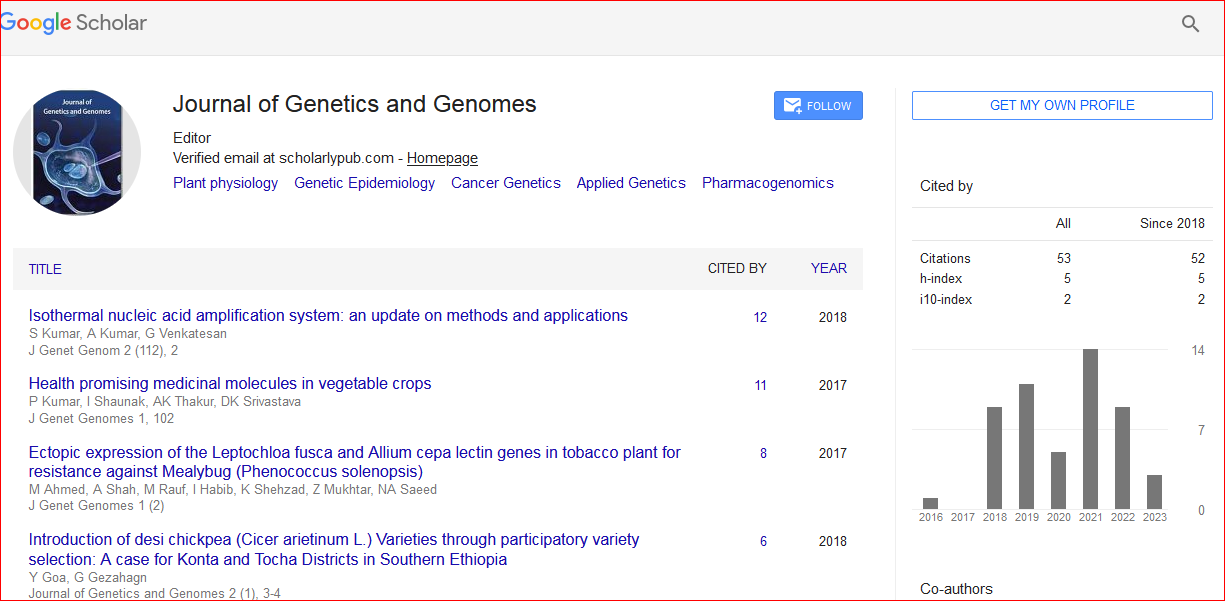
Journal of Genetics and Genomes received 65 citations as per Google Scholar report