Opinion - (2025) Volume 9, Issue 5
Received: 01-Sep-2025, Manuscript No. jchd-26-185709;
Editor assigned: 03-Sep-2025, Pre QC No. P-185709;
Reviewed: 17-Sep-2025, QC No. Q-185709;
Revised: 22-Sep-2025, Manuscript No. R-185709;
Published:
29-Sep-2025
, DOI: 10.37421/2684-6020.2024.9.265
Citation: Mehta, Sanjay. ”Personalized Coronary Heart Disease
Management: A Multifaceted Approach.” J Coron Heart Dis 09 (2025):265.
Copyright: © 2025 Mehta S. This is an open-access article distributed under the terms of the Creative Commons Attribution License, which permits unrestricted use, distribution
and reproduction in any medium, provided the original author and source are credited.
Coronary heart disease (CHD) represents a significant global health challenge, necessitating a comprehensive and evolving approach to its management and treatment. The landscape of CHD therapeutics has undergone substantial transformation, shifting from a reliance on traditional pharmacological interventions to the embrace of innovative interventional procedures and multifaceted lifestyle modifications. This evolution underscores a move towards personalized medicine, where therapeutic strategies are meticulously tailored based on an individual's unique risk factors, genetic predispositions, and the specific severity of their disease, a principle rigorously examined in recent literature [1].
Advances in understanding the pathogenesis and progression of atherosclerotic cardiovascular disease have illuminated the critical role of inflammation. Consequently, there is a growing focus on anti-inflammatory therapies as a complementary strategy to established treatments like lipid-lowering. This approach targets the underlying inflammatory processes that contribute to plaque formation and instability, offering a more comprehensive management framework for CHD patients [4].
The management of stable coronary artery disease specifically has seen significant advancements, with a concentrated effort on optimizing medical therapy, refining revascularization strategies, and reinforcing risk factor modification. The importance of a thorough patient assessment coupled with shared decision-making is paramount in guiding treatment choices, particularly when determining the optimal timing and method for revascularization. The integration of advanced imaging techniques further aids in this personalized approach [2].
Within the realm of lipid management for high-risk cardiovascular populations, including those with pre-existing CHD, PCSK9 inhibitors have emerged as a powerful therapeutic tool. Their demonstrated efficacy in achieving substantial reductions in LDL-C levels and their subsequent impact on decreasing major adverse cardiovascular events are particularly valuable for patients who are statin-intolerant or experience residual risk despite maximal statin therapy [3].
Percutaneous coronary intervention (PCI) remains a cornerstone of CHD management, and continuous advancements in stent technology, imaging guidance, and procedural techniques are crucial for optimizing patient outcomes and minimizing complications. The indications for PCI are also evolving, with careful consideration given to complex coronary lesions and patients presenting with acute coronary syndromes [5].
The critical role of cardiac rehabilitation in the recovery process and secondary prevention of CHD cannot be overstated. Comprehensive programs that integrate exercise training, patient education, and psychosocial support are proven to enhance functional capacity, improve quality of life, and reduce the incidence of future cardiovascular events. The expanding use of telehealth and digital tools is further enhancing the accessibility and adherence to these vital programs [6].
Novel antiplatelet agents are playing an increasingly important role in preventing thrombotic events in patients with CHD, especially those who have undergone percutaneous coronary intervention. Research continues to compare the benefits and risks of various antiplatelet regimens, aiming to develop personalized strategies that optimize efficacy while minimizing bleeding complications [7].
Lifestyle modifications are foundational to both the prevention and management of CHD. Healthy dietary choices, regular physical activity, smoking cessation, and effective stress management are indispensable for reducing cardiovascular risk and improving overall clinical outcomes. Integrating these interventions into comprehensive treatment plans is a key focus for effective CHD management [8].
Pharmacogenomics and genetic risk assessment are opening new avenues for tailoring CHD treatment strategies. By leveraging genetic information, clinicians can better predict individual responses to medications, identify specific risk factors, and select the most effective and safest therapeutic options for each patient, moving towards truly personalized cardiovascular medicine [9].
Resistant hypertension poses a particular challenge in patients with CHD, given the heightened cardiovascular risk associated with uncontrolled blood pressure. Addressing the diagnostic complexities, identifying underlying causes, and optimizing therapeutic strategies are crucial for achieving blood pressure control in this vulnerable population, emphasizing the need for a thorough and individualized approach [10].
The multifaceted treatment strategies for coronary heart disease (CHD) are a subject of ongoing exploration and innovation. Recent advancements highlight a paradigm shift from traditional pharmacological interventions to a more integrated approach encompassing innovative interventional procedures and comprehensive lifestyle modifications. Personalized medicine is central to this evolution, emphasizing the tailoring of therapies based on individual risk factors, genetic profiles, and disease severity. This approach acknowledges that a one-size-fits-all strategy is insufficient for optimal patient outcomes [1].
In parallel with pharmacological and interventional advancements, the impact of lifestyle modifications on the prevention and management of CHD is being thoroughly reassessed. This includes a deep dive into the crucial roles of adopting a healthy diet, engaging in regular physical activity, achieving smoking cessation, and implementing effective stress management techniques. The integration of these non-pharmacological interventions into comprehensive treatment plans is recognized as a cornerstone for reducing cardiovascular risk and improving clinical outcomes in patients with CHD [8].
Complementing these approaches, the role of inflammation in the pathogenesis and progression of coronary artery disease is increasingly understood, leading to a focused investigation into anti-inflammatory therapies. Articles review evidence for therapies targeting inflammation, such as colchicine and canakinumab, in reducing cardiovascular events in specific patient populations. This highlights the potential of an anti-inflammatory strategy as a vital adjunct to lipid-lowering for a more holistic CHD management [4].
The management of stable coronary artery disease has seen considerable refinement. Contemporary reviews emphasize optimal medical therapy, revascularization strategies, and comprehensive risk factor modification. The importance of detailed patient assessment and shared decision-making in guiding treatment choices, particularly concerning the timing and modality of revascularization, is consistently underscored. Emerging therapeutic targets and the integration of advanced imaging techniques are also key areas of discussion [2].
For high-risk cardiovascular populations, including those with established coronary heart disease, PCSK9 inhibitors have demonstrated significant value in lipid management. These novel agents are effective in achieving substantial LDL-C reduction and have shown a remarkable capacity to reduce major adverse cardiovascular events, offering a critical option for patients who are statin-intolerant or exhibit residual risk despite maximal statin therapy [3].
Percutaneous coronary intervention (PCI) continues to evolve as a primary treatment modality for CHD. Advancements in stent technology, imaging guidance, and procedural techniques are continuously being developed to optimize outcomes and minimize complications. The evolving indications for PCI in various clinical scenarios, including complex coronary lesions and acute coronary syndromes, are also a critical area of focus [5].
The critical role of cardiac rehabilitation in the recovery and secondary prevention of CHD is a well-established fact. Comprehensive programs encompassing exercise training, patient education, and psychosocial support are vital for improving functional capacity, enhancing quality of life, and reducing the incidence of future cardiovascular events. The integration of telehealth and digital tools is expanding the reach and effectiveness of these rehabilitation efforts [6].
Novel antiplatelet agents are being investigated for their efficacy in preventing thrombotic events in patients with coronary artery disease, particularly those undergoing percutaneous coronary intervention. Comparative analyses of different antiplatelet regimens are essential to guide strategies for personalized antiplatelet therapy, aiming to maximize efficacy and minimize bleeding risks [7].
Pharmacogenomics and genetic risk assessment are paving the way for personalized therapeutic strategies in CHD. The exploration of how genetic information can predict individual responses to medications, identify specific risk factors, and guide the selection of the most effective and safest therapies is a rapidly advancing field, promising more tailored and effective treatments for patients [9].
Resistant hypertension presents a significant clinical challenge in patients with coronary heart disease. This review delves into the diagnostic complexities, underlying causes, and therapeutic strategies necessary for achieving effective blood pressure control in this high-risk group, highlighting the importance of addressing contributing factors and optimizing medication regimens [10].
Coronary heart disease (CHD) management is evolving towards personalized medicine, integrating advanced pharmacological therapies, interventional procedures, and lifestyle modifications. Key advancements include the use of PCSK9 inhibitors for lipid management in high-risk individuals and anti-inflammatory agents to address underlying disease processes. Percutaneous coronary intervention (PCI) continues to see technological improvements, while novel antiplatelet therapies are being refined for thrombotic event prevention. Cardiac rehabilitation programs are vital for recovery and secondary prevention, increasingly utilizing digital tools for better accessibility. Genetic insights through pharmacogenomics are enabling more tailored treatment strategies, and managing resistant hypertension in CHD patients remains a critical clinical focus. Lifestyle modifications are foundational to both prevention and management, emphasizing diet, exercise, smoking cessation, and stress reduction.
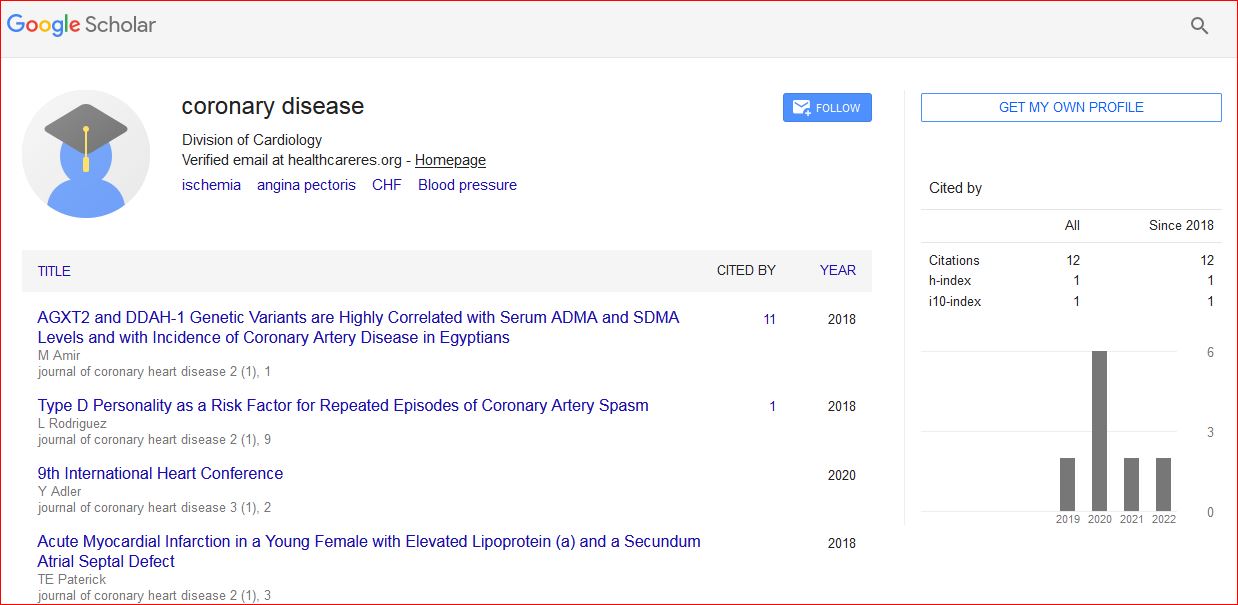
Journal of Coronary Heart Diseases received 15 citations as per Google Scholar report