Perspective - (2025) Volume 11, Issue 5
Received: 02-Oct-2025, Manuscript No. icoa-25-173609;
Editor assigned: 06-Oct-2025, Pre QC No. P-173609;
Reviewed: 20-Oct-2025, QC No. Q-173609;
Revised: 23-Oct-2025, Manuscript No. R-173609;
Published:
30-Oct-2025
, DOI: 10.37421/2469-9756.2025.11.323
Citation: Thompson, Emily R.. ”Personalized Cancer Immunotherapy: Advanced Strategies.” Immunochem Immunopathol 11 (2025):323.
Copyright: © 2025 Thompson R. Emily This is an open-access article distributed under the terms of the Creative Commons Attribution License, which permits unrestricted use,
distribution and reproduction in any medium, provided the original author and source are credited.
Personalized neoantigen vaccines represent a significant and rapidly advancing area in cancer immunotherapy. They explore the promise of precisely targeting tumor-specific mutations, a hallmark of their personalized nature. The central principle involves tailoring immune responses by meticulously identifying unique cancer antigens specific to each individual patient. This approach truly offers a highly precise and individualized strategy to effectively combat various forms of cancer [1].
The integration of Artificial Intelligence (AI) is playing an increasingly vital and transformative role in advancing personalized cancer immunotherapy. AI applications can significantly enhance the identification of appropriate therapeutic targets, accurately predict individual patient treatment responses, and ultimately optimize overall therapeutic strategies. However, it is important to acknowledge that the comprehensive and widespread implementation of AI in this complex field still faces considerable hurdles [2].
Personalized adoptive cell therapy presents another remarkably promising avenue within cancer treatment. This innovative approach involves the meticulous use of a patient's own immune cells, which are then genetically modified in a laboratory setting to specifically recognize and target cancer cells within their body. Despite notable clinical progress demonstrating its potential, significant challenges persist, particularly concerning the scalable manufacturing processes and ensuring consistent efficacy across diverse patient populations [3].
Recent breakthroughs in messenger RNA (mRNA) technology have paved the way for exciting developments in personalized mRNA neoantigen vaccines for cancer treatment. These cutting-edge vaccines are designed to deliver specific genetic instructions to the immune system, effectively training it to recognize and mount an attack against unique cancer markers present in a patient's tumor. This mechanism provides a highly tailored and dynamic therapeutic strategy for individuals battling various cancers [4].
The critical role of biomarkers in guiding and optimizing personalized immunotherapy, particularly for gastrointestinal cancers, is becoming increasingly recognized. By carefully identifying specific molecular markers present in patients, clinicians can more accurately predict their likely response to immunotherapy. This capability allows for significantly more precise treatment selection, leading to improved patient outcomes and reduced ineffective therapies [5].
Precision immunotherapy, particularly evident in the context of lung cancer, exemplifies the sophisticated application of personalized strategies. This method meticulously uses patient-specific characteristics and detailed tumor profiles to tailor immunotherapeutic approaches. The primary goal is to maximize treatment effectiveness and concurrently minimize unwanted side effects by addressing the unique biological aspects of each patient's specific disease [6].
For challenging malignancies such as hepatocellular carcinoma, multi-omics approaches are proving invaluable in the development of highly personalized immunotherapy regimens. By integrating diverse and extensive datasets from genomics, transcriptomics, and proteomics, a comprehensive and nuanced understanding of tumor biology can be achieved. This integrated knowledge then enables the creation of exceptionally customized and targeted treatment plans [7].
The evolving field of personalized oncolytic virus immunotherapy offers a novel and intriguing strategy for patients with advanced cancers. In this approach, genetically engineered viruses are designed with a dual purpose: to selectively infect and destroy cancer cells directly, while simultaneously stimulating a robust anti-tumor immune response. These treatments are carefully tailored to meet the individual patient's unique needs and tumor characteristics [8].
Looking towards the future, personalized immunotherapy for melanoma holds immense promise and is a key area of ongoing research. Researchers are actively exploring current advancements and diligently addressing upcoming challenges in developing bespoke treatments that carefully account for the unique genetic landscape of each patient's tumor. The ultimate aim is to achieve more effective and durable responses against this aggressive disease [9].
Crucially, single-cell sequencing is fundamentally transforming our understanding of the complex tumor microenvironment, which is a vital aspect for developing truly personalized immunotherapy. By meticulously dissecting the cellular heterogeneity within and around tumors at an unprecedented resolution, this advanced technology helps identify novel therapeutic targets and accurately predict individual treatment responses. This paves the way for the development of highly individualized and more effective therapies [10].
Personalized neoantigen vaccines stand as a cornerstone in modern cancer immunotherapy, specifically designed to target the unique mutations present in a patient's tumor. This approach fundamentally seeks to tailor immune responses by identifying distinct cancer antigens, which are then used to develop highly precise treatments against various cancers [1]. Further advancing this concept, personalized messenger RNA (mRNA) neoantigen vaccines for cancer immunotherapy have shown significant promise. These innovative vaccines harness mRNA technology to deliver specific instructions, effectively training the immune system to recognize and attack unique cancer markers, thus offering a highly tailored therapeutic strategy [4].
The integration of Artificial Intelligence (AI) is increasingly pivotal in driving progress within personalized cancer immunotherapy. AIâ??s capabilities are being leveraged to enhance the identification of specific therapeutic targets, predict how patients will respond to various treatments, and optimize overall therapeutic strategies for maximum benefit. However, the successful and widespread adoption of AI in clinical settings still presents notable challenges that researchers and clinicians are actively working to overcome [2]. Concurrently, personalized adoptive cell therapy represents another powerful tool in the arsenal against cancer. This method involves extracting a patient's own immune cells, genetically modifying them to specifically target cancer cells, and then reintroducing them. While clinical progress has been significant, persistent hurdles in large-scale manufacturing and ensuring consistent therapeutic efficacy continue to be areas of intensive research [3].
Biomarkers play an undeniably critical role in guiding and refining personalized immunotherapy, especially for difficult-to-treat cancers such as gastrointestinal malignancies. The ability to identify specific molecular markers within a patientâ??s profile allows for a more accurate prediction of their individual response to immunotherapy. This foresight enables clinicians to make more precise treatment selections, leading to improved patient outcomes and reducing the use of ineffective therapies [5]. This principle of tailoring treatment extends seamlessly to conditions like lung cancer, where precision immunotherapy focuses on utilizing patient-specific characteristics and comprehensive tumor profiles. The goal here is to carefully design immunotherapeutic strategies that maximize treatment effectiveness while concurrently minimizing adverse side effects, by targeting the unique aspects of each patient's specific disease [6].
For complex and aggressive cancers like hepatocellular carcinoma, multi-omics approaches are becoming indispensable for developing truly personalized immunotherapy. By comprehensively integrating vast amounts of data from genomics, transcriptomics, and proteomics, researchers can gain a deep and holistic understanding of the underlying tumor biology. This integrated understanding is crucial for enabling the creation of exceptionally customized and highly effective treatment plans [7]. Additionally, the burgeoning field of personalized oncolytic virus immunotherapy offers a distinctive and innovative strategy for patients suffering from advanced cancers. This approach involves genetically engineered viruses that are designed not only to selectively infect and destroy cancer cells directly but also to powerfully stimulate an anti-tumor immune response, all of which can be meticulously tailored to meet individual patient needs [8].
Looking ahead, personalized immunotherapy for melanoma remains a critical focus area with immense potential. Ongoing research is centered on addressing current advancements and anticipating future challenges in developing bespoke treatments. These treatments must meticulously account for the unique genetic landscape of each patient's tumor, with the overarching aim of achieving more effective and durable responses against this aggressive skin cancer [9]. A crucial technological advancement supporting these personalized strategies is single-cell sequencing. This technology is profoundly transforming our understanding of the intricate tumor microenvironment, which is a vital component for successful personalized immunotherapy. By dissecting the cellular heterogeneity both within and surrounding tumors at an unprecedented level of detail, single-cell sequencing helps to identify novel therapeutic targets and accurately predict individual patient treatment responses, thereby paving the way for truly individualized and more potent therapies [10].
Personalized cancer immunotherapy is revolutionizing oncology by tailoring treatments to individual patient and tumor profiles. Key strategies include personalized neoantigen vaccines, particularly those leveraging mRNA technology, which train the immune system to target unique cancer mutations [1, 4]. Artificial Intelligence plays an increasing role in optimizing these therapies by improving target identification and predicting responses [2]. Adoptive cell therapy, utilizing genetically modified patient immune cells, continues to advance despite manufacturing challenges [3]. The use of biomarkers is crucial for guiding treatment selection and improving outcomes, especially in gastrointestinal cancers [5], while precision immunotherapy focuses on patient-specific approaches for conditions like lung cancer [6]. Multi-omics approaches provide a comprehensive understanding of tumor biology, enabling customized plans for diseases such as hepatocellular carcinoma [7]. Additionally, personalized oncolytic virus immunotherapy offers a novel way to destroy cancer cells and stimulate immune responses [8]. The field is actively developing bespoke treatments for specific cancers like melanoma [9] and is further enhanced by single-cell sequencing, which unveils the complexities of the tumor microenvironment to inform individualized therapies [10]. These diverse approaches highlight a collective effort to develop more effective, precise, and patient-specific cancer treatments.
None
None
1. Michael R, Clément G, Hans-Georg R. "Personalized Neoantigen Vaccines for Cancer Immunotherapy".Cancers 15 (2023):4323.
Indexed at, Google Scholar, Crossref
2. Shuyi M, Yizhan L, Jiazhen L. "Artificial intelligence in personalized cancer immunotherapy: Challenges and opportunities".CSBJ 22 (2024):1115-1127.
Indexed at, Google Scholar, Crossref
3. Chunjing J, Min W, Tao L. "Personalized adoptive cell therapy for cancer: Clinical progress, challenges, and perspectives".Cell Death Discov 8 (2022):409.
Indexed at, Google Scholar, Crossref
4. Qing W, Ruibin W, Yan L. "Recent Progress in Personalized mRNA Neoantigen Vaccines for Cancer Immunotherapy".Pharmaceutics 15 (2023):1876.
Indexed at, Google Scholar, Crossref
5. Yuichi N, Reiko O, Yuuki M. "Biomarkers of Personalized Immunotherapy for Gastrointestinal Cancers".Int J Mol Sci 24 (2023):5698.
Indexed at, Google Scholar, Crossref
6. Kai M, Mingyu D, Chao L. "Precision immunotherapy in lung cancer".Mol Cancer 21 (2022):204.
Indexed at, Google Scholar, Crossref
7. Meng Y, Meng Y, Baoliang Z. "Multi-omics approach for personalized immunotherapy in hepatocellular carcinoma".Front Immunol 14 (2023):1297645.
Indexed at, Google Scholar, Crossref
8. Dong YK, Woong-Soo P, Su JI. "Personalized oncolytic virus immunotherapy against advanced cancers".WJCO 13 (2022):996-1002.
Indexed at, Google Scholar, Crossref
9. Katerina P, Savvas P, Christina G. "Personalized immunotherapy for melanoma: The road ahead".Front Oncol 13 (2023):1249767.
Indexed at, Google Scholar, Crossref
10. Meng Y, Haowei L, Wei L. "Unveiling the Complexity of Tumor Microenvironment for Personalized Immunotherapy through Single-Cell Sequencing".Cancers 16 (2024):569.
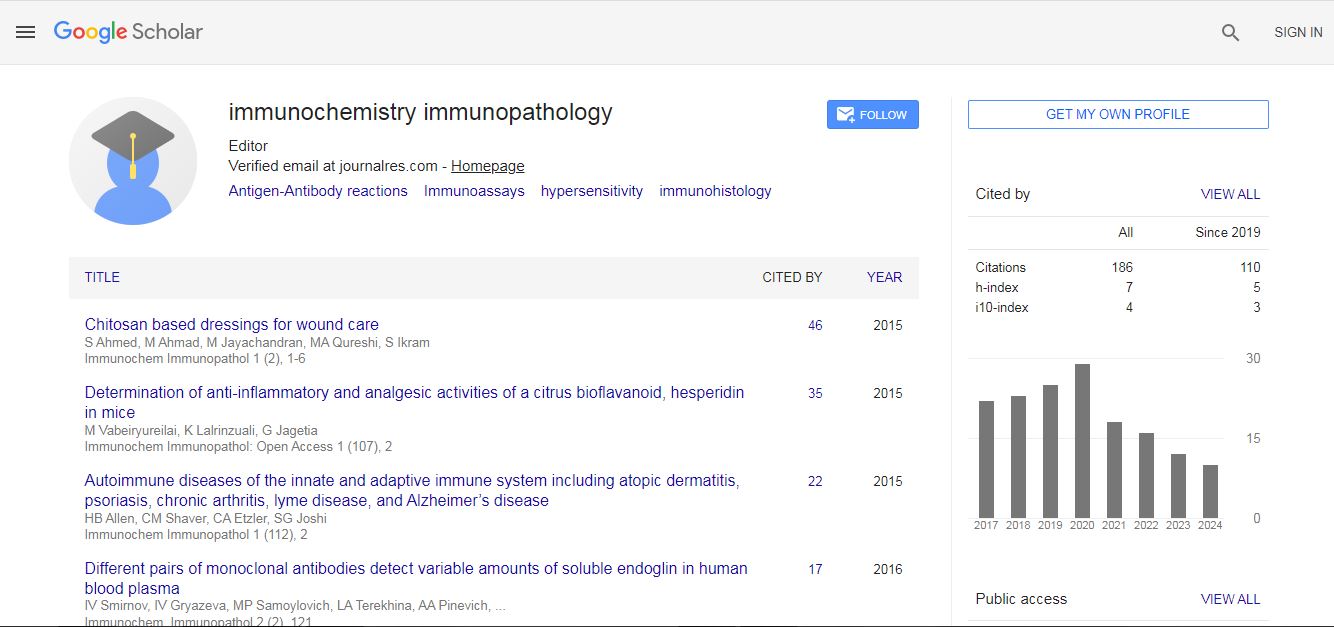
Immunochemistry & Immunopathology received 174 citations as per Google Scholar report