Commentary - (127) Volume 15, Issue 4
Received: 01-Jul-2025, Manuscript No. jnt-26-178951;
Editor assigned: 03-Jul-2025, Pre QC No. P-178951;
Reviewed: 17-Jul-2025, QC No. Q-178951;
Revised: 22-Jul-2025, Manuscript No. R-178951;
Published:
29-Jul-2025
, DOI: 10.37421/2161-0959.2025.15.577
Citation: Duarte, Camila R.. ”Pediatric Nephrology’s Transformative Era: Precision, Prediction, Progress.” J Nephrol Ther 15 (2025):577.
Copyright: © 2025 Duarte R. Camila This is an open-access article distributed under the terms of the Creative Commons Attribution License, which permits unrestricted use, distribution and reproduction in any medium, provided the original author and source are credited.
Recent advancements in pediatric nephrology are significantly transforming the diagnosis and treatment of kidney diseases in children, heralding a new era of personalized care and improved outcomes. Innovations in genetic testing have become paramount for accurately identifying the underlying causes of these conditions, paving the way for tailored therapeutic strategies. The development of novel pharmaceutical agents and the application of precision medicine principles are demonstrably enhancing treatment effectiveness for prevalent conditions such as nephrotic syndrome and chronic kidney disease. Furthermore, enhanced screening methodologies and a more profound comprehension of disease pathogenesis are vital for enabling early detection and optimizing the long-term management of pediatric kidney disorders, thereby preventing the onset of debilitating complications. The genetic underpinnings of rare pediatric kidney diseases are being elucidated with unprecedented detail, largely driven by the capabilities of next-generation sequencing technologies. This has revolutionized the diagnostic landscape, allowing for the identification of previously unknown genes and critical molecular pathways implicated in these complex conditions. Consequently, there is a growing emphasis on developing targeted therapies and providing comprehensive genetic counseling, underscoring the profound shift towards precision medicine within the field of pediatric nephrology. The therapeutic approaches to childhood nephrotic syndrome have undergone substantial evolution, with a particular focus on optimizing existing treatments and exploring novel modalities to elevate remission rates and mitigate adverse effects. Significant attention is being paid to newer therapeutic agents and innovative strategies for managing steroid-resistant forms of the disease, reinforcing the critical need for individualized treatment plans tailored to each child's unique clinical profile. Advancements in diagnostic tools are proving instrumental in the early identification of kidney diseases in neonates and infants, a particularly vulnerable population. The integration of sophisticated imaging techniques, sensitive biomarkers, and advanced genetic screening allows for prompt diagnosis and timely intervention, ultimately contributing to the preservation and improvement of long-term renal health from the earliest stages of life. The management of chronic kidney disease (CKD) in pediatric populations is increasingly guided by comprehensive reviews of current treatment paradigms and forward-looking perspectives on future directions. A central theme is the indispensable role of multidisciplinary care, robust nutritional support, and the exploration of emerging pharmacotherapies designed to decelerate disease progression and enhance the overall quality of life for affected children. Crucially, the transition of care from pediatric to adult services is also a critical aspect being addressed. The complex domain of autoimmune kidney diseases in children, specifically focusing on conditions like systemic lupus erythematosus (SLE) and IgA nephropathy, is benefiting from significant research efforts. Progress is being made in understanding the intricate mechanisms of these diseases, identifying more sensitive diagnostic markers, and developing targeted therapies aimed at achieving superior long-term renal outcomes while minimizing reliance on steroid-based treatments. The burgeoning application of artificial intelligence (AI) and machine learning in pediatric nephrology holds immense promise for revolutionizing patient care. These advanced technologies are being explored for their potential to enhance early disease detection, refine risk stratification models, and predict treatment responses more accurately, thereby facilitating a more efficient and precisely personalized approach to managing pediatric kidney conditions. The therapeutic management of congenital anomalies of the kidney and urinary tract (CAKUT) in pediatric patients is a multifaceted undertaking requiring a coordinated approach. This involves a thorough review of surgical interventions, contemporary medical management strategies, and the essential long-term follow-up protocols necessary to optimize renal function and avert potential complications, with particular emphasis on recent innovations in surgical techniques and pharmacotherapies. Pediatric glomerular diseases, encompassing conditions such as podocytopathies and glomerulonephritis, have witnessed substantial progress in both diagnosis and treatment. This includes an evolving understanding of disease pathogenesis, improvements in diagnostic modalities like kidney biopsy interpretation and genetic analysis, and the development of targeted therapeutic interventions aimed at improving patient prognoses and long-term renal outcomes. Early detection and vigilant monitoring of acute kidney injury (AKI) in critically ill children are significantly enhanced by the development and application of novel biomarkers. These emerging biomarkers offer distinct advantages over conventional markers, such as serum creatinine, by enabling earlier identification of AKI, thereby facilitating prompt intervention and potentially improving survival rates and renal recovery in this high-risk pediatric population.
Recent advancements in pediatric nephrology are fundamentally reshaping the landscape of diagnosis and treatment for kidney diseases in children. The integration of innovative genetic testing has become indispensable for uncovering the etiological basis of these conditions, which is crucial for developing personalized therapeutic plans. The ongoing development of novel drug therapies and the application of precision medicine strategies are leading to improved clinical outcomes for children affected by conditions like nephrotic syndrome and chronic kidney disease. Enhancing early detection through refined screening methods and a deeper understanding of the underlying disease processes are key components for effective management and the prevention of long-term renal complications. The exploration into the genetic architecture of rare pediatric kidney diseases has revealed profound insights, primarily facilitated by the capabilities of next-generation sequencing technologies. This has dramatically improved the diagnostic process, enabling the identification of novel genes and molecular pathways involved in disease development. The implications of these discoveries are far-reaching, influencing the development of targeted therapies and informing genetic counseling, all within the paradigm of precision medicine in pediatric nephrology. The therapeutic landscape for childhood nephrotic syndrome has seen considerable evolution, with a strong focus on optimizing existing treatment regimens and exploring novel therapeutic modalities to enhance remission rates and minimize treatment-related complications. Particular emphasis is placed on evaluating newer pharmacological agents and developing advanced strategies for managing steroid-resistant nephrotic syndrome, highlighting the imperative for individualized treatment approaches. Significant progress has been made in developing and implementing advanced diagnostic tools that are critical for the early identification of kidney diseases in neonates and infants. These tools encompass refined imaging techniques, the utilization of sensitive biomarkers, and comprehensive genetic screening, all of which contribute to prompt diagnosis and timely intervention, ultimately safeguarding and improving the long-term renal health of this vulnerable patient group. The management of chronic kidney disease (CKD) in children is increasingly informed by a thorough review of current treatment protocols and an outlook on future therapeutic directions. Central to this approach is the recognition of the vital role played by multidisciplinary care teams, optimized nutritional support, and the investigation of emerging pharmacotherapies aimed at retarding disease progression and improving the quality of life for pediatric CKD patients. The essential process of transitioning care from pediatric to adult healthcare systems is also a critical consideration. The complex field of pediatric autoimmune kidney diseases, with a specific focus on systemic lupus erythematosus (SLE) and IgA nephropathy, is benefiting from ongoing research and clinical advancements. This includes a better understanding of disease mechanisms, the identification of improved diagnostic markers, and the development of novel, targeted therapeutic strategies designed to achieve superior long-term renal outcomes and reduce the need for prolonged steroid use. The integration of artificial intelligence (AI) and machine learning technologies into pediatric nephrology represents a rapidly growing area with significant potential. This field is actively exploring how these advanced computational methods can assist in the early detection of kidney diseases, improve the accuracy of risk stratification, and predict patient responses to various treatments, thereby facilitating more efficient and personalized care pathways. The therapeutic management of congenital anomalies of the kidney and urinary tract (CAKUT) in pediatric patients is a complex process that necessitates a comprehensive approach, integrating surgical interventions with optimized medical management strategies. This includes meticulous long-term follow-up protocols designed to preserve renal function and prevent secondary complications, with a keen eye on recent innovations in both surgical techniques and medical therapies. The diagnosis and treatment of glomerular diseases in children have experienced considerable advancements. This review delves into the evolving understanding of podocytopathies and glomerulonephritis, emphasizing improvements in diagnostic techniques such as the interpretation of kidney biopsies and genetic analyses, alongside the development of targeted therapies aimed at enhancing patient prognoses. The early detection and effective monitoring of acute kidney injury (AKI) in critically ill children are being significantly bolstered by the advent of novel biomarkers. These emerging markers offer advantages over traditional indicators like creatinine, allowing for earlier identification of AKI and enabling timely interventions that can potentially improve outcomes and renal recovery in this vulnerable pediatric population.
Pediatric nephrology is undergoing a transformation driven by genetic testing, precision medicine, and novel drug development, leading to improved diagnosis and treatment of kidney diseases in children. Advances in understanding genetic causes of rare kidney diseases and optimizing immunosuppressive therapies for nephrotic syndrome are crucial. Early detection through improved screening, imaging, and biomarkers is vital, especially for neonates and infants. Management of chronic kidney disease emphasizes multidisciplinary care and new pharmacotherapies, while autoimmune kidney diseases and glomerular disorders are benefiting from targeted treatments. Artificial intelligence is emerging as a tool for early detection and personalized care. Therapeutic strategies for congenital anomalies of the kidney and urinary tract are evolving, and novel biomarkers are enhancing the management of acute kidney injury.
None
None
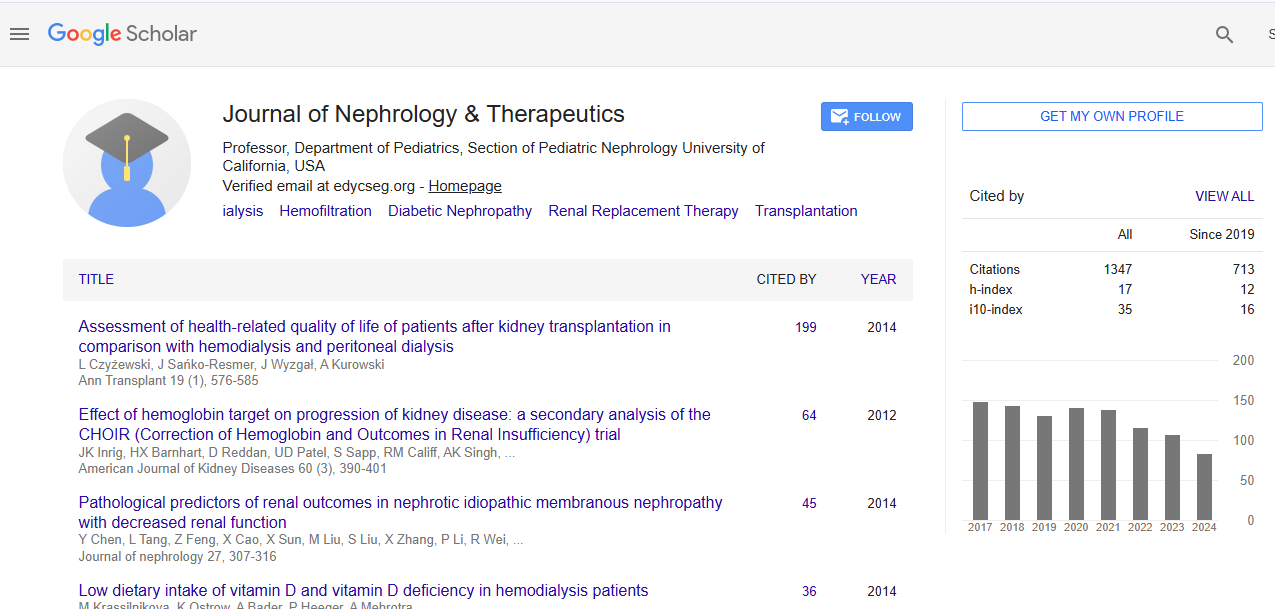
Journal of Nephrology & Therapeutics received 784 citations as per Google Scholar report