Opinion - (2025) Volume 11, Issue 3
Received: 01-May-2025, Manuscript No. ohcr-25-174271;
Editor assigned: 05-May-2025, Pre QC No. P-174271;
Reviewed: 19-May-2025, QC No. Q-174271;
Revised: 22-May-2025, Manuscript No. R-174271;
Published:
29-May-2025
, DOI: 10.37421/2471-8726.2025.11.198
Citation: Carter, Emily. ”Pediatric Dentistry: Complex Cases, Innovative Solutions.” Oral Health Case Rep 11 (2025):198.
Copyright: © 2025 Carter E. This is an open-access article distributed under the terms of the Creative Commons Attribution License, which permits unrestricted use, distribution and reproduction in any medium, provided the original author and source are credited.
This case study details the successful management of a complex dental trauma, specifically a crown-root fracture with luxation in a young patient's permanent incisor. What's key here is the multi-disciplinary approach over two years, highlighting pulp revascularization and aesthetic restoration as crucial for saving the tooth and maintaining its function[1].
This case report showcases a successful revascularization procedure on immature permanent molars exhibiting necrosis, pulp canal obliteration, and inflammatory root resorption. The really valuable insight here is the potential for regeneration in such complex cases, offering an alternative to traditional apexification and highlighting conservative management's long-term benefits for tooth vitality[2].
This case illustrates the effective use of full zirconia crowns to manage severe early childhood caries, offering a durable and esthetic restorative solution for young patients. What's highlighted is how these crowns not only restore function and appearance but also significantly improve the child's quality of life and oral health long-term[3].
This case report explores the diagnosis and surgical management of an odontogenic myxoma, a rare benign tumor, in a pediatric patient's maxilla. What's crucial here is recognizing the challenges in early diagnosis due to non-specific symptoms and the importance of complete surgical excision for preventing recurrence while preserving developing structures[4].
This case report details the long-term multidisciplinary approach to managing a pediatric patient with hypophosphatasia, a rare metabolic bone disease affecting dental development. What's particularly insightful is the ten-year follow-up, showing how early diagnosis and coordinated care are vital for mitigating the severe dental and skeletal manifestations, improving the child's overall health and quality of life[5].
This case report showcases a complex scenario involving impacted compound odontoma and mesiodens in a child's anterior maxilla, requiring a multispecialty management approach. The key takeaway is how crucial early diagnosis and collaborative treatment planning are to prevent complications like malocclusion and eruption disturbances, ultimately ensuring proper dental development[6].
This case report highlights the early onset and rapid progression of localized aggressive periodontitis in a pediatric patient. The main insight here is the critical need for prompt diagnosis and targeted treatment, including antimicrobial therapy and surgical intervention, to arrest disease progression and prevent premature tooth loss in young individuals[7].
This case report details a rare occurrence of unicystic ameloblastoma in a very young child, providing valuable insights into its presentation and management in pediatric populations. What's particularly significant is the three-year follow-up, demonstrating the importance of conservative yet thorough surgical treatment combined with long-term monitoring to prevent recurrence and ensure proper growth and development[8].
This case report demonstrates the successful use of a metal ceramic fixed partial denture for rehabilitating congenitally missing maxillary lateral incisors in a pediatric patient. What we learn is how this restorative approach provides functional and esthetic improvements, crucial for psychological and social development in children, with the three-year follow-up confirming its durability and positive outcomes[9].
This case report emphasizes the significance of early intervention for ectopic eruption of a permanent maxillary canine in a young patient. What's crucial to understand is how timely diagnosis and straightforward interceptive orthodontic treatment can prevent more complex and prolonged issues later, guiding the tooth into its correct position and ensuring proper occlusal development[10].
The management of complex dental trauma in young patients, such as a crown-root fracture with luxation in a permanent incisor, often necessitates a sophisticated multi-disciplinary approach. This extended care over two years typically highlights the crucial roles of pulp revascularization and aesthetic restoration. Such combined efforts are fundamental not only for saving the affected tooth but also for preserving its long-term function and appearance in a developing dentition [1]. Similarly, the presence of impacted compound odontoma and mesiodens in a childâ??s anterior maxilla presents a complex scenario. Successfully navigating these cases mandates a multispecialty management strategy, emphasizing early diagnosis and meticulous collaborative treatment planning. This proactive approach is essential to prevent potential complications, including severe malocclusion and disturbances in eruption patterns, thereby ensuring the proper and healthy development of the entire dentition [6]. Moreover, the early intervention for ectopic eruption of a permanent maxillary canine serves as a prime example of preventing future extensive orthodontic challenges. Swift and accurate diagnosis, coupled with straightforward interceptive orthodontic treatment, can effectively guide the tooth into its correct anatomical position. This timely action ensures proper occlusal development and averts the need for more complex and prolonged interventions down the line [10].
Beyond traumatic injuries, pediatric dentistry frequently encounters rare oral pathologies and systemic conditions with significant dental manifestations. An odontogenic myxoma, a rare benign tumor of the maxilla in a pediatric patient, exemplifies the challenges in early diagnosis due to its often non-specific symptoms. Critically, complete surgical excision is paramount for preventing recurrence while meticulously preserving adjacent developing dental structures and bone [4]. In another complex area, the multidisciplinary management of pediatric hypophosphatasia, a rare metabolic bone disease impacting dental development, requires an extensive long-term follow-up. A ten-year follow-up in one case demonstrated how early diagnosis and coordinated care are absolutely vital for effectively mitigating the severe dental and skeletal manifestations of the disease, ultimately improving the child's overall health and quality of life significantly [5]. Furthermore, the rare occurrence of unicystic ameloblastoma in a very young child offers valuable insights into its unique presentation and subsequent management within pediatric populations. The significance of conservative yet thorough surgical treatment, coupled with consistent long-term monitoring over a three-year period, is highlighted to effectively prevent recurrence and ensure the childâ??s proper craniofacial growth and development [8]. These cases collectively underline the necessity for specialized diagnostic acumen and comprehensive, patient-centered care for uncommon pediatric conditions.
Innovative regenerative and restorative techniques are transforming the landscape of pediatric dental care, offering enhanced outcomes for young patients. Successful revascularization procedures on immature permanent molars affected by necrosis, pulp canal obliteration, and inflammatory root resorption underscore the remarkable potential for true tissue regeneration in such challenging clinical scenarios. This regenerative approach stands as a compelling alternative to traditional apexification, with its long-term benefits for tooth vitality and continued root development being a key insight [2]. For managing severe early childhood caries, the application of full zirconia crowns has proven to be an exceptionally durable and aesthetically pleasing restorative solution for young patients. These crowns are not just about restoring the toothâ??s physical integrity and appearance; they significantly contribute to improving the childâ??s overall quality of life and long-term oral health [3]. Addressing congenitally missing maxillary lateral incisors, a metal ceramic fixed partial denture provides an effective rehabilitation strategy for pediatric patients. This restorative approach offers substantial functional and esthetic improvements, which are particularly crucial for the psychological and social development of children, with a three-year follow-up confirming the intervention's durability and positive long-term outcomes [9]. These examples demonstrate how contemporary dental materials and techniques effectively restore function and significantly enhance patient well-being.
Beyond these broader categories, specific dental diseases like localized aggressive periodontitis demand focused and immediate attention in the pediatric demographic. This condition is characterized by its early onset and often rapid progression in young individuals. The main insight gleaned from such cases is the critical need for prompt and accurate diagnosis, followed by targeted, aggressive treatment. This comprehensive approach typically includes antimicrobial therapy alongside surgical intervention, designed specifically to arrest the rapid disease progression and ultimately prevent premature tooth loss, which can have profound long-term consequences for the child's oral health and overall development [7]. This highlights that even conditions typically associated with adults can manifest severely in children, necessitating acute awareness and precise clinical responses.
Pediatric dentistry involves a wide array of complex cases, from traumatic injuries to rare developmental disorders and acquired diseases. Successful outcomes often hinge on early diagnosis, multidisciplinary collaboration, and innovative treatment approaches. For instance, managing dental trauma like crown-root fractures or developmental anomalies such as impacted odontomas and ectopic eruptions requires timely intervention and coordinated specialist care to preserve tooth vitality and ensure proper occlusal development. Regenerative procedures, like pulp revascularization for necrotic molars, are emerging as viable alternatives to traditional treatments, offering long-term benefits for tooth vitality. Furthermore, advanced restorative techniques, including full zirconia crowns for severe early childhood caries and fixed partial dentures for congenitally missing teeth, significantly enhance function and aesthetics, improving children's quality of life. Pediatric patients also present with unique pathologies like odontogenic myxoma, unicystic ameloblastoma, and systemic conditions such as hypophosphatasia, all demanding specialized diagnostic acumen and long-term, conservative management to prevent recurrence and support normal growth. Even common-sounding conditions like localized aggressive periodontitis require prompt, targeted antimicrobial and surgical interventions to prevent premature tooth loss. The consistent thread across these diverse cases is the critical role of comprehensive, patient-centered care and sustained follow-up in safeguarding oral health and overall well-being in young individuals.
None
None
1. R. S, G. MC, G. C. "Management of a complicated crown-root fracture with luxation in a permanent immature maxillary incisor: A case report with 2-year follow-up".J Clin Exp Dent 13 (2021):e502-e508.
Indexed at, Google Scholar, Crossref
2. R. MJ, S. J, R. S. "Revascularization of necrotic immature permanent molars with pulp canal obliteration and inflammatory root resorption: A case report".J Indian Soc Pedod Prev Dent 41 (2023):321-325.
Indexed at, Google Scholar, Crossref
3. H. BH, Y. YD, W. W. "Application of full zirconia crowns for early childhood caries: a case report".J Oral Dis Res 15 (2023):651-655.
Indexed at, Google Scholar, Crossref
4. K. A, F. A, K. A. "Case Report: Odontogenic Myxoma of the Maxilla in a Pediatric Patient".J Clin Pediatr Dent 46 (2022):149-152.
Indexed at, Google Scholar, Crossref
5. E. SK, B. YO, S. HN. "Multidisciplinary management of pediatric hypophosphatasia: A case report with 10-year follow-up".J Korean Acad Pediatr Dent 48 (2021):227-234.
Indexed at, Google Scholar, Crossref
6. N. K, M. FK, S. AS. "Multispecialty approach for the management of impacted compound odontoma and mesiodens in the anterior maxilla of a pediatric patient: a case report".J Med Case Rep 17 (2023):588.
Indexed at, Google Scholar, Crossref
7. M. K, K. T, N. D. "Localized Aggressive Periodontitis in a Pediatric Patient: A Case Report".J Indian Soc Periodontol 26 (2022):511-515.
Indexed at, Google Scholar, Crossref
8. X. L, C. L, F. C. "Unicystic ameloblastoma in a 5-year-old child: a case report with 3-year follow-up".BMC Oral Health 24 (2024):161.
Indexed at, Google Scholar, Crossref
9. M. KK, S. YP, O. SK. "Rehabilitation of congenitally missing maxillary lateral incisors with a metal ceramic fixed partial denture in a pediatric patient: A 3-year follow-up case report".J Adv Prosthodont 12 (2020):438-442.
Indexed at, Google Scholar, Crossref
10. M. H, S. S, A. G. "Early Intervention in Ectopic Eruption of Permanent Maxillary Canine: A Case Report".J Indian Soc Pedod Prev Dent 39 (2021):375-378.
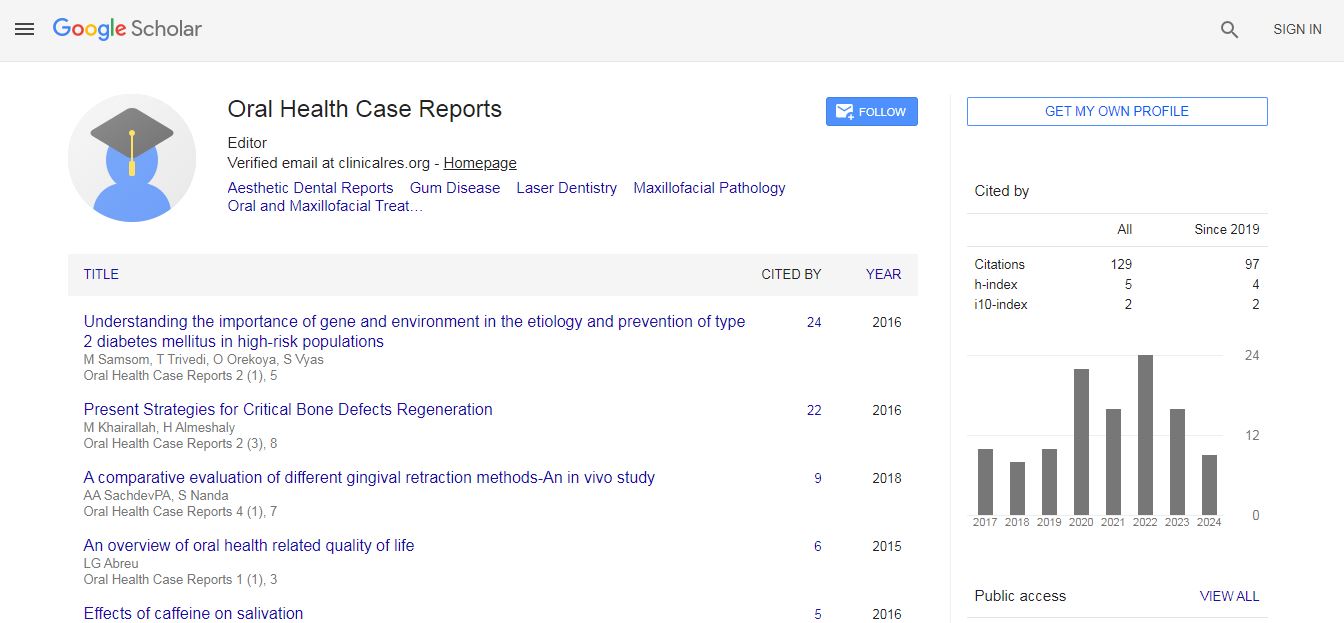
Oral Health Case Reports received 120 citations as per Google Scholar report