Short Communication - (2025) Volume 10, Issue 6
Received: 02-Nov-2025, Manuscript No. apn-26-179362;
Editor assigned: 04-Nov-2025, Pre QC No. P-179362;
Reviewed: 16-Nov-2025, QC No. Q-179362;
Revised: 23-Nov-2025, Manuscript No. R-179362;
Published:
30-Nov-2025
, DOI: 10.37421/2573-0347.2025.10.466
Citation: Gallagher, Ethan. âÂÂPathophysiology Essentials for Advanced Practice Nurses.â J Adv Practice Nurs 10 (2025):466.
Copyright: © 2025 Gallagher E. This is an open-access article distributed under the terms of the Creative Commons Attribution License, which permits unrestricted use,
distribution and reproduction in any medium, provided the original author and source are credited.
This article explores the pivotal role of pathophysiological understanding in shaping effective clinical reasoning for advanced practice nurses. It highlights how a robust grasp of disease processes, from cellular alterations to systemic responses, empowers nurses to precisely interpret patient data, identify subtle deviations from normal physiological states, and subsequently formulate evidence-based care plans. The overarching objective is to bridge the gap between theoretical knowledge and its practical application in diagnostic and therapeutic decision-making, emphasizing the crucial integration of scientific principles with astute clinical observation and assessment [1].
Further delving into specific physiological systems, this research examines the intricate neurological underpinnings of pain. It illuminates how advanced practice nurses can leverage this profound knowledge to refine and improve pain management strategies for their patients. The article details the complex biological pathways involved in nociception, the natural modulation of pain signals, and the often-debilitating development of chronic pain syndromes, thereby offering valuable insights into the creation of personalized analgesic approaches and the effective implementation of non-pharmacological interventions. This work unequivocally underscores the paramount importance of understanding these fundamental biological processes for achieving optimal patient outcomes and enhancing quality of life [2].
Another critical area of focus is the pathophysiology of cardiovascular diseases and its profound implications for advanced nursing practice. The content covers a comprehensive range of cellular and molecular mechanisms underlying common and serious conditions such as atherosclerosis, heart failure, and cardiac arrhythmias. The authors compellingly stress that a firm and enduring grasp of these complex pathophysiological processes is absolutely essential for nurses to excel in risk factor assessment, accurate interpretation of diagnostic tests, and the timely implementation of targeted interventions designed to prevent disease exacerbations and significantly improve the quality of life for individuals managing chronic heart conditions [3].
Shifting focus to the respiratory system, this article provides advanced practice nurses with indispensable knowledge crucial for effectively managing a spectrum of acute and chronic respiratory conditions. It thoroughly explores the pathophysiology of prevalent conditions including Chronic Obstructive Pulmonary Disease (COPD), asthma, and pneumonia, examining these at the fundamental alveolar and airway levels. The insights gleaned from this detailed exploration are critically important for enabling accurate diagnosis, guiding effective pharmacological and non-pharmacological management strategies, and empowering nurses to deliver comprehensive patient education aimed at promoting optimal respiratory health and well-being [4].
This paper meticulously examines the pathophysiological basis of a wide array of endocrine disorders, equipping advanced practice nurses with the specialized knowledge necessary to accurately diagnose and effectively manage complex conditions such as diabetes mellitus, various thyroid disorders, and adrenal insufficiency. It provides a detailed exposition of hormonal regulation, intricate feedback mechanisms, and the cascading consequences of endocrine dysfunction on overall health. A deep and comprehensive understanding of these intricate physiological processes is unequivocally vital for the development and implementation of effective, highly individualized patient care plans that address the unique needs of each patient [5].
In the realm of gastrointestinal health, this article systematically addresses the pathophysiology of common and significant gastrointestinal disorders, offering advanced practice nurses a robust framework for thoroughly understanding conditions such as inflammatory bowel disease (IBD), gastroesophageal reflux disease (GERD), and peptic ulcer disease. It provides clear explanations of the cellular damage, inflammatory responses, and altered motility patterns that characterize these prevalent ailments. This fundamental knowledge is absolutely critical for facilitating accurate clinical assessment, precise diagnostic interpretation, and ultimately, sound therapeutic decision-making within the field of gastroenterology [6].
This research adeptly explores the pathophysiological basis of a diverse range of neurological disorders, including critical conditions such as stroke, epilepsy, and various neurodegenerative diseases, from the essential perspective of advanced nursing practice. It meticulously details the complex processes of neuronal damage, neurotransmitter imbalances, and the inflammatory cascades involved in the pathogenesis of these conditions. The authors strongly advocate for the systematic integration of this profound understanding into the core of clinical reasoning processes, thereby aiming to significantly enhance the accuracy of assessment, the efficacy of diagnosis, and the effectiveness of management for patients grappling with complex and challenging neurological conditions [7].
This article thoroughly investigates the pathophysiology of various renal diseases, furnishing advanced practice nurses with critically important knowledge essential for the effective management of conditions such as chronic kidney disease (CKD) and acute kidney injury (AKI). It comprehensively covers the mechanisms of glomerular and tubular dysfunction, the complexities of electrolyte imbalances, and the significant hormonal effects associated with impaired renal function. A robust and detailed understanding of these underlying pathophysiological mechanisms is demonstrably essential for delivering optimal patient care and proactively preventing the development of serious complications [8].
This paper directly addresses the critical pathophysiological aspects of infectious diseases, highlighting their direct relevance for advanced practice nurses in their multifaceted diagnostic and treatment roles. It thoroughly explores key concepts such as microbial virulence factors, the complexities of host immune responses, and the increasingly significant mechanisms of antibiotic resistance. A deep and nuanced understanding of these dynamic interactions is demonstrably key to achieving accurate diagnoses, implementing effective antimicrobial therapies, and developing robust infection prevention strategies that safeguard both individual patients and public health [9].
Finally, this article meticulously explores the pathophysiology of oncological processes, providing advanced practice nurses with indispensable knowledge that forms the bedrock of effective cancer care. It delves into the intricate details of cellular mutations, the complex interactions within the tumor microenvironment, and the multifaceted mechanisms driving metastasis. The authors compellingly highlight how a profound understanding of these fundamental oncological processes directly informs patient assessment, guides effective symptom management, and enables the successful application of cutting-edge targeted therapies and immunotherapies in the fight against cancer [10].
The foundational principles of effective clinical reasoning for advanced practice nurses are intricately linked to a deep understanding of pathophysiological mechanisms. This knowledge allows nurses to accurately interpret patient data, identify deviations from normal, and formulate evidence-based care plans, translating theoretical knowledge into practical diagnostic and therapeutic decision-making through the integration of scientific principles and clinical observation [1].
Specifically within the domain of pain management, research highlights the critical importance of understanding the neurological underpinnings of pain. Advanced practice nurses can leverage this knowledge to refine pain management strategies by comprehending complex pathways of nociception, pain modulation, and chronic pain development, leading to personalized analgesic approaches and effective non-pharmacological interventions to improve patient outcomes [2].
In cardiovascular care, a thorough understanding of the pathophysiology of cardiovascular diseases is essential for advanced nursing practice. This includes grasping the cellular and molecular mechanisms of conditions like atherosclerosis and heart failure, enabling nurses to better assess risk factors, interpret diagnostic tests, and implement targeted interventions to prevent exacerbations and enhance the quality of life for patients with chronic heart conditions [3].
For respiratory conditions, knowledge of respiratory pathophysiology is vital for advanced practice nurses. Exploring the mechanisms of diseases like COPD and asthma at the alveolar and airway levels is crucial for accurate diagnosis, effective management strategies including pharmacological and non-pharmacological interventions, and comprehensive patient education to promote respiratory health [4].
The pathophysiological basis of endocrine disorders provides advanced practice nurses with the necessary knowledge for diagnosing and managing conditions such as diabetes and thyroid disorders. Understanding hormonal regulation, feedback mechanisms, and the consequences of dysfunction is key to developing effective, individualized patient care plans [5].
In gastroenterology, understanding the pathophysiology of gastrointestinal disorders like IBD and GERD is paramount. Explanations of cellular damage, inflammatory responses, and altered motility provide a critical framework for accurate assessment, diagnostic interpretation, and therapeutic decision-making in this specialty [6].
Neurological pathophysiology, encompassing conditions like stroke and neurodegenerative diseases, offers crucial insights for advanced nursing practice. Detailing neuronal damage and neurotransmitter imbalances, this knowledge is vital for enhancing assessment, diagnosis, and management of complex neurological conditions through integrated clinical reasoning [7].
Renal pathophysiology knowledge is critical for advanced practice nurses managing conditions such as chronic kidney disease. Understanding glomerular and tubular dysfunction, electrolyte imbalances, and hormonal effects of impaired renal function is essential for effective patient care and complication prevention [8].
The pathophysiological aspects of infectious diseases are highly relevant for advanced practice nurses. Comprehending microbial virulence, host immune responses, and antibiotic resistance mechanisms is key to accurate diagnosis, effective antimicrobial therapy, and robust infection prevention strategies [9].
Finally, oncological pathophysiology provides advanced practice nurses with essential knowledge for cancer care. Understanding cellular mutations, tumor microenvironment interactions, and metastasis mechanisms informs patient assessment, symptom management, and the application of targeted therapies and immunotherapy [10].
This collection of articles emphasizes the critical importance of understanding pathophysiology for advanced practice nurses across various specialties. It highlights how a deep knowledge of disease mechanisms, from cellular changes to systemic responses, is fundamental for accurate assessment, diagnosis, and effective patient care. The content covers diverse areas including clinical reasoning, pain management, cardiovascular diseases, respiratory conditions, endocrine disorders, gastrointestinal issues, neurological disorders, renal diseases, infectious diseases, and oncology. Each article underscores the need to translate scientific principles into practical clinical decision-making to improve patient outcomes and promote health.
None
None
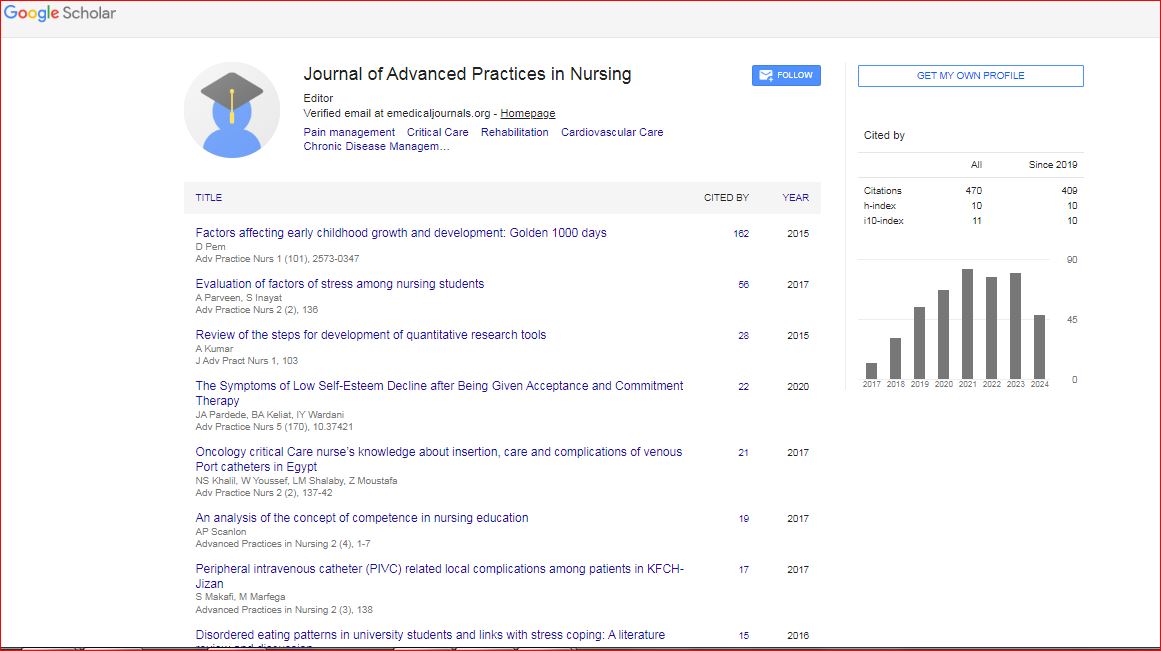
Journal of Advanced Practices in Nursing received 410 citations as per Google Scholar report