Opinion - (2025) Volume 9, Issue 4
Received: 01-Jul-2025, Manuscript No. fsb-26-189955;
Editor assigned: 03-Jul-2025, Pre QC No. P-189955;
Reviewed: 17-Jul-2025, QC No. Q-189955;
Revised: 22-Jul-2025, Manuscript No. R-189955;
Published:
29-Jul-2025
, DOI: 10.37421/2577-0543.2025.9.241
Citation: Svensson, Clara. ”Particle Size Engineering for Enhanced Drug Bioavailability.” J Formul Sci Bioavailab 09 (2025):241.
Copyright: © 2025 Svensson C. This is an open-access article distributed under the terms of the Creative Commons Attribution License, which permits unrestricted use, distribution and reproduction in any medium, provided the original author and source are credited.
The enhancement of drug dissolution rates and subsequent bioavailability is a paramount objective in pharmaceutical development, particularly for compounds exhibiting poor aqueous solubility. Particle size reduction stands out as a principal strategy to achieve this goal, primarily by increasing the surface area available for dissolution. Techniques such as micronization and nanonization are extensively employed to achieve sub-micron or even nanometer-sized particles. This modification directly impacts the Noyes-Whitney equation, a fundamental principle governing dissolution kinetics, by increasing the surface area-to-volume ratio. Consequently, the rate at which a drug dissolves in biological fluids is significantly accelerated [1].
Beyond the direct impact on dissolution, smaller particle sizes can profoundly influence drug absorption. This improvement is attributed to enhanced membrane permeation, as smaller particles may traverse biological barriers more readily. Furthermore, the reduction in particle size can lead to a decrease in the diffusion layer thickness surrounding the drug particles, facilitating faster drug transfer into the surrounding medium. However, it is crucial to acknowledge the challenges associated with these techniques, including the propensity for particle agglomeration and the increased complexity of manufacturing processes, which demand careful consideration and optimization [1].
Nanocrystallization has emerged as a particularly powerful technique to surmount the inherent challenges posed by poorly soluble drugs regarding their dissolution velocity and bioavailability. By meticulously reducing drug particles into the nanometer range, the surface area is dramatically amplified. This leads to a substantial increase in both the dissolution rate and the saturation solubility of the drug. Such improvements are critical for achieving adequate in vivo drug concentrations and therapeutic efficacy, proving especially effective for lipophilic drug substances [2].
The impact of particle size reduction on the performance of amorphous solid dispersions is a critical area of investigation for enhancing drug dissolution. When drug particles are reduced in size within a solid dispersion matrix, the overall surface area accessible for dissolution is increased. This enlarged surface area promotes a faster rate of drug release from the dispersion, thereby contributing to an overall improvement in the drug's bioavailability. This highlights the synergistic effect of amorphization and particle size control [3].
Micronization techniques, including but not limited to jet milling, represent a widely adopted approach in the pharmaceutical industry to elevate the dissolution rate and bioavailability of active pharmaceutical ingredients (APIs) that suffer from poor solubility. The fundamental principle behind micronization is the significant enlargement of the surface area that is exposed to the dissolution medium. This increased surface area directly accelerates the dissolution process, leading to more rapid absorption and potentially improved therapeutic outcomes [4].
The formulation of nano-suspensions offers a promising and innovative strategy for significantly boosting the oral bioavailability of drugs that are poorly soluble in water. By reducing the particle size of the drug to the sub-micron or nanometer range, the surface area available for dissolution is substantially increased. This leads to higher dissolution rates and consequently, improved absorption of the drug into the systemic circulation, making it an effective delivery system for challenging compounds [5].
Engineered particle surfaces and precisely controlled particle size distribution are indispensable elements for the optimization of both drug dissolution and absorption. Advanced techniques such as spray drying and controlled precipitation are instrumental in allowing for the meticulous manipulation of particle characteristics. This capability enables the tailoring of these characteristics to achieve desired pharmacokinetic profiles, ensuring that the drug is released and absorbed in a predictable and effective manner [6].
The application of amorphous nanodroplets and nanoparticles has demonstrated considerable potential in augmenting the oral absorption of hydrophobic drugs. The reduction in particle size to the nanoscale significantly expands the surface area available for dissolution. Concurrently, the amorphous nature of these systems inhibits recrystallization, a phenomenon that can drastically reduce solubility, thereby maintaining supersaturation and promoting enhanced absorption [7].
Solid lipid nanoparticles (SLNs) and nanostructured lipid carriers (NLCs) represent sophisticated and effective strategies for enhancing the oral bioavailability of drugs characterized by poor solubility. The reduction of particle size into the nano-range, in conjunction with the use of lipid matrices, synergistically elevates both dissolution rates and absorption. These systems offer a stable and highly versatile platform for drug delivery [8].
The particle size of amorphous solid dispersions exerts a considerable influence on their dissolution kinetics and their capacity for supersaturation. Generally, a reduction in particle size leads to a more rapid dissolution rate. Moreover, smaller particles tend to achieve higher drug concentrations in solution, a phenomenon known as supersaturation, which is crucial for facilitating improved drug absorption and therapeutic efficacy [9].
Controlled crystallization processes and meticulous particle size engineering are fundamental for effectively modulating drug release profiles and thereby improving the bioavailability of compounds that present solubility challenges. Techniques designed to produce smaller and more uniform particles are consistently linked to enhanced dissolution rates and superior therapeutic outcomes. This underscores the critical role of particle characteristics in drug performance [10].
The critical role of particle size reduction in enhancing drug dissolution rates, particularly for poorly soluble compounds, is well-established in pharmaceutical science. Micronization and nanonization are prominent techniques that achieve this by increasing the surface area-to-volume ratio of drug particles. This directly influences the Noyes-Whitney equation, a cornerstone of dissolution kinetics, leading to accelerated dissolution. Furthermore, smaller particle sizes can improve drug absorption by facilitating membrane permeation and reducing the diffusion layer thickness. However, practitioners must carefully address challenges such as particle agglomeration and increased manufacturing complexity [1].
Nanocrystallization stands out as a highly effective strategy for overcoming the limitations of poor solubility and bioavailability. By engineering drug particles into the nanometer size range, both dissolution velocity and saturation solubility are substantially elevated. This results in a significant improvement in in vivo drug performance, a benefit particularly pronounced for lipophilic drugs. The ability to achieve such fine particle sizes unlocks new possibilities for formulating challenging drug candidates [2].
The influence of particle size reduction on amorphous solid dispersions is a crucial factor in augmenting drug dissolution. When particles within these dispersions are reduced in size, the surface area available for dissolution increases. This enhanced surface area promotes a more rapid release of the drug from the dispersion matrix, consequently leading to an improvement in overall drug bioavailability. This interplay between amorphization and particle size is vital for effective drug delivery [3].
Micronization, often achieved through techniques like jet milling, is a widely employed method to boost the dissolution rate and bioavailability of active pharmaceutical ingredients that exhibit poor solubility. The underlying mechanism is the considerable increase in the surface area accessible to the dissolution medium, which in turn accelerates the rate at which the drug dissolves. This technique is a cornerstone in the development of numerous poorly soluble drugs [4].
Nano-suspensions represent a sophisticated approach to enhance the oral bioavailability of drugs with poor water solubility. The reduction of particle size to the sub-micron or nanometer level dramatically increases the surface area, which is directly correlated with higher dissolution rates. This improved dissolution subsequently leads to enhanced drug absorption, making nano-suspensions a valuable formulation strategy [5].
Effective particle engineering, encompassing controlled particle size distribution and engineered particle surfaces, is essential for optimizing drug dissolution and absorption. Techniques such as spray drying and controlled precipitation provide the means to precisely manipulate particle characteristics. This level of control allows for the fine-tuning of drug release profiles and the achievement of desired pharmacokinetic outcomes [6].
The utilization of amorphous nanodroplets and nanoparticles holds significant promise for improving the oral absorption of hydrophobic drugs. The dramatically increased surface area resulting from particle size reduction to the nanoscale facilitates enhanced dissolution. Moreover, the amorphous nature of these formulations prevents recrystallization, a process that can compromise solubility, thus maintaining supersaturation and promoting absorption [7].
Solid lipid nanoparticles (SLNs) and nanostructured lipid carriers (NLCs) are recognized as potent strategies for enhancing the oral bioavailability of poorly soluble drugs. By reducing particle size into the nano-range and incorporating them into lipid matrices, both dissolution and absorption are improved. These lipid-based nanocarriers provide a stable and adaptable platform for drug delivery [8].
The particle size of amorphous solid dispersions critically affects their dissolution behavior and supersaturation potential. Generally, smaller particle sizes lead to faster dissolution rates and higher drug concentrations in solution. This supersaturation phenomenon is key to facilitating improved drug absorption and achieving therapeutic levels in the body [9].
Controlled crystallization processes and sophisticated particle size engineering are fundamental for modulating drug release and improving the bioavailability of compounds with poor solubility. The production of smaller, more uniform particles is consistently associated with enhanced dissolution rates and better therapeutic results. This underscores the importance of precise control over particle characteristics in pharmaceutical development [10].
Particle size reduction, through techniques like micronization and nanonization, significantly enhances drug dissolution rates and bioavailability by increasing surface area. Smaller particles improve absorption by aiding membrane permeation and reducing diffusion layers, though agglomeration and manufacturing complexity are challenges. Nanocrystallization, nano-suspensions, amorphous solid dispersions, and lipid nanoparticles like SLNs and NLCs are effective strategies for poorly soluble drugs. Engineered particle surfaces and controlled size distribution are crucial for optimizing drug release and absorption. Amorphous nanodroplets and nanoparticles also improve hydrophobic drug absorption by increasing surface area and maintaining supersaturation. Controlled crystallization and precise particle engineering lead to improved dissolution and therapeutic outcomes.
None
None
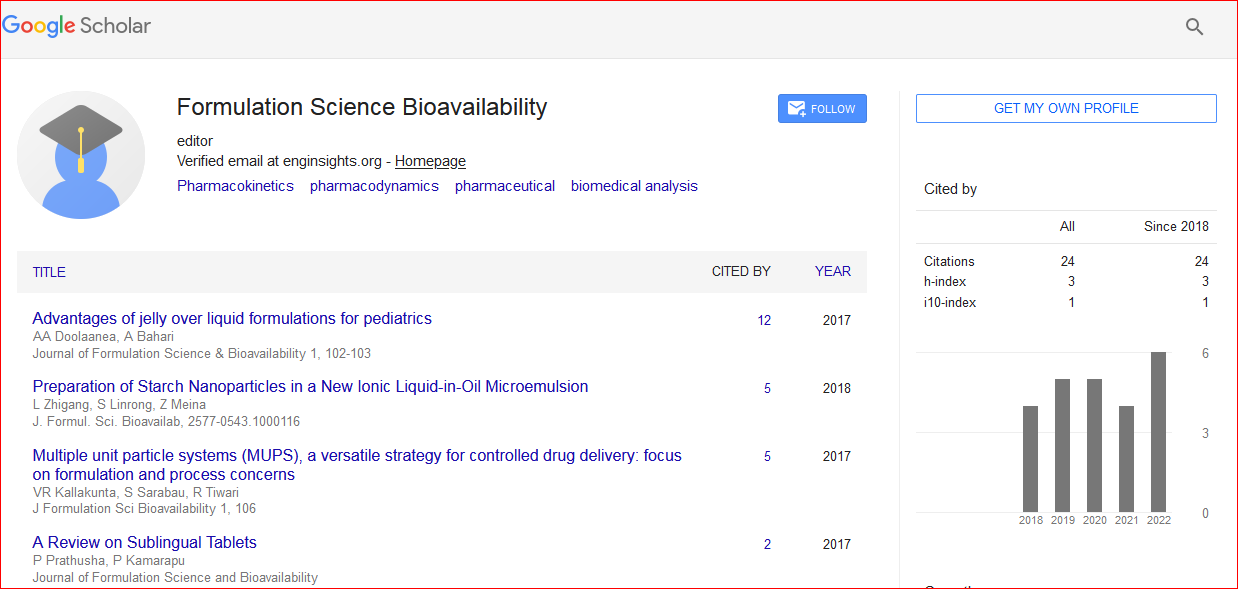
Journal of Formulation Science & Bioavailability received 23 citations as per Google Scholar report