Commentary - (2025) Volume 16, Issue 5
Received: 01-Oct-2025, Manuscript No. jvst-26-188132;
Editor assigned: 03-Oct-2025, Pre QC No. P-188132;
Reviewed: 17-Oct-2025, QC No. Q-188132;
Revised: 22-Oct-2025, Manuscript No. R-188132;
Published:
29-Oct-2025
, DOI: 10.37421/2157-7579.2025.16.324
Citation: Johansson, Erik. ”Parasitic Diseases: Threat To Livestock
And Food Security.” J Vet Sci Techno 16 (2025):324.
Copyright: © 2025 Johansson E. This is an open-access article distributed under the terms of the Creative Commons Attribution License, which permits unrestricted use,
distribution and reproduction in any medium, provided the original author and source are credited.
Parasitic diseases represent a formidable challenge to global livestock productivity, leading to significant economic repercussions for farmers worldwide. These infections manifest in various forms, each with distinct impacts on animal health and farm profitability. Helminthosis, a prevalent parasitic disease in cattle, is characterized by reduced growth rates, diminished feed efficiency, compromised reproductive success, and heightened susceptibility to other ailments. Effective control strategies, encompassing anthelmintic treatments, enhanced management practices, and the development of resistant breeds, are paramount in mitigating these detrimental effects [1].
Protozoan parasites, particularly Eimeria spp. and Cryptosporidium spp., inflict substantial morbidity and mortality among young livestock, notably poultry and calves. These pathogens induce intestinal damage, leading to malabsorption, severe diarrhea, and stunted growth, which directly curtail meat and milk production. Advances in diagnostic tools and the implementation of targeted chemoprophylaxis are crucial for effective disease management [2].
Ectoparasites, including ticks and mites, exert a dual threat to livestock. Beyond the direct harm caused by blood-feeding and skin irritation, they serve as vectors for a multitude of viral, bacterial, and protozoal diseases. This multifaceted impact results in anemia, decreased weight gain, damage to wool and hides, and considerable economic losses stemming from reduced productivity and compromised meat quality. Integrated pest management approaches are therefore indispensable for their control [3].
Gastrointestinal nematodes pose a pervasive threat to ruminant productivity on a global scale. Their presence leads to impaired nutrient absorption, suppressed immune function, and debilitating diarrhea. Consequently, affected animals exhibit poor weight gain, a decline in milk yield, and an increased vulnerability to secondary infections, thereby severely impacting the profitability of cattle and sheep farming. Strategic deworming programs and judicious grazing management are vital for mitigating these adverse outcomes [4].
Vector-borne parasitic diseases, such as trypanosomosis and anaplasmosis in cattle, exert substantial economic pressure through diminished productivity, widespread infertility, and increased mortality rates. These diseases directly affect meat and milk yields and undermine the efficiency of animal breeding programs. Control measures are heavily reliant on effective vector control alongside early detection and prompt treatment [5].
The emergence of novel parasitic diseases coupled with the escalating prevalence of drug resistance in existing parasites presents profound challenges to sustaining livestock productivity. The development of innovative diagnostic tools and the establishment of effective, sustainable control strategies, including the exploration of alternative therapies and the identification of genetic resistance, are critical for ensuring future food security [6].
The indirect economic costs associated with parasitic diseases, such as increased labor expenditure for treatment and management, and the diminished market value of affected animals, frequently surpass the direct financial losses incurred from reduced productivity. A comprehensive understanding of these economic ramifications is essential for the formulation of effective disease control policies and strategic investments [7].
Enhancing animal husbandry and implementing robust biosecurity measures, including pasture rotation and improved sanitation protocols, can significantly curtail parasite transmission and their subsequent deleterious impact on livestock productivity. These proactive, preventative strategies often prove more cost-effective in the long run than relying solely on curative treatments [8].
The development and deployment of vaccines targeting key parasitic diseases in livestock offer a promising and sustainable avenue for reducing the dependence on chemical treatments and mitigating associated economic losses. Despite persistent challenges, ongoing advancements in vaccinology are paving the way for more effective and enduring parasite control solutions [9].
Parasitic infections can significantly amplify the detrimental effects of other stressors on livestock, such as inadequate nutrition or challenging environmental conditions, leading to a compounded decline in both animal health and overall productivity. Consequently, integrated approaches that simultaneously address parasitic burdens and promote general animal welfare are indispensable for maintaining healthy and productive herds [10].
Parasitic diseases significantly impede livestock productivity, resulting in reduced growth rates, decreased feed efficiency, lower reproductive success, and increased susceptibility to secondary infections. This cascade of effects leads to substantial economic losses for farmers globally. Consequently, the implementation of effective control strategies, including the judicious use of anthelmintic treatments, the adoption of improved farm management practices, and dedicated research into developing parasite-resistant livestock breeds, is absolutely crucial for mitigating these widespread impacts [1].
Protozoan parasites, exemplified by Eimeria spp. and Cryptosporidium spp., are primary contributors to morbidity and mortality, particularly in young livestock such as poultry and calves. These infections trigger considerable intestinal damage, leading to impaired nutrient absorption, persistent diarrhea, and ultimately, stunted growth. These physiological disturbances have a direct and adverse effect on both meat and milk production. Therefore, advancements in diagnostic technologies and the strategic application of targeted chemoprophylaxis are recognized as key components in the successful management of these devastating diseases [2].
Ectoparasites, such as ticks and mites, inflict damage through multiple mechanisms. Beyond the direct consequences of blood-feeding and the resulting skin irritation, these parasites act as critical vectors for a wide array of viral, bacterial, and protozoal diseases. This combined impact frequently results in anemia, a noticeable reduction in weight gain, damage to valuable wool and hide products, and significant economic losses due to decreased animal productivity and a decline in the overall quality of meat. Consequently, the adoption of comprehensive integrated pest management strategies is deemed essential for effective control [3].
The widespread impact of gastrointestinal nematodes on ruminant productivity represents a global concern. These parasites provoke reduced nutrient absorption, suppress vital immune functions, and induce chronic diarrhea. The observable outcomes include poor weight gain, a marked decrease in milk yield, and an elevated susceptibility to secondary infections, all of which significantly erode the profitability of cattle and sheep farming operations. Therefore, the implementation of strategic deworming programs, coupled with meticulous grazing management, is vital for mitigating these detrimental effects [4].
Vector-borne parasitic diseases, including prevalent conditions such as trypanosomosis and anaplasmosis in cattle, are responsible for considerable economic losses. These losses are primarily driven by reduced productivity, significant infertility rates, and increased mortality. The economic consequences extend to diminished meat and milk production, as well as reduced efficiency within animal breeding programs. Effective control predominantly relies on robust vector control measures combined with early detection and prompt therapeutic interventions [5].
Emerging parasitic diseases and the increasing phenomenon of drug resistance in parasitic populations present formidable obstacles to maintaining consistent livestock productivity. The imperative for developing novel diagnostic tools and establishing effective, sustainable control measures, which includes exploring alternative therapeutic approaches and identifying genetic resistance within livestock populations, is paramount for safeguarding future food security [6].
The indirect economic costs associated with parasitic diseases often exceed direct losses. These indirect costs encompass increased labor requirements for treatment and management interventions, as well as a reduction in the market value of affected animals. A thorough understanding of these complex economic ramifications is fundamental for the successful development and implementation of effective disease control policies and for guiding essential investments in animal health [7].
Improvements in fundamental animal husbandry practices and the stringent application of biosecurity measures, such as strategic pasture rotation and enhanced sanitation protocols, can demonstrably reduce parasite transmission rates and thereby lessen their subsequent impact on livestock productivity. These proactive preventative strategies are frequently more economically viable than exclusive reliance on therapeutic treatments [8].
The advent and widespread adoption of vaccines against key parasitic diseases in livestock represent a highly promising and sustainable approach to lessening the reliance on conventional chemical treatments and effectively mitigating associated economic losses. Despite ongoing challenges, significant advancements in the field of vaccinology are progressively enabling the development of more efficacious and enduring parasite control solutions [9].
Parasitic infections possess the capacity to substantially exacerbate the negative effects of other stressors impacting livestock, including suboptimal nutrition or adverse environmental conditions. This synergistic interaction can lead to a compounded decline in animal health and productivity. Therefore, the implementation of integrated approaches that comprehensively address both parasitic burdens and overall animal welfare is critical for ensuring the health and productivity of livestock populations [10].
Parasitic diseases pose a significant threat to livestock productivity and farm economics worldwide. These infections, caused by helminths, protozoa, ectoparasites, and vectors, lead to reduced growth, impaired reproduction, increased susceptibility to other diseases, and economic losses through decreased production and quality. Control strategies include anthelmintic treatments, improved husbandry, biosecurity, integrated pest management, and vector control. Emerging diseases and drug resistance are growing concerns, emphasizing the need for novel diagnostics, vaccines, and sustainable control methods. Indirect costs and the synergistic effects of parasites with other stressors highlight the importance of integrated health management for food security.
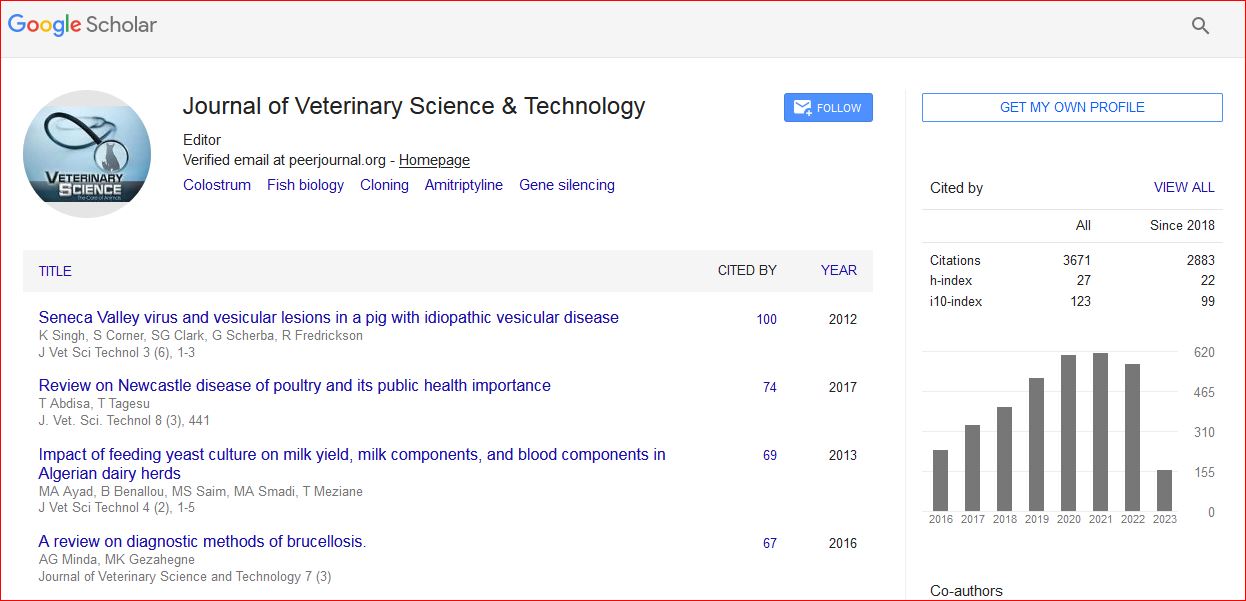
Veterinary Science & Technology received 4472 citations as per Google Scholar report