Short Communication - (2025) Volume 10, Issue 4
Received: 01-Aug-2025, Manuscript No. jidm-26-188081;
Editor assigned: 04-Aug-2025, Pre QC No. P-188081;
Reviewed: 18-Aug-2025, QC No. Q-188081;
Revised: 22-Aug-2025, Manuscript No. R-188081;
Published:
29-Aug-2025
, DOI: 10.37421/2576-1420.2025.10.418
Citation: Hassan, Ahmed. ”Parasitic Diseases: Diagnosis, Management,
and Control.” J Infect Dis Med 10 (2025):418.
Copyright: © 2025 Hassan A. This is an open-access article distributed under the terms of the Creative Commons Attribution License, which permits unrestricted use,
distribution and reproduction in any medium, provided the original author and source are credited.
The intricate field of parasitic infectious diseases necessitates a comprehensive understanding of their diagnosis and management, with continuous advancements shaping current clinical practices. Recent research has highlighted innovative diagnostic tools and evolving therapeutic strategies, underscoring the critical need for integrated approaches that consider diverse factors such as geographical prevalence, host-specific characteristics, and the emergence of drug resistance patterns, all crucial for effective treatment and control of these global health challenges [1].
Neglected tropical diseases, a significant burden in many parts of the world, present unique challenges in diagnosis and treatment. Schistosomiasis, a prime example, has seen progress in diagnostic algorithms, incorporating both serological and molecular methods, while also evaluating the efficacy of established drugs like praziquantel and exploring new therapeutic candidates, recognizing the profound impact of socioeconomic factors on disease burden and the development of control strategies [2].
The utility of point-of-care diagnostics in the management of infectious diseases, particularly in resource-limited settings, is gaining prominence. For malaria, rapid diagnostic tests (RDTs) are being assessed for their accuracy and applicability across various clinical scenarios. Strategies aimed at enhancing their performance and integrating them effectively into public health programs, alongside monitoring the evolving landscape of antimalarial drug resistance, are vital for sustained progress [3].
Giardiasis, a ubiquitous protozoan infection, continues to be a subject of detailed examination, with recent studies providing a comprehensive review of its epidemiology, pathogenesis, clinical manifestations, and diagnostic approaches. This includes established methods like microscopic examination and antigen detection, as well as current treatment guidelines, while also addressing persistent challenges related to drug resistance and patient adherence [4].
Leishmaniasis, especially in its endemic regions, presents a complex diagnostic and management spectrum. Recent investigations explore the range of clinical presentations, from traditional microscopy to advanced molecular techniques for diagnosis, and critically examine evolving therapeutic strategies, including the integration of novel drug combinations. The imperative for vector control and integrated management approaches is consistently emphasized to combat this disease effectively [5].
Amebiasis, particularly infections caused by Entamoeba histolytica, poses diagnostic dilemmas and requires careful consideration of therapeutic strategies. Research continues to refine diagnostic techniques, including stool microscopy, antigen detection, and serology, alongside presenting current treatment recommendations for both intestinal and extraintestinal manifestations, addressing concerns about asymptomatic carriage and potential resistance [6].
Echinococcosis, a zoonotic parasitic disease with both cystic and alveolar forms, demands thorough investigation from diagnosis to management. Contemporary reviews cover its epidemiology, sophisticated diagnostic imaging techniques, reliable serological markers, and molecular approaches. Critical evaluation of management strategies, encompassing surgical intervention and medical treatment with drugs like albendazole, along with their inherent limitations, remains a key area of focus [7].
Trichomoniasis, a prevalent sexually transmitted infection, is subject to ongoing research concerning its diagnosis and management. Studies detail clinical presentations, laboratory diagnostic methods ranging from microscopy and culture to nucleic acid amplification tests, and current treatment guidelines, emphasizing the critical importance of partner notification and effective prevention strategies to curb its transmission [8].
Toxoplasmosis, especially in immunocompromised individuals, requires precise diagnostic modalities and tailored management plans. The review of congenital, acquired, and reactivation forms, diagnostic tools including serology and molecular methods, and specific treatment regimens, along with exploring alternative therapies and preventative measures, is crucial for improving patient outcomes [9].
Filariasis, with a particular focus on lymphatic filariasis, continues to be a subject of significant research, providing updates on its diagnosis and management. Investigations review current diagnostic tools, such as antigen detection and ultrasound, and discuss global strategies for elimination, particularly mass drug administration. The challenges associated with drug resistance and the exploration of alternative treatment approaches are also critical components of these efforts [10].
The current landscape of parasitic infectious diseases is characterized by a dynamic interplay between sophisticated diagnostic advancements and evolving therapeutic interventions. Integrated management strategies are paramount, taking into account geographical distribution, host immune status, and the persistent challenge of drug resistance, which collectively inform effective treatment protocols and disease control efforts globally [1].
Within the realm of neglected tropical diseases, schistosomiasis demands targeted attention due to its significant morbidity. Progress in diagnostic algorithms, encompassing both immunological and molecular assays, alongside the critical evaluation of anthelmintic drugs like praziquantel and the development of new compounds, are vital. Understanding the socio-economic determinants of disease transmission and burden is fundamental for designing effective public health interventions [2].
The integration of point-of-care diagnostic technologies is revolutionizing the management of infectious diseases, especially in remote or resource-constrained areas. For malaria, the accuracy and utility of rapid diagnostic tests (RDTs) are continually being refined, with efforts focused on optimizing their use in diverse clinical settings and ensuring their seamless integration into national health programs, while vigilance against emerging drug resistance remains a priority [3].
Giardiasis, a widespread protozoan infection, is thoroughly investigated with recent literature offering a comprehensive overview of its epidemiology, the mechanisms of pathogenesis, characteristic clinical signs, and a spectrum of diagnostic techniques. These range from traditional microscopic methods to more sensitive antigen detection assays, complemented by updated treatment guidelines that address the ongoing issues of antimicrobial resistance and patient compliance [4].
Leishmaniasis control is significantly influenced by advancements in diagnostic capabilities and therapeutic options, particularly in regions where the disease is endemic. Research delves into the varied clinical presentations, diagnostic methods from direct microscopy to sophisticated molecular diagnostics, and the development of novel treatment regimens, often involving drug combinations. The importance of a multi-pronged approach that includes vector control alongside medical management is consistently highlighted [5].
Amebiasis, specifically infections caused by Entamoeba histolytica, continues to present diagnostic complexities and necessitates well-defined therapeutic strategies. Current investigations scrutinize diagnostic techniques such as stool examination, immunological tests, and molecular approaches, coupled with the formulation of evidence-based treatment recommendations for both intestinal and invasive forms of the disease, while also considering the implications of asymptomatic infections and resistance development [6].
Echinococcosis, a significant zoonotic parasitic infection, is addressed from a holistic perspective, covering its epidemiological patterns and diagnostic modalities. Advanced imaging techniques, reliable serological markers, and molecular assays are employed for accurate diagnosis, while management strategies, including surgical options and antiparasitic chemotherapy with drugs like albendazole, are continuously refined and their limitations assessed [7].
Trichomoniasis, a common sexually transmitted infection, benefits from modern diagnostic and therapeutic approaches. Clinical presentation, laboratory confirmation through microscopy, culture, and nucleic acid amplification tests, and adherence to current treatment protocols using agents like metronidazole are key. Emphasizing partner notification and robust prevention strategies is crucial for breaking the cycle of transmission [8].
Toxoplasmosis diagnosis and management are particularly critical in immunocompromised populations, where the risk of severe disease is elevated. Studies explore various clinical manifestations, diagnostic tools including serological markers and PCR, and optimal treatment regimens, often involving synergistic drug combinations, alongside strategies to prevent primary infection and reactivation [9].
Filariasis, with a concentrated focus on lymphatic filariasis, is being tackled through improved diagnostic tools and strategic management plans aimed at elimination. Current diagnostic methods, including antigen detection and ultrasound, are pivotal. The global strategy of mass drug administration, primarily with diethylcarbamazine, faces challenges that spur research into alternative treatments and approaches to overcome emerging drug resistance, all contributing to the goal of eradication [10].
This collection of articles provides a comprehensive overview of the diagnosis and management of various parasitic infectious diseases. It covers advancements in diagnostic tools, therapeutic strategies, and integrated approaches that consider geographical factors, host characteristics, and drug resistance. Specific diseases discussed include protozoan and helminthic infections, schistosomiasis, malaria, giardiasis, leishmaniasis, amebiasis, echinococcosis, trichomoniasis, toxoplasmosis, and filariasis. The articles highlight the challenges and progress in diagnosis and treatment, emphasizing the importance of point-of-care diagnostics, neglected tropical diseases, and strategies for disease elimination and control. Emerging drug resistance and adherence to treatment are also recurring themes.
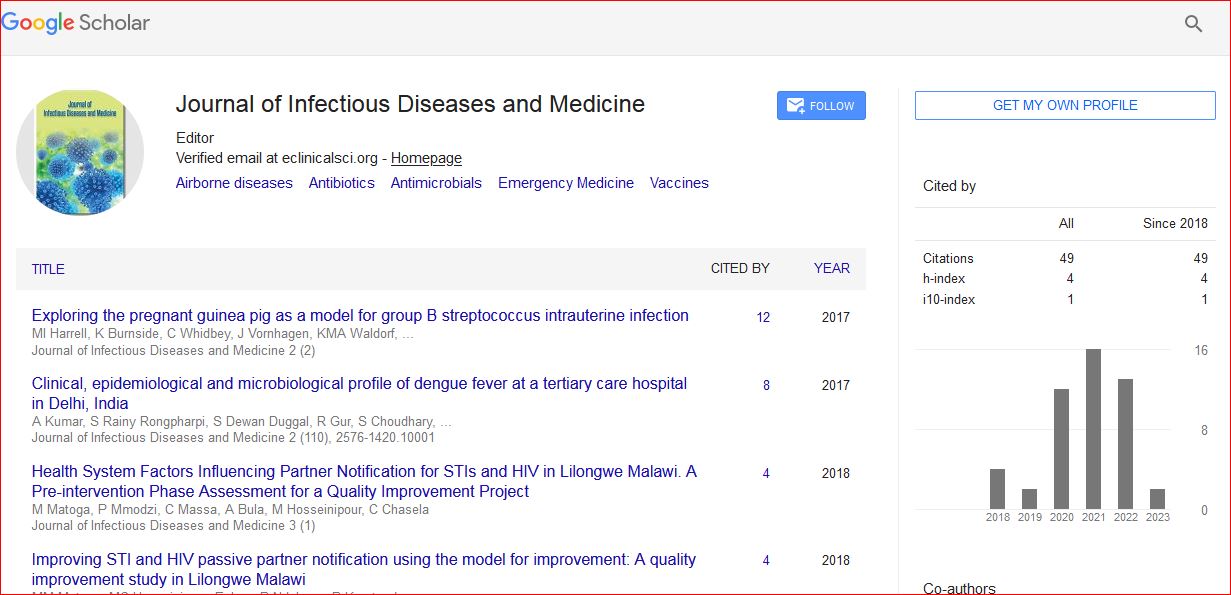
Journal of Infectious Diseases and Medicine received 1059 citations as per Google Scholar report