Brief Report - (2025) Volume 9, Issue 4
Received: 01-Aug-2025, Manuscript No. ahbs-26-182490;
Editor assigned: 04-Aug-2025, Pre QC No. P-182490;
Reviewed: 18-Aug-2025, QC No. Q-182490;
Revised: 22-Aug-2025, Manuscript No. R-182490;
Published:
29-Aug-2025
, DOI: 10.37421/2952-8097.2025.9.325
Citation: O Connor, Sinead. "Parasites Manipulate Behavior,
Reshaping Animal Lives." J Anim Health Behav Sci 09 (2025):325.
Copyright: © 2025 O Connor S. This is an open-access article distributed under the terms of the Creative Commons Attribution License, which permits unrestricted use,
distribution and reproduction in any medium, provided the original author and source are credited.
Parasitic infections represent a profound biological force, exerting significant influence over the behavior of their hosts. These alterations are not merely incidental but are often sophisticated adaptations that serve to enhance parasite survival and transmission, fundamentally impacting host fitness and ecological interactions. The range of behavioral modifications is vast, encompassing changes in feeding habits, activity levels, fear responses, and reproductive strategies, all stemming from the parasite's influence on the host's physiology and neurochemistry [1].
The neurochemical underpinnings of these parasite-induced behavioral shifts are complex and multifaceted, frequently involving the manipulation of key neurotransmitter systems such as dopamine, serotonin, and GABA. These alterations can precipitate dramatic changes in a host's motivation, cognitive processes, and emotional responses, thereby facilitating parasite propagation. For instance, modifications in dopamine levels can profoundly influence host activity and exploratory behaviors, potentially increasing their vulnerability to predation or subsequent infection [2].
Social behavior, a cornerstone of many animal societies, is also a common target for parasitic manipulation. Parasitic infections can disrupt essential social interactions, including aggression, affiliative behaviors, and social learning. Such disruptions can weaken the social bonds within a group, render hosts more susceptible to harm from conspecifics, and consequently impact population dynamics. The mechanisms underlying these social changes often involve the host's immune responses that inadvertently affect neural function or direct parasitic interference with critical signaling pathways [3].
Parasites frequently engage in the manipulation of host foraging and predator avoidance behaviors, strategically positioning hosts to increase their own transmission rates. This manipulation can manifest as increased boldness, reduced vigilance, or heightened attraction to specific environments or predator cues. These precisely tuned adaptations underscore the intricate co-evolutionary arms race that exists between parasites and their hosts [4].
Reproductive behavior is another critical aspect of host life history frequently targeted by parasites seeking to optimize their transmission. Parasites may alter a host's mating receptivity, mate choice preferences, or even parental care strategies. These sophisticated manipulations can exert substantial influence on host population structure and evolutionary trajectories, shaping the very dynamics of host populations [5].
Cognitive functions, including learning, memory, and decision-making capabilities, are demonstrably vulnerable to parasitic disruption. Infections can impair a host's ability to learn from past experiences or to make optimal choices in challenging situations, frequently leading to an increased susceptibility to various forms of harm. These cognitive deficits carry significant implications for a host's ecological interactions and overall survival rates [6].
The host's stress response system, particularly the hypothalamic-pituitary-adrenal (HPA) axis, is frequently dysregulated by parasitic infections. This dysregulation can lead to pronounced alterations in behavioral phenotypes. Chronic stress induced by parasites can manifest as heightened anxiety, diminished social engagement, and compromised coping mechanisms, ultimately rendering hosts less fit and more vulnerable to environmental challenges [7].
Specific parasite species have evolved the capacity to induce unique behavioral syndromes in their hosts, meticulously tailored to facilitate transmission within a particular ecological niche. A classic example involves parasites that infect aquatic snails, often rendering them hyperactive and prone to migrating into exposed areas, thereby increasing the likelihood of being consumed by the next host in the parasite's life cycle [8].
The gut microbiome, a dynamic and influential component of host physiology, plays a critical role in regulating host behavior. Parasitic infections can dramatically alter the composition and functional capacity of this microbial community. These induced dysbiotic changes can, in turn, influence host mood, anxiety levels, and social behavior through intricate gut-brain axis signaling pathways, adding another dimension to parasite-host manipulation [9].
Ultimately, the comprehensive evaluation of the behavioral effects induced by parasites is of paramount importance for both veterinary practice and wildlife management. Changes in host behavior can serve as crucial early indicators of parasitic infection, thereby informing disease surveillance and guiding intervention strategies. Moreover, a deeper understanding of these adaptive manipulations provides invaluable insights into the complex and intricate evolutionary dynamics that govern parasite-host relationships [10].
Parasitic infections significantly influence animal behavior, impacting host fitness, social interactions, and transmission dynamics. These behavioral changes, often subtle, can manifest as altered feeding patterns, reduced activity, increased fearfulness, or modified reproductive strategies, all serving to either benefit the parasite's life cycle or as a byproduct of the host's compromised physiological state. Understanding these behavioral shifts is crucial for managing animal health and conservation efforts [1].
The neurochemical underpinnings of parasite-induced behavioral modifications are diverse, often involving manipulation of neurotransmitter systems like dopamine, serotonin, and GABA. These alterations can lead to profound changes in host motivation, cognition, and emotional responses, thereby facilitating parasite transmission. For instance, altered dopamine levels can influence host activity and exploration, making them more susceptible to predation or further infection [2].
Social behavior in animals can be significantly disrupted by parasitic infections. This includes alterations in aggression, affiliative interactions, and social learning. Such changes can weaken social bonds, increase host vulnerability within a group, and potentially impact population dynamics. The mechanisms often involve host immune responses that affect neural function or direct parasitic manipulation of signaling pathways [3].
Parasites often manipulate host foraging and predator avoidance behaviors to increase their own transmission rates. This can involve making hosts bolder, less vigilant, or more attracted to specific environments or predator cues. These adaptations are highly specific, reflecting a co-evolutionary arms race between parasite and host [4].
Reproductive behavior is frequently targeted by parasites aiming to optimize their transmission through host mating or dispersal. This can involve altering mating receptivity, mate choice, or parental care. Such manipulations can have significant consequences for host population structure and evolution [5].
Cognitive functions such as learning, memory, and decision-making are vulnerable to parasitic disruption. Infections can impair a host's ability to learn from experience or make optimal choices, often leading to increased susceptibility to harm. This has profound implications for ecological interactions and survival rates [6].
The stress response system (HPA axis) is often dysregulated by parasitic infections, leading to altered behavioral phenotypes. Chronic stress can result in increased anxiety, reduced sociality, and impaired coping mechanisms, making hosts less fit and more vulnerable [7].
Specific parasite species can induce unique behavioral syndromes in their hosts, tailored to facilitate transmission within a particular ecological context. For instance, parasites infecting aquatic snails often make them more active and prone to moving into exposed areas, increasing the chances of being eaten by the next host in the life cycle [8].
The gut microbiome plays a critical role in host behavior, and parasitic infections can dramatically alter its composition and function. These dysbiotic changes can influence host mood, anxiety, and social behavior through the gut-brain axis, offering another layer of parasite manipulation [9].
Evaluating the behavioral effects of parasites is essential for veterinary practice and wildlife management. Changes in behavior can serve as early indicators of infection, influencing disease surveillance and intervention strategies. Understanding these adaptations also sheds light on the intricate evolutionary dynamics between parasites and their hosts [10].
Parasitic infections profoundly alter animal behavior, impacting host fitness, social dynamics, and transmission. These changes, driven by manipulation of neurochemistry and physiology, can affect foraging, predator avoidance, reproduction, cognition, and stress responses. Parasites exploit these behavioral shifts to enhance their own propagation, sometimes inducing specific syndromes tailored to their life cycles. The gut microbiome also plays a role, with parasites altering its composition and influencing host behavior via the gut-brain axis. Understanding these parasite-induced behavioral modifications is vital for animal health management, disease surveillance, and comprehending host-parasite co-evolution.
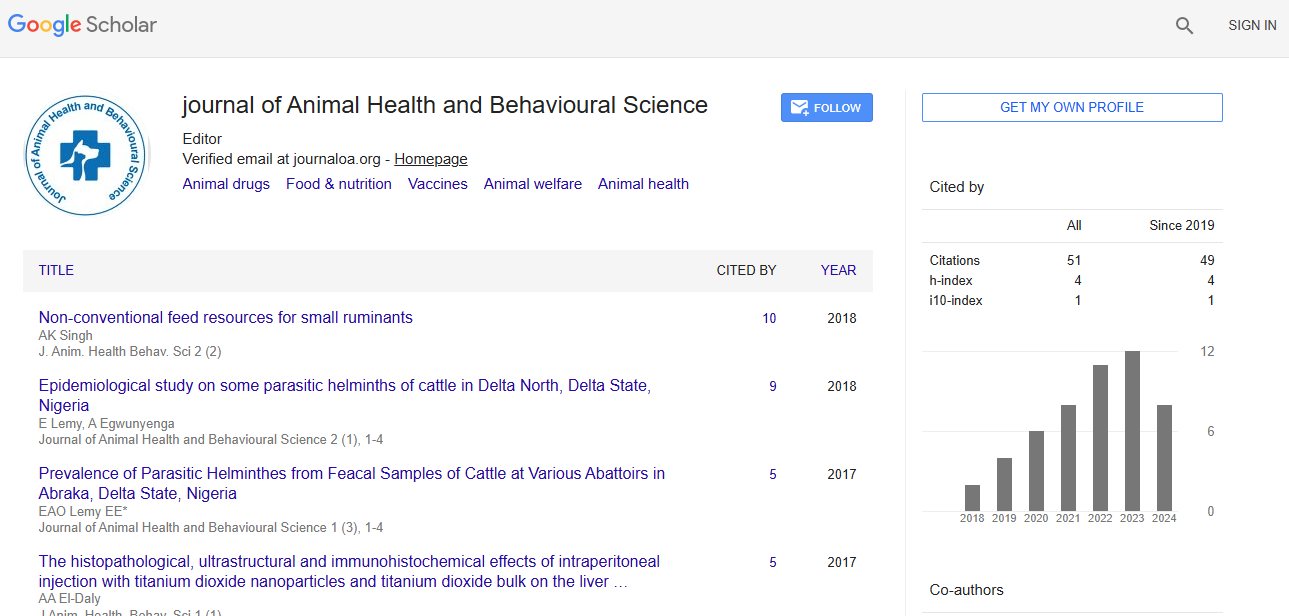
Journal of Animal Health and Behavioural Science received 38 citations as per Google Scholar report