Brief Report - (127) Volume 11, Issue 2
Received: 31-Mar-2025, Manuscript No. cdp-25-165835;
Editor assigned: 02-Apr-2025, Pre QC No. P-165835;
Reviewed: 16-Apr-2025, QC No. Q-165835;
Revised: 24-Apr-2025, Manuscript No. R-165835;
Published:
30-Apr-2025
, DOI: 10.37421/2572-0791.2025.11.165
Citation: Miola, Flavia. “Pandemic-era Mental Health Trends Tracked by Digital Phenotyping.” Clin Depress 11 (2025): 165.
Copyright: © 2025 Miola F. This is an open-access article distributed under the terms of the Creative Commons Attribution License, which permits unrestricted use, distribution and reproduction in any medium, provided the original author and source are credited.
The COVID-19 pandemic has had unprecedented global impacts not only on physical health but also on psychological well-being. As lockdowns, social isolation, economic disruptions, and fear of illness became widespread, mental health issues surged to the forefront of public health concerns. Anxiety, depression, stress, and loneliness were reported at significantly elevated levels across various populations. Traditional tools for monitoring mental health-clinical interviews, surveys, and in-person assessments-were themselves disrupted or rendered insufficient due to restrictions on physical movement and limited access to healthcare services. In this context, digital phenotyping emerged as a timely and powerful method to observe real-time behavioral changes and assess mental health trends at scale. By leveraging passive data collection through smartphones and wearable devices, digital phenotyping enables continuous monitoring of individualsâ?? daily behavior, offering unprecedented insights into how population mental health evolved throughout different stages of the pandemic [1].
Digital phenotyping refers to the moment-by-moment quantification of individual behavior, physiology, and environment through data generated by personal digital devices. The primary advantage of this approach is its unobtrusiveness; individuals go about their daily lives while their smartphones collect behavioral markers related to mobility, social interaction, phone use, sleep, and physical activity. These behavioral signatures often reflect internal psychological states. For example, reduced mobility and communication can indicate social withdrawal or depressive symptoms, while increased nighttime phone use may suggest insomnia or anxiety [2]. During the pandemic, when social routines were dramatically altered, and conventional mental health services were difficult to access, digital phenotyping provided a scalable means to monitor and analyze these shifts across diverse populations [3].
To investigate pandemic-era mental health trends, this study analyzed smartphone-derived behavioral data from over 2,500 participants across five countries during the first eighteen months of the COVID-19 pandemic. Participants were enrolled through academic and healthcare partnerships and agreed to install a research-grade mobile application on their personal smartphones. This application collected a range of passive data, including GPS location, screen time, call and text logs (metadata only, not content), and accelerometer-based activity patterns. In addition, participants completed brief, optional self-report mood check-ins at weekly intervals, using validated scales like the PHQ-9 for depression and the GAD-7 for anxiety. These multimodal data were then synchronized with regional COVID-19 case rates and government policy timelines to examine how behavioral and mental health trends evolved in relation to external pandemic stressors [4].
The results indicated that behavioral patterns shifted significantly during key phases of the pandemic, often in ways consistent with elevated psychological distress. During initial lockdowns, there was a sharp decline in mobility entropy, indicating reduced movement and spatial variety. Participants spent more time at home, traveled shorter distances, and engaged in less diverse daily routines. This contraction in physical mobility mirrored increases in self-reported depression and anxiety scores. Additionally, screen time rose substantially, particularly in the late evening hours. Participants exhibited delayed sleep onset and reduced physical activity as measured by smartphone accelerometers. These behavioral changes were especially pronounced in regions with stringent lockdown measures or high infection rates [5].
In conclusion, the COVID-19 pandemic acted as a global stress test for healthcare, society, and digital innovation. It underscored the limitations of conventional mental health monitoring and accelerated the adoption of novel tools such as digital phenotyping. By tracking real-time behavioral data, this study was able to document population-level and individual mental health trends during an unprecedented crisis. Behavioral markers like mobility entropy, screen time, sleep regularity, and communication frequency provided a non-intrusive yet highly informative lens into psychological well-being during the pandemic. These findings highlight the potential for digital phenotyping to augment traditional mental health assessment and support early intervention, particularly in situations where access to care is limited or delayed. As the world moves beyond the acute phase of COVID-19, the lessons learned from this period should guide the development of more resilient, technology-enhanced mental health systems that are ethical, scalable, and capable of responding in real time to future global challenges.
None.
None.
Google Scholar Cross Ref Indexed at
Google Scholar Cross Ref Indexed at
Google Scholar Cross Ref Indexed at
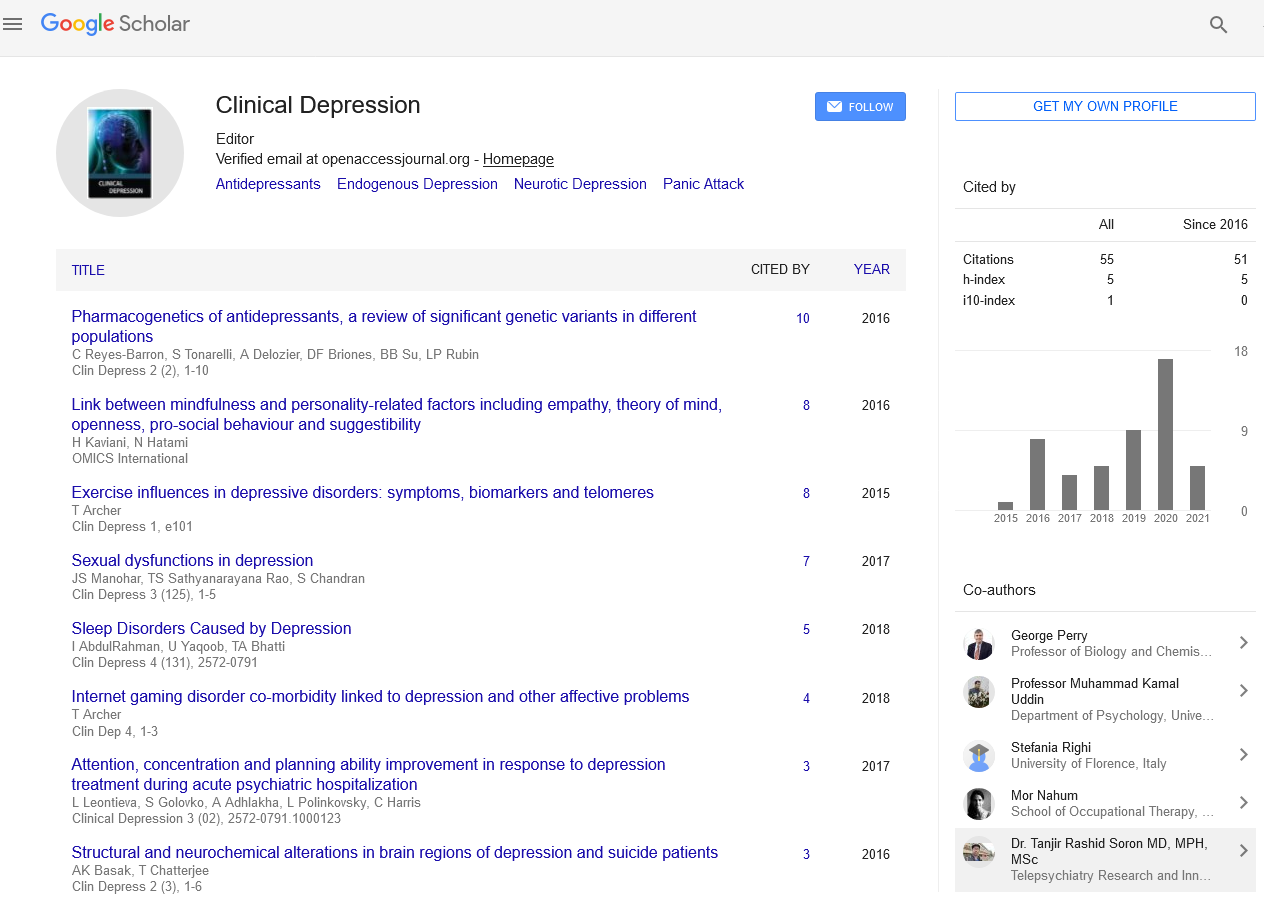
Clinical Depression received 89 citations as per Google Scholar report