Commentary - (2025) Volume 13, Issue 4
Received: 04-Aug-2025, Manuscript No. jcdd-25-176809;
Editor assigned: 06-Aug-2025, Pre QC No. P-176809;
Reviewed: 20-Aug-2025, QC No. Q-176809;
Revised: 25-Aug-2025, Manuscript No. R-176809;
Published:
01-Sep-2025
, DOI: 10.37421/2329-9517.2025.13.681
Citation: Novak, Peter. ”Pacing’s Future: Innovation, Safety,
Personalization.” J Cardiovasc Dis Diagn 13 (2025):681.
Copyright: © 2025 Novak P. This is an open-access article distributed under the terms of the Creative Commons Attribution License, which permits unrestricted use, distribution
and reproduction in any medium, provided the original author and source are credited.
The landscape of cardiac pacing technology is undergoing continuous transformation, with remarkable strides being made, particularly in the development of leadless pacemakers. These innovative devices represent a major advancement in managing various heart rhythm disorders, offering a compelling alternative to traditional systems. They function by eliminating the need for conventional leads, thereby significantly reducing the risk of complications often associated with lead malfunction or infection. This progression in design and application is meticulously explored, detailing their operational mechanisms, current availability, and potential future developments, all centered on enhancing patient safety and comfort [1].
However, a comprehensive understanding of cardiac pacing requires an equally rigorous focus on the potential complications that can arise. It is critical for clinicians to grasp the incidence rates of these issues, identify key predictive factors, and establish the most effective management strategies. Such detailed insight is paramount for improving overall patient safety and ensuring optimal long-term outcomes following device implantation [2].
Addressing these challenges proactively is a core aspect of modern electrophysiology. Furthermore, the very philosophy of pacing has evolved towards mimicking the heart's natural physiology more closely. Physiological pacing techniques, notably His bundle pacing and left bundle branch pacing, represent a significant paradigm shift. These methods aim to restore the heart's intrinsic electrical activation sequence, which is vital for maintaining ventricular synchrony and potentially leading to superior long-term clinical benefits for patients who rely on pacemaker support [3].
This approach reflects a deeper understanding of cardiac mechanics. A persistent concern for individuals living with pacemakers and other cardiac implantable electronic devices has been their compatibility with Magnetic Resonance Imaging (MRI). Historically, MRI scans were largely contraindicated, limiting diagnostic options. However, recent systematic reviews and meta-analyses have consolidated compelling evidence affirming the safety of MRI for patients with both pacemakers and Implantable Cardioverter-Defibrillators (ICDs) under specific conditions. This provides crucial, updated guidance for clinical practice, expanding diagnostic access for countless patients [4].
It's a testament to ongoing engineering and clinical research. The broader evolution of both leadless pacemakers and ICDs continues to redefine strategies in cardiac rhythm management. This area is characterized by ongoing innovation in device design, functional enhancements, and the exploration of expanded clinical applications. The trajectory points towards increasingly sophisticated and less invasive solutions for a wide range of cardiac arrhythmias, improving quality of life for patients [5].
This forward momentum is driven by both technological ingenuity and clinical necessity. Patient follow-up has also been revolutionized by the widespread adoption of remote monitoring technologies for cardiac implantable electronic devices. This capability allows for continuous oversight of device function and patient physiological parameters, facilitating the early detection of potential issues. Ultimately, remote monitoring improves the efficiency of patient care, reduces the need for frequent clinic visits, and significantly contributes to better clinical outcomes [6].
This proactive surveillance model is becoming standard practice. Specific patient populations, such as children and adolescents, present unique considerations for pacemaker implantation. A systematic review dedicated to this younger demographic illuminates the contemporary indications for pacing and meticulously evaluates the long-term outcomes. These insights are indispensable for refining management strategies and ensuring the best possible prognosis for this special group of patients [7], acknowledging their distinct anatomical and physiological needs. Looking to the future, Artificial Intelligence (AI) is rapidly emerging as a transformative force within cardiac implantable electronic devices. AI holds immense promise for enhancing pacemaker functionality, significantly improving diagnostic capabilities through advanced data analysis, and enabling truly personalized therapy. This integration promises more efficient, effective, and adaptive management of complex heart rhythm disorders, ushering in an era of intelligent cardiac devices [8].
Despite all these advancements, complications can sometimes necessitate the critical procedure of lead extraction. This intervention is often required to manage issues such as lead malfunction or infection. Contemporary data from systematic reviews and meta-analyses provides a comprehensive summary of the safety and effectiveness outcomes associated with transvenous lead extraction, offering vital information for clinicians making complex decisions [9].
Finally, safeguarding patient health requires robust protocols for the prevention and management of infections related to cardiac implantable electronic devices. A scientific statement offers comprehensive guidelines, detailing strategies to prevent infections during the implantation procedure itself and outlining effective management protocols should an infection manifest. These guidelines are fundamental to maintaining the highest standards of patient safety and care [10].
The field of cardiac pacing has witnessed remarkable advancements, particularly with the emergence of leadless pacemakers, which represent a significant leap forward in addressing cardiac rhythm disorders [1]. These devices aim to mitigate complications often associated with traditional transvenous leads, offering a less invasive solution and improving long-term outcomes for patients. Parallel to this, physiological pacing techniques, such as His bundle pacing and left bundle branch pacing, are gaining prominence. These methods strive to replicate the heart's natural electrical activation, thereby enhancing ventricular synchrony and potentially leading to better clinical results for individuals requiring pacemaker therapy [3]. This ongoing innovation in device design and pacing methodology collectively underscores a paradigm shift towards more effective and patient-centric cardiac rhythm management [5].
Understanding and managing the complexities of cardiac pacing is paramount for patient safety. A thorough examination of cardiac pacing complications, including their incidence, predictive factors, and optimal management strategies, is crucial for improving patient outcomes [2]. Beyond general complications, specific concerns like Magnetic Resonance Imaging (MRI) compatibility have been a long-standing challenge. Recent systematic reviews and meta-analyses provide reassuring evidence on the safety of MRI scans for patients with both pacemakers and Implantable Cardioverter-Defibrillators (ICDs), offering essential clinical guidance and expanding diagnostic access [4]. Furthermore, preventing and managing infections related to cardiac implantable electronic devices remains a critical aspect of patient care, with comprehensive guidelines offering strategies for prevention during implantation and effective protocols for management if infections occur [10].
When complications, particularly lead-related issues, arise, procedures like lead extraction become necessary. This critical intervention is vital for managing device-related problems, and contemporary data, summarized in systematic reviews and meta-analyses, provides important insights into the safety and effectiveness of transvenous lead extraction [9]. These detailed studies help clinicians make informed decisions about when and how to perform such intricate procedures, ensuring the best possible outcome for patients who require explantation or revision.
Modern patient care is being fundamentally reshaped by advancements in remote monitoring for cardiac implantable electronic devices. This technology enables continuous oversight of device function and patient health, facilitating the early detection of potential issues. Remote monitoring significantly enhances the efficiency of patient care, reduces the need for frequent in-person clinic visits, and ultimately contributes to improved clinical outcomes by allowing for timely interventions [6]. This proactive approach to surveillance has become an indispensable tool in managing long-term device therapy.
Looking towards future horizons, Artificial Intelligence (AI) is rapidly integrating into cardiac implantable electronic devices. This integration promises to revolutionize device functionality, enhancing diagnostic capabilities through sophisticated data analysis and enabling truly personalized therapeutic responses. The advent of AI in pacemakers and ICDs heralds a new era of more efficient, effective, and adaptive management of complex heart rhythm disorders, moving towards precision medicine [8].
Moreover, specialized patient populations demand tailored approaches. Pacemaker implantation in children and adolescents, for instance, presents unique considerations. A systematic review specifically addresses the contemporary indications for pacing in younger patients and evaluates their long-term outcomes, offering invaluable insights for optimizing management strategies within this distinct demographic [7]. This focus on specific patient groups ensures that advancements are applied thoughtfully across the entire spectrum of patients needing cardiac pacing. These combined efforts demonstrate a robust and evolving commitment to improving cardiac rhythm management.
The landscape of cardiac pacing is rapidly advancing, with a strong focus on innovation and improved patient outcomes. Leadless pacemakers represent a significant technological leap, reducing lead-related complications and driving future directions in cardiac rhythm management [1, 5]. Alongside these innovations, physiological pacing techniques, such as His bundle and left bundle branch pacing, are gaining traction for their ability to mimic natural heart activation and improve ventricular synchrony [3]. However, the field also emphasizes understanding and mitigating risks. Comprehensive reviews highlight the incidence, predictors, and management of general cardiac pacing complications [2]. Crucial guidance is available on Magnetic Resonance Imaging (MRI) safety for patients with pacemakers and Implantable Cardioverter-Defibrillators (ICDs), expanding diagnostic options [4]. Procedures like transvenous lead extraction are vital for managing lead-related issues, with contemporary data supporting their safety and effectiveness [9]. Furthermore, robust guidelines address the critical prevention and management of cardiac implantable electronic device infections [10]. Modern care is being enhanced by remote monitoring, which allows for early detection of problems and improves patient care efficiency [6]. Artificial Intelligence (AI) is also emerging as a transformative force, promising to enhance device functionality, diagnostics, and personalized therapy for heart rhythm disorders [8]. Specific populations, like children and adolescents, receive dedicated attention, with research outlining unique indications and outcomes for pacemaker implantation in younger patients [7]. Overall, these developments point towards a future of more refined, safer, and personalized cardiac rhythm management.
Indexed at, Google Scholar, Crossref
Indexed at, Google Scholar, Crossref
Indexed at, Google Scholar, Crossref
Indexed at, Google Scholar, Crossref
Indexed at, Google Scholar, Crossref
Indexed at, Google Scholar, Crossref
Indexed at, Google Scholar, Crossref
Indexed at, Google Scholar, Crossref
Indexed at, Google Scholar, Crossref
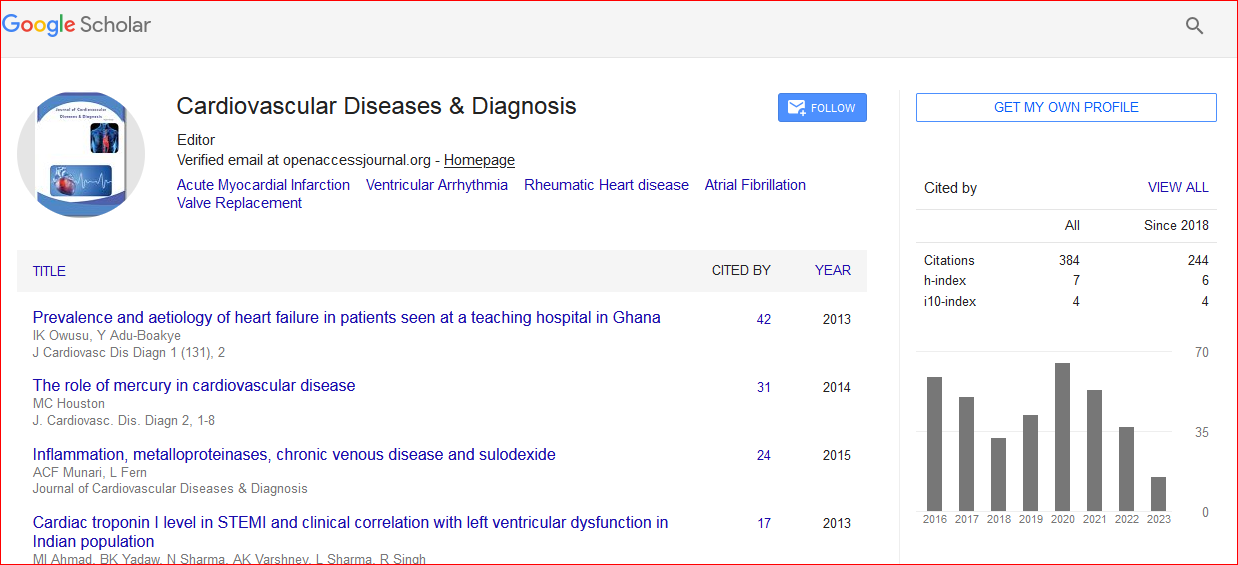
Cardiovascular Diseases & Diagnosis received 427 citations as per Google Scholar report