Perspective - (2025) Volume 11, Issue 4
Received: 01-Jul-2025, Manuscript No. ohcr-25-174297;
Editor assigned: 03-Jul-2025, Pre QC No. P-174297;
Reviewed: 17-Jul-2025, QC No. Q-174297;
Revised: 22-Jul-2025, Manuscript No. R-174297;
Published:
29-Jul-2025
, DOI: 10.37421/2471-8726.2025.11.206
Citation: Nakamura, Keiko. ”Oral Health: Systemic, AI, and Integrated Solutions.” Oral Health Case Rep 11 (2025):206.
Copyright: © 2025 Nakamura K. This is an open-access article distributed under the terms of the Creative Commons Attribution License, which permits unrestricted use, distribution and reproduction in any medium, provided the original author and source are credited.
Recent research updates our understanding of how periodontitis connects to various systemic conditions, highlighting inflammatory mechanisms and shared risk factors that link gum disease with illnesses like cardiovascular disease, diabetes, and certain autoimmune disorders. Managing periodontitis, essentially, plays a role in improving overall systemic health outcomes, underscoring the importance of integrated healthcare approaches [1].
Examining hurdles in early diagnosis of oral squamous cell carcinoma is crucial for future strategies. The importance of timely detection for improving patient outcomes is emphasized, particularly through advanced imaging techniques, biomarker discovery, and Artificial Intelligence, with the goal to identify lesions before they become invasive, highlighting the need for better screening protocols and public awareness [2].
New developments in preventing and managing dental caries in children are explored, covering various strategies including fluoride varnishes, sealants, and sugar substitutes. Innovative technologies like silver diamine fluoride are also discussed, stressing the importance of early intervention and a multi-faceted approach involving parents, caregivers, and dental professionals to reduce the global burden of childhood tooth decay [3].
The complex role of the oral microbiome is delved into, showing how the balance or imbalance of oral microbes profoundly affects systemic health. This research explains mechanisms by which oral bacteria contribute to or protect against various diseases, including inflammatory conditions, cardiovascular disease, and metabolic disorders, making understanding these connections crucial for developing new diagnostic and therapeutic strategies that link oral and general health [4].
This review provides clinicians with the latest approaches to managing xerostomia, or dry mouth. It discusses various causes, from medications to systemic diseases, and outlines both non-pharmacological and pharmacological interventions. The article emphasizes personalized patient care, highlighting strategies for symptom relief, salivary stimulation, and preventing oral complications associated with reduced salivary flow [5].
Recent progress in identifying and treating oral candidiasis, a common fungal infection, is highlighted. This includes exploring new diagnostic techniques, like molecular methods, and discussing evolving therapeutic strategies to combat antifungal resistance, emphasizing the importance of accurate diagnosis and tailored treatments to effectively manage this persistent oral disease, especially in immunocompromised individuals [6].
A critical review examines significant disparities in oral health among children, identifying socioeconomic status, race/ethnicity, and geographic location as key contributing factors. These inequalities lead to unequal access to care and worse oral health outcomes, advocating for targeted public health interventions and policies aimed at promoting equity and improving oral health for all children [7].
The unique oral health challenges faced by older adults are addressed in a narrative review, covering issues like root caries, periodontal disease, xerostomia, and the impact of systemic conditions and polypharmacy on oral health. The article underscores the need for integrated care models and specialized dental services to maintain oral function and enhance the quality of life for the growing elderly population [8].
Various oral manifestations observed in patients with COVID-19 are explored in this narrative review. It describes conditions such as taste disturbances, dry mouth, oral lesions, and fungal infections, suggesting potential direct and indirect pathogenic mechanisms. Recognizing these oral signs is important for dental professionals in both diagnosis and patient management during and after the pandemic [9].
A systematic review evaluates the growing application of Artificial Intelligence (AI) in diagnosing oral and maxillofacial diseases. It highlights AI's potential to enhance diagnostic accuracy for conditions like caries, periodontal disease, and oral cancer through image analysis and predictive modeling, discussing both the promise and current limitations of AI, emphasizing its role as a supportive tool for clinicians rather than a replacement [10].
Understanding the intricate connections between oral health and overall systemic well-being is increasingly critical. For instance, recent research confirms that periodontitis is not an isolated condition but is deeply linked to various systemic diseases, including cardiovascular disease, diabetes, and certain autoimmune disorders. This connection is driven by shared inflammatory mechanisms and risk factors, underscoring how managing gum disease can significantly improve broader systemic health outcomes [1]. Expanding on this, the oral microbiome plays a profound role in systemic health. The balance or imbalance of oral microbes can contribute to or protect against a range of conditions, from inflammatory diseases to metabolic disorders, highlighting the importance of studying these microbial communities for new diagnostic and therapeutic strategies that bridge oral and general health [4].
Advancements in diagnostic methodologies are transforming how oral and maxillofacial diseases are identified and managed. Early diagnosis of oral squamous cell carcinoma, for example, is paramount for improving patient outcomes. Future strategies in this area heavily emphasize advanced imaging techniques, the discovery of novel biomarkers, and the powerful application of Artificial Intelligence (AI). The goal remains to identify lesions before they become invasive, which demands better screening protocols and heightened public awareness [2]. In a similar vein, AI is undergoing a significant evaluation for its role in diagnosing a spectrum of oral and maxillofacial conditions. This technology shows considerable potential to enhance diagnostic accuracy for issues like caries, periodontal disease, and oral cancer through sophisticated image analysis and predictive modeling, positioning AI as a crucial supportive tool for clinicians [10].
Specific oral health challenges also see continuous innovation in prevention and management. Dental caries in children, a significant global burden, benefits from new developments such as fluoride varnishes, sealants, sugar substitutes, and innovative silver diamine fluoride applications. A multi-faceted approach involving parents, caregivers, and dental professionals is key to reducing this widespread issue [3]. Furthermore, managing xerostomia, commonly known as dry mouth, has received updated clinical guidance. This involves addressing its various causes, from medications to systemic diseases, and employing both non-pharmacological and pharmacological interventions. Personalized patient care is central to relieving symptoms and preventing associated oral complications [5]. Another common concern, oral candidiasis, a fungal infection, has seen progress in its diagnosis and treatment. This includes molecular diagnostic methods and evolving therapeutic strategies designed to combat antifungal resistance, ensuring accurate diagnosis and tailored treatments, particularly for immunocompromised individuals [6].
Addressing oral health needs across different populations reveals critical disparities and unique challenges. Children, for instance, face significant oral health disparities influenced by socioeconomic status, race/ethnicity, and geographic location. These inequalities often translate into unequal access to care and poorer oral health outcomes, necessitating targeted public health interventions and policies that promote equity [7]. Older adults present another demographic with distinct oral health challenges, including root caries, periodontal disease, and xerostomia, frequently complicated by systemic conditions and polypharmacy. Integrated care models and specialized dental services are essential to maintain oral function and enhance the quality of life for this growing population [8]. Moreover, the recent COVID-19 pandemic brought to light various oral manifestations, such as taste disturbances, dry mouth, oral lesions, and fungal infections, which dental professionals must recognize for effective diagnosis and patient management during and after the pandemic [9].
Collectively, these insights underscore a dynamic and evolving landscape in oral healthcare. The emphasis is consistently on prevention, early detection, personalized care, and integrating oral health into broader systemic health strategies. From understanding microbial ecosystems to leveraging cutting-edge Artificial Intelligence, the field is advancing rapidly to improve diagnostic accuracy, treatment efficacy, and overall patient well-being across all age groups and health statuses, striving for more equitable and comprehensive care in dentistry.
Recent findings highlight the profound systemic links of periodontitis to conditions like cardiovascular disease, diabetes, and autoimmune disorders, advocating for integrated healthcare approaches to improve overall health outcomes. There's a critical focus on the early diagnosis of oral squamous cell carcinoma, driven by advancements in imaging, biomarker discovery, and Artificial Intelligence, aiming for timely detection and better screening protocols. Innovations in pediatric dental care, including fluoride applications and sealants, are key to preventing and managing childhood dental caries, emphasizing comprehensive strategies involving parents and dental professionals. The oral microbiome plays a significant role in systemic health, influencing various diseases, thus making the understanding of its balance crucial for developing new diagnostic and therapeutic methods. Managing xerostomia (dry mouth) involves updated clinical approaches, from non-pharmacological to pharmacological interventions, with an emphasis on personalized patient care to alleviate symptoms and prevent complications. Advances in oral candidiasis diagnosis and treatment include molecular techniques and strategies to counter antifungal resistance, highlighting the necessity for precise diagnosis and customized therapies, especially for vulnerable populations. Oral health disparities in children, stemming from socioeconomic factors and geographic location, demand targeted public health policies to ensure equitable access and improved outcomes. Older adults face distinct oral health issues, such as root caries and periodontal disease, often compounded by systemic conditions, necessitating specialized and integrated dental care. The impact of COVID-19 extends to various oral manifestations, requiring dental professionals to be aware of these signs for effective patient management. Finally, Artificial Intelligence is transforming the diagnosis of oral and maxillofacial diseases, offering a powerful supportive tool for clinicians through enhanced diagnostic accuracy.
None
None
1. Ian LC, Robert JG, Bruce LP. "Systemic Links of Periodontitis: An Update".J Clin Periodontol 50 (2023):11-20.
Indexed at, Google Scholar, Crossref
2. Camile SF, Simi K, Yuan L. "Early diagnosis of oral squamous cell carcinoma: Current challenges and future directions".J Oral Pathol Med 50 (2021):893-903.
Indexed at, Google Scholar, Crossref
3. Preeya P, Chun-Hung C, Orawan C. "Recent advances in the prevention and management of dental caries in children".J Clin Pediatr Dent 46 (2022):255-263.
Indexed at, Google Scholar, Crossref
4. George H, Patricia ID, Miriam S. "The oral microbiome and its impact on systemic health".Nat Rev Microbiol 19 (2021):790-802.
Indexed at, Google Scholar, Crossref
5. Susan F, Helen VW, Anne-Marie G. "Management of Xerostomia: An Update for the Clinician".Oral Dis 26 (2020):786-802.
Indexed at, Google Scholar, Crossref
6. Julian RN, Attila G, Mark O. "Advances in the Diagnosis and Treatment of Oral Candidiasis".Front Cell Infect Microbiol 13 (2023):1152019.
Indexed at, Google Scholar, Crossref
7. Christopher EO, Esohe O, Victor O. "Oral health disparities in children: A critical review".J Public Health Dent 80 (2020):1-9.
Indexed at, Google Scholar, Crossref
8. Poul EP, Daniel K, Christian K. "Oral Health and Care in Older Adults: A Narrative Review".Int Dent J 69 (2019):11-19.
Indexed at, Google Scholar, Crossref
9. Benedetta F, Danilo DV, Arturo DB. "Oral manifestations of COVID-19: a narrative review".Oral Dis 27 (2021):751-760.
Indexed at, Google Scholar, Crossref
10. Falk S, Animesh C, Takahiro K. "Artificial intelligence in oral and maxillofacial diseases: A systematic review".J Dent Res 102 (2023):499-509.
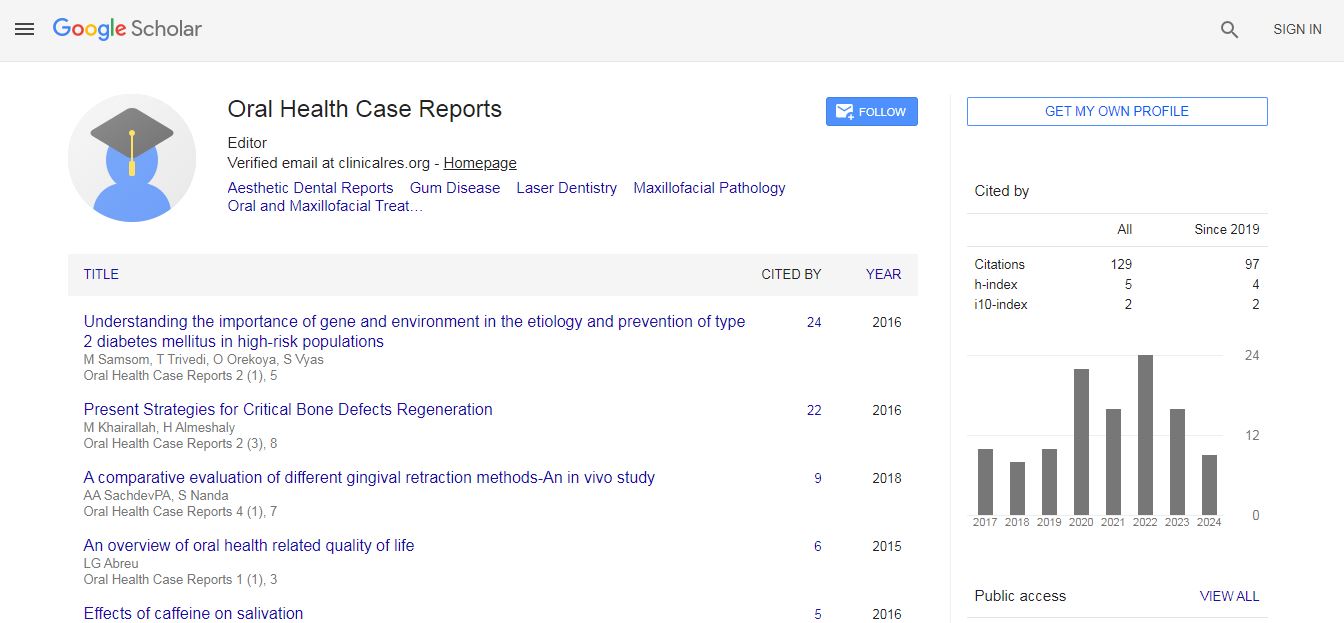
Oral Health Case Reports received 120 citations as per Google Scholar report