Brief Report - (2025) Volume 11, Issue 3
Received: 01-May-2025, Manuscript No. ohcr-25-174263;
Editor assigned: 03-May-2025, Pre QC No. P-174263;
Reviewed: 19-May-2025, QC No. Q-174263;
Revised: 22-May-2025, Manuscript No. R-174263;
Published:
29-May-2025
, DOI: 10.37421/2471-8726.2025.11.194
Citation: Brooks, Nathaniel. ”Oral Health Conditions: Diagnosis, Management, Prevention.” Oral Health Case Rep 11 (2025):194.
Copyright: © 2025 Brooks N. This is an open-access article distributed under the terms of the Creative Commons Attribution License, which permits unrestricted use, distribution and reproduction in any medium, provided the original author and source are credited.
Oral lesions in children are diverse, often reflecting systemic conditions or local factors. Recognizing these early is crucial for effective management. This review highlights the importance of thorough clinical examination and knowledge of common presentations specific to pediatric dentistry, helping clinicians accurately diagnose and treat conditions ranging from developmental anomalies to infections and autoimmune issues [1].
Here's the thing about oral lichen planus: it's a chronic inflammatory condition, and managing it effectively often means staying current with treatment protocols. This paper offers updated guidelines, emphasizing diagnostic criteria and therapeutic approaches, which often involve corticosteroids or other immunomodulators. The goal is to minimize symptoms and prevent potential malignant transformation, underscoring the need for vigilant follow-up [2].
When we talk about oral mucositis, what we're really discussing is a debilitating complication, often seen in cancer patients undergoing radiation or chemotherapy. This review provides a clear look at how it develops, what it looks like clinically, and the strategies for managing it. The focus is on symptomatic relief and preventing secondary infections, which is critical for patient quality of life during treatment [3].
Let's break down recurrent aphthous stomatitis. It's a common condition, those painful oral ulcers, and its exact cause is still elusive, though genetics, immunology, and environmental factors are often implicated. This systematic review explores its underlying mechanisms, typical clinical features, and various treatment options, from topical steroids to systemic therapies, aiming to alleviate discomfort and reduce recurrence frequency [4].
Geographic tongue, or benign migratory glossitis, is an interesting one â?? it presents with shifting patterns of redness and white borders on the tongue, often asymptomatic but sometimes causing sensitivity. This review covers what might cause it, how it looks, and approaches to management. Essentially, it's about understanding that while it's generally harmless, identifying triggers and managing any associated discomfort is key [5].
Pemphigus vulgaris is a serious autoimmune blistering disease, often presenting with oral lesions as the initial sign. This review succinctly covers its underlying pathology, what to look for clinically, and the therapeutic approaches, typically involving systemic corticosteroids and immunosuppressants. Early diagnosis and intervention are critical here to control the disease and improve patient outcomes, given its potential severity [6].
Here's a look at oral lesions linked to systemic lupus erythematosus (SLE). SLE is a complex autoimmune disease, and its oral manifestations can range from ulcers to specific discoid lesions, often serving as diagnostic indicators. This systematic review synthesizes current knowledge on these presentations, emphasizing their importance for early diagnosis and multidisciplinary management in patients with or suspected of having SLE [7].
What this review really means is that oral pigmentation can be both normal and a sign of something more serious. It explores the different types, from common physiological variations to pathological conditions like melanomas or systemic disease indicators. Distinguishing between these is crucial for clinicians, guiding decisions on whether a biopsy or further investigation is needed [8].
The world of oral pre-malignancy is critical for cancer prevention. This review delves into the clinical presentation and diagnostic strategies for these potentially transformative lesions. It highlights the importance of early detection and accurate characterization, using both traditional methods and adjunctive diagnostic aids, to identify high-risk areas and manage them proactively before they progress to full-blown oral cancer [9].
Burning Mouth Syndrome is a tricky one because often there are no visible lesions, yet patients experience significant discomfort. This comprehensive review covers the diagnostic journey, which often involves ruling out underlying systemic or local causes, and explores various management strategies. The key here is a multidisciplinary approach, combining pharmacological and psychological interventions to alleviate the persistent burning sensation and improve patients' quality of life [10].
Oral lesions in children are diverse, often reflecting systemic conditions or local factors. Early recognition is crucial for effective management, helping clinicians accurately diagnose and treat conditions from developmental anomalies to infections and autoimmune issues [1]. Oral lichen planus is a chronic inflammatory condition, requiring current treatment protocols that emphasize diagnostic criteria and therapeutic approaches. These often involve corticosteroids or other immunomodulators. The goal is to minimize symptoms and prevent potential malignant transformation, underscoring the need for vigilant follow-up [2]. Oral mucositis is a debilitating complication frequently observed in cancer patients undergoing radiation or chemotherapy. Strategies for managing it focus on symptomatic relief and preventing secondary infections, which is critical for patient quality of life during treatment [3].
Recurrent aphthous stomatitis presents as common, painful oral ulcers. Its exact cause is still elusive, though genetics, immunology, and environmental factors are often implicated. Treatment options, ranging from topical steroids to systemic therapies, aim to alleviate discomfort and reduce recurrence frequency [4]. Geographic tongue, or benign migratory glossitis, is an interesting condition characterized by shifting patterns of redness and white borders on the tongue. It's often asymptomatic but can sometimes cause sensitivity. Understanding that it is generally harmless, identifying triggers, and managing any associated discomfort is key [5].
Pemphigus vulgaris is a serious autoimmune blistering disease, frequently presenting with oral lesions as the initial sign. This condition requires early diagnosis and intervention with systemic corticosteroids and immunosuppressants to control the disease and improve patient outcomes, given its potential severity [6]. Oral lesions linked to Systemic Lupus Erythematosus (SLE) can vary from ulcers to specific discoid lesions, often serving as critical diagnostic indicators. Current knowledge synthesizes these presentations, emphasizing their importance for early diagnosis and multidisciplinary management in patients with or suspected of having SLE [7].
Oral pigmentation can be both normal and a sign of something more serious. It's crucial for clinicians to distinguish between common physiological variations and pathological conditions, such as melanomas or systemic disease indicators, guiding decisions on whether a biopsy or further investigation is needed [8]. The world of oral pre-malignancy is critical for cancer prevention. Reviews delve into the clinical presentation and diagnostic strategies for these potentially transformative lesions, highlighting the importance of early detection and accurate characterization using traditional methods and adjunctive diagnostic aids to proactively manage high-risk areas before they progress to full-blown oral cancer [9].
Burning Mouth Syndrome is a tricky condition because patients often experience significant discomfort without visible lesions. The diagnostic journey typically involves ruling out underlying systemic or local causes. A multidisciplinary approach, combining pharmacological and psychological interventions, is key to alleviating the persistent burning sensation and improving patients' quality of life [10].
Oral health involves a wide spectrum of conditions, from diverse pediatric lesions reflecting systemic issues, to chronic inflammatory disorders like oral lichen planus requiring vigilant management to prevent malignant transformation. Debilitating complications such as oral mucositis in cancer patients demand focused symptomatic relief and infection prevention. Common conditions like recurrent aphthous stomatitis, with its unclear etiology, benefit from varied therapies to reduce discomfort and recurrence. Unique presentations like geographic tongue, though often harmless, necessitate understanding triggers and managing sensitivity. Serious autoimmune diseases such as pemphigus vulgaris and Systemic Lupus Erythematosus frequently manifest with oral lesions, underscoring the need for early diagnosis and specialized, often multidisciplinary, intervention. Distinguishing between normal and pathological oral pigmentation is vital for clinical decisions. The proactive management of oral pre-malignant lesions through early detection and accurate characterization is crucial for cancer prevention. Lastly, Burning Mouth Syndrome, characterized by discomfort without visible lesions, highlights the importance of a comprehensive diagnostic journey and a multidisciplinary approach, combining pharmacological and psychological strategies to enhance patient quality of life.
None
None
1. Ari B, Pudji L, Retno A. "Oral lesions in paediatric dentistry: A review".Eur J Paediatr Dent 22 (2021):102-106.
Indexed at, Google Scholar, Crossref
2. Salim AA, Gamal AA, Nasser A. "Updated guidelines for the management of oral lichen planus".Saudi Dent J 32 (2020):512-517.
Indexed at, Google Scholar, Crossref
3. Stephen TS, Lynn SE, Howard F. "Oral Mucositis: A Concise Review on Pathogenesis, Clinical Presentation, and Management".Int J Radiat Oncol Biol Phys 105 (2019):13-23.
Indexed at, Google Scholar, Crossref
4. Zofia S, Ewelina S, Malgorzata K. "Recurrent aphthous stomatitis: A systematic review on aetiopathogenesis, clinical presentation and treatment.".Adv Clin Exp Med 29 (2020):205-212.
Indexed at, Google Scholar, Crossref
5. Shivani G, Jyoti G, Ritu S. "Benign migratory glossitis: A review of aetiology, clinical presentation, and management".Int J Clin Pediatr Dent 13 (2020):297-300.
Indexed at, Google Scholar, Crossref
6. Meera S, Seema S, Sheeba G. "Pemphigus vulgaris: A concise review of pathogenesis, clinical features and treatment".J Oral Maxillofac Pathol 24 (2020):182-186.
Indexed at, Google Scholar, Crossref
7. Shirin I, Seyedeh NS, Sajad K. "Oral lesions in patients with systemic lupus erythematosus: a systematic review".Int J Clin Pediatr Dent 14 (2021):521-525.
Indexed at, Google Scholar, Crossref
8. Syed AS, Sheetal P, Dhruv AP. "Physiological and pathological oral pigmentation: A review of the literature".J Family Med Prim Care 9 (2020):4668-4673.
Indexed at, Google Scholar, Crossref
9. Shubham S, Abhishek S, Prashant S. "Oral pre-malignancy: A narrative review on clinical aspects and current diagnostic approaches.".J Oral Maxillofac Pathol 27 (2023):10-14.
Indexed at, Google Scholar, Crossref
10. Himanshi K, Ruchi K, Tanuj K. "Burning mouth syndrome: a comprehensive review of diagnosis and management".J Int Med Res 49 (2021):1-12.
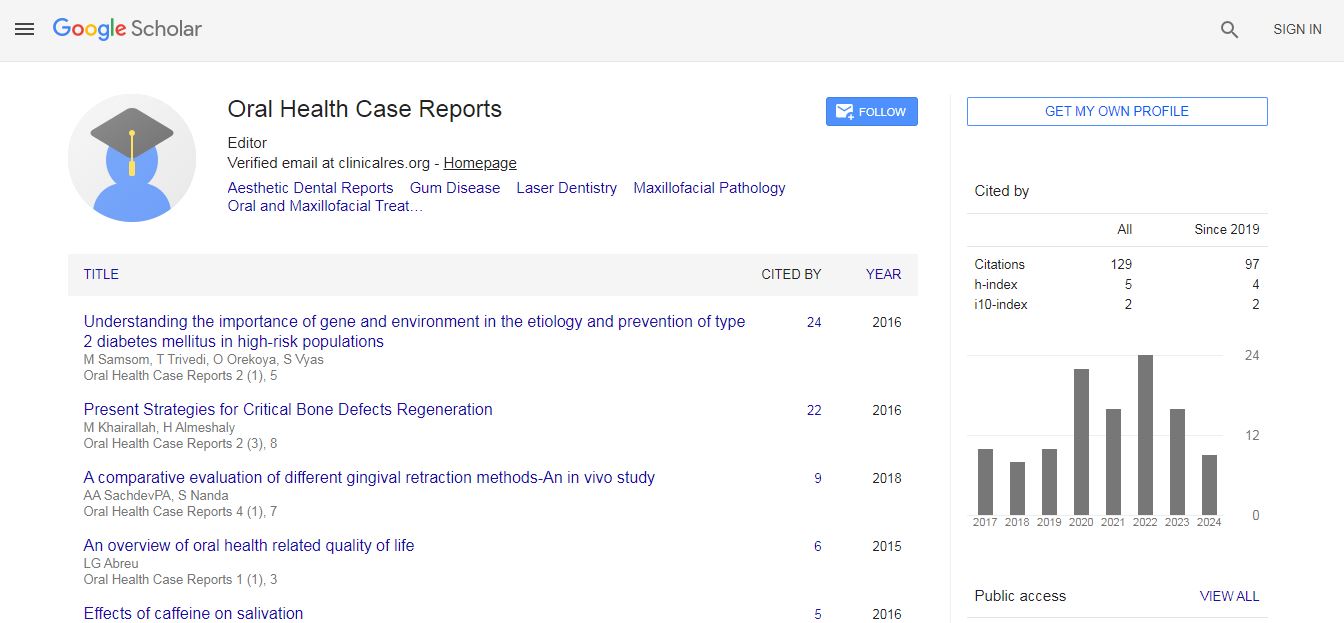
Oral Health Case Reports received 120 citations as per Google Scholar report