Commentary - (2025) Volume 9, Issue 6
Received: 01-Nov-2025, Manuscript No. fsb-26-189976;
Editor assigned: 03-Nov-2025, Pre QC No. P-189976;
Reviewed: 17-Nov-2025, QC No. Q-189976;
Revised: 24-Nov-2025, Manuscript No. R-189976;
Published:
29-Nov-2025
, DOI: 10.37421/2577-0543.2025.9.262
Citation: Sato, Kenji. ”Oral Biopharmaceutical Delivery: Advanced Formulation Solutions.” J. Formul. Sci. Bioavailability 09 (2025):262.
Copyright: © 2025 Sato K. This is an open-access article distributed under the terms of the Creative Commons Attribution License, which permits unrestricted use, distribution and reproduction in any medium, provided the original author and source are credited.
The oral delivery of biopharmaceuticals faces substantial obstacles due to their inherent instability within the gastrointestinal tract and their limited absorption across the intestinal barrier. Key challenges include enzymatic degradation, sensitivity to pH variations, and the necessity for efficient transport mechanisms across the intestinal epithelium. Despite these hurdles, significant opportunities are emerging from advancements in formulation strategies, such as the development of nanoparticle-based delivery systems, the utilization of mucoadhesive polymers, and the incorporation of permeation enhancers. These innovative approaches are designed to protect biopharmaceuticals from degradation and to facilitate their uptake, thereby paving the way for a more convenient and patient-friendly route of administration for these vital therapeutic agents [1].
Nanoparticle-based systems, encompassing a range of formulations including liposomes, solid lipid nanoparticles, and polymeric nanoparticles, present a highly promising avenue for overcoming the limitations in oral bioavailability associated with peptide and protein drugs. These sophisticated formulations serve to protect the therapeutic payload from the harsh conditions of the gastrointestinal tract and can be strategically engineered to enhance cellular uptake through various mechanisms, notably endocytosis. The careful design of nanoparticle characteristics, including their size, surface charge, and the inclusion of targeting ligands, is absolutely crucial for optimizing their therapeutic efficacy and ensuring successful drug delivery [2].
The intestinal mucus layer constitutes a significant physical barrier that impedment the absorption of orally administered biopharmaceuticals. Mucoadhesive polymers can be effectively incorporated into drug formulations to prolong the residence time of the therapeutic agent at the absorption site, thereby allowing for extended contact and consequently improving drug uptake. The core of this strategy involves designing polymers that interact effectively with the mucus layer and facilitate the controlled release of the drug, which in turn enhances its bioavailability. This particular approach is especially relevant for drugs that necessitate sustained exposure within the gastrointestinal tract to achieve their therapeutic effect [3].
Enhancing intestinal permeability is an absolutely critical step in achieving effective oral delivery of biopharmaceuticals. Permeation enhancers function by transiently disrupting the tight junctions that exist between epithelial cells, thereby facilitating paracellular transport of the drug. However, it is of paramount importance to ensure that these enhancers are non-toxic and do not compromise the long-term integrity of the intestinal barrier. A synergistic approach that combines permeation enhancers with protective formulation strategies holds significant potential for improving oral bioavailability and ensuring therapeutic success [4].
Oral insulin delivery continues to present a formidable challenge, yet considerable progress is being made through the exploration of diverse formulation approaches. Micro- and nano-encapsulation techniques, frequently employing polymers or lipids, are specifically aimed at protecting insulin from degradation and enhancing its absorption into the bloodstream. Furthermore, strategies that involve the use of absorption enhancers and stimuli-responsive systems, designed to release insulin in response to specific physiological cues, are currently under intense investigation. These advancements offer substantial potential for improved glycemic control in patients suffering from diabetes [5].
The development of oral vaccines, particularly those designed for large protein antigens, represents a dynamic and actively researched area within pharmaceutical science. The strategies often involve the co-delivery of antigens alongside adjuvants and the judicious use of carrier systems to successfully overcome the intestinal barrier and effectively induce robust mucosal and systemic immune responses. Formulation approaches are meticulously designed to promote antigen uptake by immune cells present in the gut-associated lymphoid tissue (GALT), thereby offering a non-invasive and potentially more effective vaccination strategy compared to traditional parenteral administration [6].
Chitosan nanoparticles have emerged as a remarkably versatile and adaptable platform for the oral delivery of a wide array of biopharmaceuticals. This arises from their inherent mucoadhesive properties, their biodegradability, and their notable ability to shield drugs from enzymatic degradation within the gastrointestinal environment. The positive charge inherent to chitosan nanoparticles facilitates their interaction with the negatively charged intestinal epithelium, thereby promoting enhanced cellular uptake. Further modification of these nanoparticles with specific targeting ligands or other functional groups can significantly augment their delivery efficiency and ultimately lead to improved therapeutic outcomes [7].
Solid lipid nanoparticles (SLNs) and nanostructured lipid carriers (NLCs) offer distinct advantages for oral biopharmaceutical delivery by effectively encapsulating drugs within a solid lipid matrix. This encapsulation provides crucial protection from the harsh gastrointestinal environment and significantly improves drug absorption. These lipid-based nanocarrier systems are capable of enhancing the stability of sensitive drugs and can provide sustained release profiles over extended periods. Surface modification of SLNs and NLCs can further improve their mucoadhesion and cellular uptake, ultimately leading to enhanced oral bioavailability and therapeutic efficacy [8].
Protease inhibitors and other digestive enzymes present a major threat to the structural integrity of orally administered proteins and peptides, leading to their degradation before absorption. Formulation strategies that involve the encapsulation of these sensitive biomolecules within protective matrices, such as polymeric nanoparticles or liposomes, are absolutely crucial for shielding them from enzymatic breakdown. The co-administration of oral drugs with specific enzyme inhibitors, or the design of pH-responsive systems that ensure drug release in targeted intestinal regions, represent alternative or complementary approaches to mitigate this significant challenge [9].
The development of oral formulations for antibodies and other large protein therapeutics is a highly sought-after objective within the biopharmaceutical industry, holding the potential to fundamentally revolutionize current treatment paradigms. Advanced strategies being explored include the innovative use of enteric coatings, the incorporation of mucoadhesive polymers, and the application of various types of nanoparticles designed to protect the antibody and facilitate its passage across the complex intestinal barrier. Furthermore, significant research efforts are focused on developing delivery systems that mimic natural absorption pathways, with the ultimate aim of achieving effective therapeutic levels through oral administration [10].
The oral administration of biopharmaceuticals is hindered by their susceptibility to degradation in the gastrointestinal tract and poor absorption. Enzymatic breakdown, pH instability, and the need for efficient transport across the intestinal lining are significant hurdles. However, breakthroughs in formulation, including nanoparticle systems, mucoadhesive polymers, and permeation enhancers, offer solutions by protecting drugs and aiding their uptake, thereby making oral delivery more feasible [1].
Nanoparticle-based delivery systems, such as liposomes, solid lipid nanoparticles, and polymeric nanoparticles, are instrumental in overcoming the poor oral bioavailability of peptide and protein drugs. These formulations safeguard the therapeutic cargo from the adverse conditions of the GI tract and can be designed to enhance cellular uptake via mechanisms like endocytosis. Optimizing nanoparticle size, surface charge, and targeting ligands is key to their effectiveness [2].
The intestinal mucus layer poses a physical barrier to the absorption of oral biopharmaceuticals. Mucoadhesive polymers can be incorporated into formulations to increase drug residence time at the absorption site, promoting better uptake. These polymers are designed to interact effectively with mucus and release drugs controllably, improving bioavailability, particularly for drugs requiring sustained gastrointestinal exposure [3].
Improving intestinal permeability is a crucial factor for the effective oral delivery of biopharmaceuticals. Permeation enhancers transiently alter tight junctions between epithelial cells, enabling paracellular transport. It is vital to ensure these enhancers are non-toxic and do not compromise the intestinal barrier's long-term integrity. Combining them with protective formulations can provide a synergistic benefit [4].
Oral insulin delivery remains a challenge, but advances in formulations are promising. Micro- and nano-encapsulation using polymers or lipids protect insulin from degradation and enhance its absorption. Absorption enhancers and stimuli-responsive systems that release insulin based on physiological cues are also being investigated for improved glycemic control in diabetes [5].
Developing oral vaccines, especially for large protein antigens, is an active research area. Strategies involve co-delivering antigens with adjuvants and using carrier systems to bypass the intestinal barrier and induce strong immune responses. Formulations aim to enhance antigen uptake by gut-associated lymphoid tissue (GALT) immune cells, offering a non-invasive vaccination method [6].
Chitosan nanoparticles are versatile for oral biopharmaceutical delivery due to their mucoadhesion, biodegradability, and protective qualities against enzymatic degradation. Their positive charge aids interaction with the intestinal epithelium, promoting cellular uptake. Surface modifications can further improve delivery efficiency and therapeutic outcomes [7].
Solid lipid nanoparticles (SLNs) and nanostructured lipid carriers (NLCs) protect biopharmaceuticals from the GI environment and improve absorption by encapsulating drugs in a lipid matrix. These systems enhance drug stability and enable sustained release. Surface modifications can boost mucoadhesion and cellular uptake, leading to better oral bioavailability [8].
Protease inhibitors and GI enzymes threaten orally delivered proteins and peptides. Encapsulation in protective matrices like nanoparticles or liposomes shields these molecules from enzymatic degradation. Co-administration with enzyme inhibitors or the use of pH-responsive systems can also address this issue [9].
Oral delivery of antibodies and large protein therapeutics is a significant goal. Strategies include enteric coatings, mucoadhesive polymers, and nanoparticles to protect drugs and facilitate intestinal passage. Delivery systems mimicking natural absorption pathways are also being explored to achieve therapeutic levels orally [10].
Oral administration of biopharmaceuticals is challenging due to instability and poor absorption in the gastrointestinal tract, stemming from enzymatic degradation and pH sensitivity. Advanced formulation strategies are being developed to overcome these barriers. Nanoparticle-based systems, including liposomes and polymeric nanoparticles, protect drugs and enhance cellular uptake. Mucoadhesive polymers increase drug residence time at absorption sites, improving bioavailability. Permeation enhancers transiently disrupt intestinal epithelial tight junctions to facilitate drug transport, though their safety is crucial. Specific applications include oral insulin delivery, oral vaccines, and the delivery of large protein therapeutics like antibodies, employing micro- and nano-encapsulation, stimuli-responsive systems, and protective carriers. Chitosan nanoparticles, solid lipid nanoparticles, and nanostructured lipid carriers are also promising platforms due to their protective and absorptive enhancement properties. Addressing enzymatic degradation through encapsulation or co-administration with inhibitors is also a key focus.
None
None
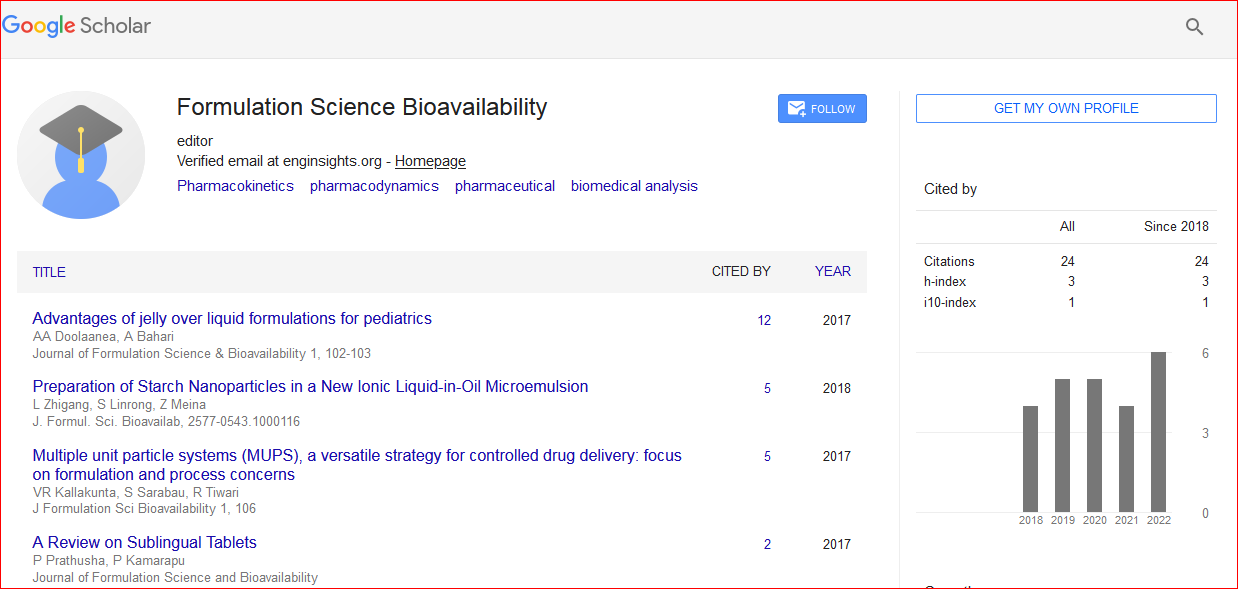
Journal of Formulation Science & Bioavailability received 23 citations as per Google Scholar report