Perspective - (2025) Volume 11, Issue 3
Received: 01-May-2025, Manuscript No. aso-26-184617;
Editor assigned: 05-May-2025, Pre QC No. P-184617;
Reviewed: 19-May-2025, QC No. Q-184617;
Revised: 22-May-2025, Manuscript No. R-184617;
Published:
29-May-2025
, DOI: 10.37421/2471-2671.2025.11.173
Citation: Chen, Amelia. ”Optimizing Quality Of Life After Cancer
Surgery.” Arch Surg Oncol 11 (2025):173.
Copyright: © 2025 Chen A. This is an open-access article distributed under the terms of the Creative Commons Attribution License, which permits unrestricted use, distribution
and reproduction in any medium, provided the original author and source are credited.
The landscape of cancer surgery has seen significant evolution, with a growing emphasis on optimizing the quality of life (QoL) and functional outcomes for patients throughout their survivorship journey. This shift underscores a move towards more patient-centered care models, recognizing that the impact of surgery extends far beyond immediate survival rates. Advancements in surgical techniques, perioperative management, and survivorship strategies are continually being refined to improve long-term well-being, highlighting the dynamic nature of oncologic care [1].
Understanding the long-term functional consequences following complex oncologic resections is of paramount importance for clinicians and patients alike. Research in this area examines the impact of various surgical approaches on crucial aspects of daily living such as mobility, pain management, and the ability to return to everyday activities. This necessitates a thorough pre-operative assessment and the development of tailored post-operative rehabilitation programs to enhance recovery and overall QoL for individuals undergoing major cancer surgery [2].
In parallel, patient-reported outcome measures (PROMs) are increasingly being recognized as critical indicators of surgical success, providing a direct perspective on the patient's experience. This focus has driven the development and validation of novel PROMs specifically designed to assess QoL and functional status after various cancer surgeries, particularly in areas like gastrointestinal cancer. The findings from such research strongly support the routine use of these validated instruments to capture a more holistic view of patient recovery and to inform clinical decision-making effectively [3].
The psychological impact of cancer surgery is another critical dimension that cannot be overstated when considering the overall well-being of patients. Studies are investigating the prevalence of psychological morbidities, such as anxiety and depression, in patients following major oncologic procedures. Furthermore, research is exploring the effectiveness of psychological support interventions, emphasizing that addressing mental health is an integral component of optimizing QoL and functional recovery [4].
Optimizing recovery from specific types of cancer surgery, such as lung cancer surgery, often requires a multifaceted approach that goes beyond the surgical procedure itself. This involves examining the role of prehabilitation programs, which may include exercise and nutritional support, in improving post-operative functional capacity and QoL. The growing body of evidence suggests that proactive interventions can significantly mitigate the decline in physical function frequently experienced after thoracic surgery [5].
The advent of minimally invasive surgical techniques has profoundly reshaped outcomes in oncologic surgery, often leading to improved patient experiences. Comparative studies examining QoL and functional recovery between laparoscopic and open approaches, for instance in colorectal cancer, consistently demonstrate that minimally invasive surgery generally leads to faster recovery, reduced pain, and improved short-term functional outcomes, thereby contributing to better overall QoL [6].
Survivorship care plans are increasingly recognized as essential tools for guiding patients through the complex post-treatment phase of their cancer journey. These plans focus on the management of long-term functional deficits and QoL concerns that may arise after surgery. The importance of multidisciplinary follow-up and comprehensive patient education is highlighted as a cornerstone of effective survivorship care following cancer surgery [7].
The impact of specific surgical procedures on sexual health and QoL, an often-overlooked area, is gaining attention in oncologic research. Investigations into the long-term effects of procedures such as pelvic exenteration for advanced gynecological cancers on sexual function and overall QoL are crucial. These studies stress the necessity of open communication and specialized support for patients navigating these sensitive challenges [8].
Rehabilitation plays a pivotal role in restoring function and improving QoL after surgical interventions for various cancers, including head and neck cancers. Research in this domain examines the evidence supporting diverse rehabilitation strategies, encompassing speech therapy, physical therapy, and nutritional support, aimed at enhancing post-operative recovery and effectively addressing functional deficits [9].
Finally, the integration of technology in post-operative care holds significant promise for monitoring and supporting cancer surgery survivors. Studies exploring the use of remote monitoring and telehealth platforms to assess functional recovery and QoL suggest that these technologies can improve patient engagement and facilitate timely interventions, ultimately leading to enhanced outcomes and a better overall survivorship experience [10].
The evolving field of cancer surgery is increasingly focused on enhancing patient quality of life (QoL) and functional outcomes, moving towards a more patient-centered approach. This involves integrating advancements in surgical techniques, perioperative care, and survivorship strategies to ensure long-term well-being. The use of patient-reported outcome measures (PROMs) is vital for a comprehensive understanding of functional recovery and QoL, guiding personalized rehabilitation and support services for cancer survivors [1].
Assessing the long-term functional consequences after extensive oncologic resections is critical for patients' recovery and well-being. Studies investigate how different surgical approaches influence patient mobility, pain levels, and their ability to resume daily activities. Emphasis is placed on the importance of pre-operative evaluations and personalized post-operative rehabilitation programs designed to optimize recovery and enhance the QoL for individuals who have undergone major cancer surgery [2].
Patient-reported outcomes are now considered key indicators of surgical success, prompting the development and validation of new PROMs for assessing QoL and functional status after various cancer surgeries, such as those for gastrointestinal cancers. The findings from this research advocate for the regular use of validated PROMs to gain a more complete picture of patient recovery and to inform clinical decision-making processes [3].
The psychological well-being of patients following cancer surgery is a significant concern. Research is actively exploring the prevalence of mental health issues like anxiety and depression in patients post-oncologic procedures and evaluating the effectiveness of psychological support interventions. This highlights the integral role of mental health care in optimizing QoL and functional recovery for cancer survivors [4].
Optimizing recovery after specific cancer surgeries, like those for lung cancer, necessitates a comprehensive strategy. This includes examining the benefits of prehabilitation programs, such as exercise and nutritional support, which aim to improve post-operative functional capacity and QoL. Evidence suggests these proactive interventions can substantially reduce the physical functional decline commonly experienced after thoracic surgery [5].
Minimally invasive surgical techniques have transformed oncologic surgery, often leading to better patient outcomes. Comparative studies assessing QoL and functional recovery between minimally invasive and open surgical approaches for conditions like colorectal cancer indicate that the former generally results in quicker recovery, less pain, and improved short-term functional results, contributing to enhanced overall QoL [6].
Effective survivorship care plans are essential for patients navigating the post-treatment phase of cancer. These plans address the management of persistent functional deficits and QoL concerns experienced by cancer surgery patients. The importance of multidisciplinary follow-up and robust patient education is emphasized as critical components for optimal survivorship care [7].
An often-underestimated aspect of cancer surgery outcomes is its impact on sexual health and QoL. Studies are examining the long-term effects of procedures like pelvic exenteration for advanced gynecological cancers on sexual function and overall well-being. These investigations underscore the need for open dialogue and specialized support for patients dealing with such challenges [8].
Rehabilitation plays a crucial role in restoring function and enhancing QoL after surgical treatment for cancers such as head and neck cancers. Research in this area evaluates various rehabilitation strategies, including speech, physical, and nutritional therapy, to improve post-operative recovery and manage functional impairments [9].
Technological advancements are being integrated into post-operative care to monitor and support cancer surgery survivors. The utilization of remote monitoring and telehealth platforms to track functional recovery and QoL shows promise in improving patient engagement and enabling timely interventions, ultimately leading to better long-term outcomes [10].
This collection of research highlights the critical importance of quality of life (QoL) and functional outcomes following cancer surgery. It emphasizes patient-centered care, advancements in surgical techniques, and the role of rehabilitation in recovery. The integration of patient-reported outcome measures (PROMs) is crucial for understanding patient experiences and guiding personalized care. Psychological well-being, prehabilitation, and minimally invasive surgery are identified as key factors influencing recovery. Survivorship care plans and technological advancements like telehealth are also explored as essential components of optimizing post-surgical patient experiences and long-term outcomes.
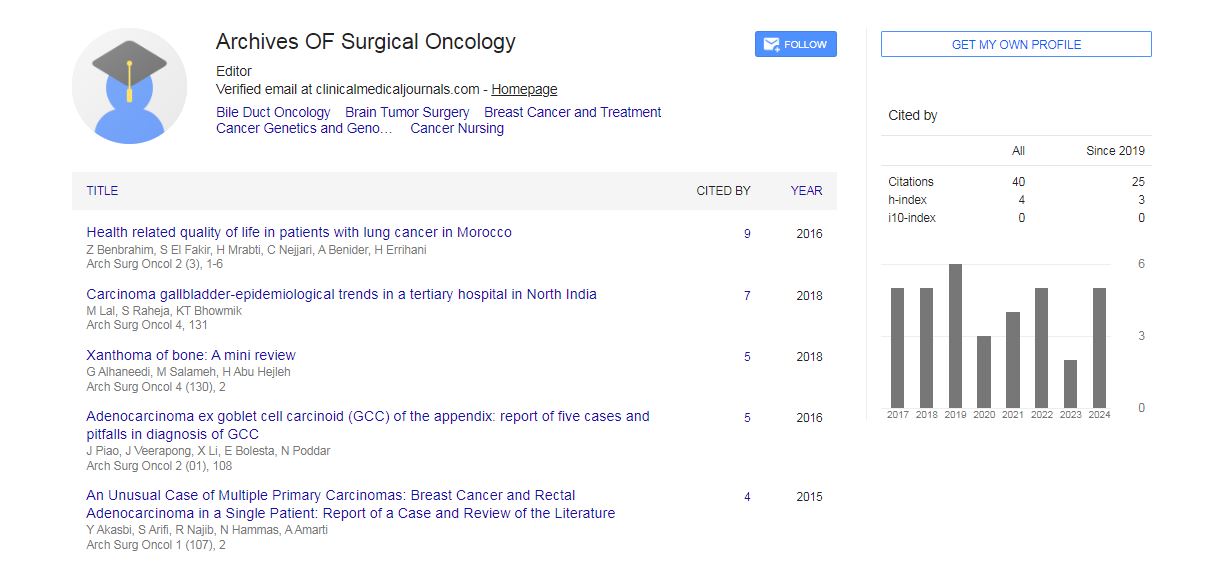
Archives of Surgical Oncology received 37 citations as per Google Scholar report