Perspective - (2025) Volume 14, Issue 3
Received: 01-May-2025, Manuscript No. iem-26-179782;
Editor assigned: 04-May-2025, Pre QC No. P-179782;
Reviewed: 14-May-2025, QC No. Q-179782;
Revised: 21-May-2025, Manuscript No. R-179782;
Published:
29-May-2025
, DOI: 10.37421/2169- 0316.2025.14.303
Citation: O’Connor, Liam. ”Optimizing Productivity Through Time-Motion Analysis.” J Ind Eng Manag 14 (2025):303.
Copyright: © 2025 O’Connor L. This is an open-access article distributed under the terms of the Creative Commons Attribution License, which permits unrestricted use,
distribution and reproduction in any medium, provided the original author and source are credited.
Industrial engineering has long recognized the fundamental importance of meticulously analyzing work processes to enhance operational efficiency and productivity. At the core of this lies the systematic study of time and motion, a discipline dedicated to observing, measuring, and evaluating every aspect of a task. This approach is instrumental in pinpointing inefficiencies, identifying bottlenecks, and uncovering opportunities for improvement, ultimately leading to optimized workflows, reduced waste, and increased output within industrial settings [1].
The advent of digital technologies has significantly transformed the landscape of traditional time and motion studies. Modern manufacturing and industrial environments are increasingly leveraging sensor technologies, artificial intelligence-powered analytics, and sophisticated simulation software. These digital tools offer more accurate and real-time data for motion analysis, enabling a more dynamic and responsive approach to productivity improvements and facilitating the integration of advanced methods into existing processes [2].
Beyond the mechanical aspects of task execution, the human element plays a crucial role in the effectiveness and sustainability of time and motion studies. Acknowledging the importance of ergonomics and employee well-being is paramount. While efficiency gains are essential, it is the consideration of worker comfort, safety, and job satisfaction that leads to sustained productivity improvements. Integrating human-centered design principles into motion analysis can effectively prevent burnout and foster long-term performance [3].
The principles of lean manufacturing, particularly value stream mapping and cycle time reduction, offer a powerful framework for improving operational efficiency. By meticulously analyzing the time and motion involved in a specific production line, organizations can achieve significant reductions in lead time and a notable increase in throughput, with measurable outcomes demonstrating the effectiveness of this approach [4].
For optimizing complex logistical operations, simulation modeling stands out as a valuable technique in conjunction with time and motion analysis. The creation of digital twins for supply chains allows for the rigorous testing of various scenarios and process improvements without disrupting live operations. This methodology is particularly effective in identifying critical bottlenecks and enhancing the flow of both goods and information throughout the logistical network [5].
In the realm of assembly line processes, the application of motion capture technology and biomechanical analysis provides deep insights into worker movements. By precisely tracking these movements, researchers can identify inefficient postures and potential risks of repetitive strain injuries, paving the way for redesigned workstations and tools that improve both productivity and worker health [6].
A proactive approach to productivity enhancement can be achieved through the integration of real-time data analytics with time and motion studies. The continuous collection and analysis of live operational data, encompassing task completion times and movement patterns, empowers organizations to make immediate adjustments to their processes. This enables a continuous improvement cycle, preventing the gradual accumulation of inefficiencies and maintaining optimal productivity levels [7].
The healthcare sector also benefits significantly from the application of time and motion analysis. By optimizing patient flow and enhancing staff efficiency, studies in this domain can refine ward layouts, reduce unnecessary travel for medical personnel, and streamline diagnostic pathways, ultimately elevating the quality and speed of patient care [8].
The evolution of data collection methods has led to the utilization of wearable sensors and Internet of Things (IoT) devices for time and motion analysis. This approach moves beyond traditional, periodic observations to provide a more granular and comprehensive understanding of work patterns. The data gathered can be meticulously analyzed to precisely identify time-consuming activities and uncover opportunities for optimizing worker motion [9].
Furthermore, the integration of motion analysis with augmented reality (AR) presents an innovative frontier for training and process improvement. AR technology can overlay optimal motion paths and deliver real-time feedback to workers, guiding them towards more efficient movements and accelerating skill acquisition while embedding best practices for enhanced productivity [10].
The foundational principles of time and motion analysis are critical to the field of industrial engineering, offering a systematic framework for enhancing productivity. This discipline involves the detailed observation, measurement, and evaluation of work tasks to identify areas of inefficiency, bottlenecks, and potential improvements. The practical application of these principles allows for the optimization of workflows, reduction of waste, and an overall boost in output within industrial settings [1].
The integration of digital tools and automation has profoundly impacted traditional time and motion studies. Modern industrial environments benefit from advanced technologies such as sensor technologies, AI-powered analytics, and simulation software, which provide more accurate and real-time data for motion analysis. This leads to more dynamic and responsive productivity improvements and facilitates the seamless integration of these advanced methods into existing industrial processes [2].
Recognizing the indispensable role of human factors in time and motion studies is crucial for achieving sustainable productivity gains. The emphasis on ergonomics and employee well-being ensures that efficiency is pursued without compromising worker comfort, safety, and job satisfaction. Incorporating human-centered design into motion analysis is vital for preventing burnout and enhancing long-term performance [3].
Lean manufacturing principles, particularly value stream mapping and cycle time reduction, offer a robust methodology for improving operational efficiency. The detailed analysis of time and motion within specific production lines can lead to significant reductions in lead time and marked increases in throughput, with measurable outcomes demonstrating the effectiveness of these techniques [4].
Simulation modeling, when combined with time and motion analysis, proves highly effective for optimizing complex logistical operations. By developing digital twins of supply chains, organizations can test various scenarios and process improvements without disrupting ongoing operations, thus effectively identifying bottlenecks and optimizing the flow of goods and information [5].
Motion capture technology and biomechanical analysis are instrumental in refining assembly line processes. Precise tracking of worker movements allows for the identification of inefficient postures and risks of repetitive strain, leading to the redesign of workstations and tools aimed at enhancing both productivity and worker health [6].
The implementation of real-time data analytics in conjunction with time and motion studies facilitates continuous improvement. The collection and analysis of live operational data, including task completion times and movement patterns, enable immediate process adjustments. This proactive strategy is key to preventing the buildup of inefficiencies and maintaining peak productivity [7].
In the healthcare sector, time and motion analysis plays a vital role in optimizing operations. By improving patient flow and staff efficiency, studies can refine ward layouts, minimize unnecessary travel time for medical personnel, and streamline patient diagnostic pathways, ultimately enhancing the quality and speed of care delivery [8].
The use of wearable sensors and IoT devices has enabled more granular and comprehensive time and motion data collection. This approach moves beyond traditional periodic observations to provide a detailed understanding of work patterns, allowing for precise identification of time-consuming activities and opportunities for motion optimization [9].
Augmented reality (AR) is emerging as a powerful tool for motion guidance and training, integrated with motion analysis techniques. AR can overlay optimal motion paths and provide real-time feedback to workers, guiding them toward more efficient movements, accelerating skill acquisition, and embedding best practices for productivity enhancement [10].
Time and motion analysis are fundamental to industrial engineering for enhancing productivity by identifying inefficiencies and optimizing workflows. Modern approaches integrate digital tools like AI and sensors for real-time data, while also emphasizing human factors, ergonomics, and worker well-being for sustainable gains. Lean manufacturing principles, value stream mapping, and cycle time reduction offer practical methods for improving operational efficiency. Simulation modeling and digital twins aid in optimizing complex logistics. Motion capture and biomechanical analysis refine assembly lines by improving worker posture and reducing strain. Real-time data analytics enable continuous improvement, and applications extend to healthcare for optimizing patient flow and staff efficiency. Emerging technologies like wearable sensors, IoT, and augmented reality offer more granular data collection and innovative training methods for further productivity enhancements.
None
None
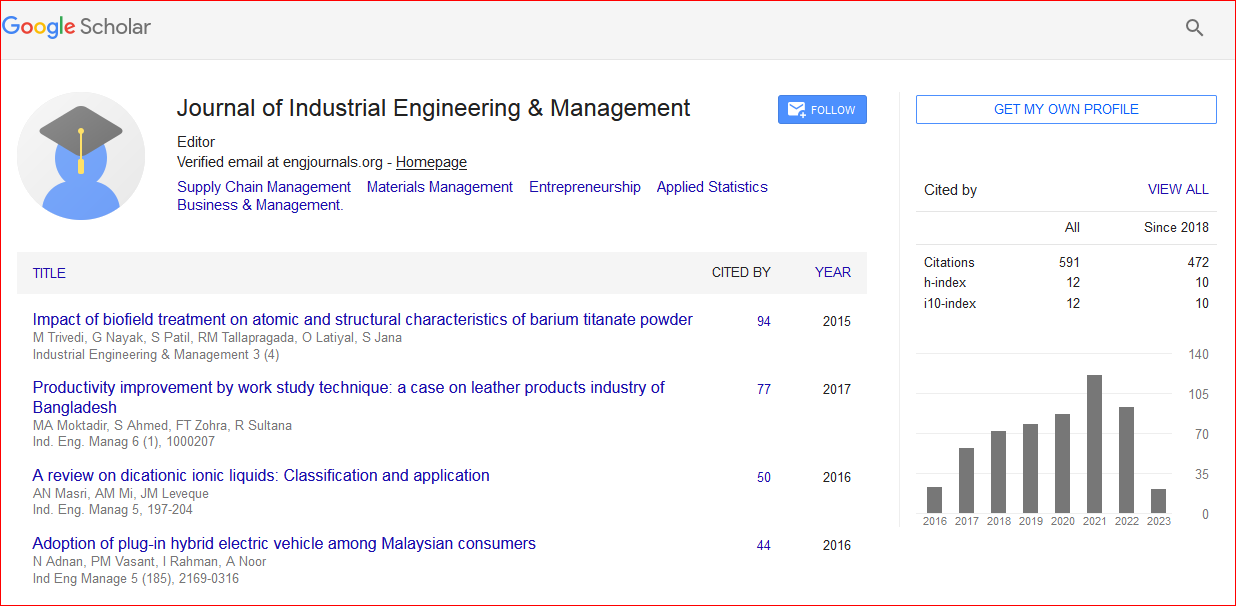
Industrial Engineering & Management received 739 citations as per Google Scholar report