Commentary - (2025) Volume 9, Issue 6
Received: 01-Dec-2025, Manuscript No. jcao-26-187187;
Editor assigned: 03-Dec-2025, Pre QC No. P-187187;
Reviewed: 17-Dec-2025, QC No. Q-187187;
Revised: 22-Dec-2025, Manuscript No. R-187187;
Published:
29-Dec-2025
, DOI: 10.37421/2684-6004.2025.9.324
Citation: Schmidt, Lucas. ”Optimizing Post-Anesthesia Care: Recovery, Safety, and Outcomes.” J Clin Anesthesiol 09 (2025):324.
Copyright: © 2025 Schmidt L. This is an open-access article distributed under the terms of the Creative Commons Attribution License, which permits unrestricted use, distribution and reproduction in any medium, provided the original author and source are credited.
The Post-Anesthesia Care Unit (PACU) plays a pivotal role in patient recovery following surgical procedures, necessitating a focus on optimized care to ensure patient safety and efficient throughput. Recent advancements have significantly shaped the landscape of PACU management, emphasizing strategies to enhance recovery, shorten hospital stays, and mitigate potential complications. This comprehensive review delves into these evolving practices, offering insights into the latest research and clinical applications within the PACU setting. The optimization of patient recovery in the PACU is a multifaceted endeavor, driven by a desire to improve patient outcomes and streamline healthcare resource utilization. Key to this effort are comprehensive strategies designed to address the immediate post-operative period, ensuring a smooth transition from the operating room to discharge or further care. The integration of evidence-based practices is paramount in achieving these goals. A significant area of development in PACU care involves the implementation of Enhanced Recovery After Surgery (ERAS) protocols, which are increasingly being tailored for the specific needs of patients in the PACU. These protocols aim to standardize care across various phases of the perioperative journey, promoting faster recovery and reducing the incidence of adverse events. Their adaptation for PACU management represents a critical step in advancing patient care. Pain management remains a cornerstone of effective PACU care, with a growing emphasis on multimodal approaches. These strategies move beyond traditional opioid-centric methods to incorporate a wider range of pharmacological and non-pharmacological interventions. The goal is to provide adequate analgesia while minimizing the side effects associated with opioids, thereby improving patient comfort and accelerating recovery. Early mobilization is another critical component of modern PACU management, recognized for its substantial benefits in promoting patient recovery. Timely ambulation can actively reduce the risks of common post-operative complications such as venous thromboembolism and respiratory issues. Practical considerations for safe and effective implementation are essential for maximizing these advantages. The integration of advanced monitoring technologies is transforming the ability to detect subtle changes in patient status within the PACU. Tools such as continuous electroencephalography (EEG) and non-invasive cardiac output monitoring offer real-time insights into physiological parameters, enabling earlier identification of at-risk patients and facilitating prompt interventions. Post-operative nausea and vomiting (PONV) represent a common and distressing complication for patients recovering from anesthesia. Effective management strategies, including risk stratification and the judicious use of antiemetic prophylaxis, are crucial for enhancing patient comfort and overall satisfaction with the PACU experience. The nursing staff within the PACU are integral to the delivery of high-quality patient care. Their evolving role encompasses advanced assessment skills, vigilant monitoring, and expert management of post-anesthetic complications. Continuous professional development is vital to ensure they are equipped with the latest knowledge and competencies. Patient-reported outcome measures (PROMs) are increasingly being utilized in the PACU to capture the patient's perspective on their recovery journey. By systematically collecting and analyzing this data, healthcare providers can gain valuable insights into patient satisfaction and identify areas for improvement in care delivery and support. Finally, the economic implications of PACU management are a significant consideration for healthcare systems. Strategies that focus on efficient patient flow, optimized resource utilization, and the reduction of patient length of stay can yield considerable financial benefits, underscoring the importance of evidence-based practices in achieving both clinical and economic efficiencies.
Post-anesthesia care unit (PACU) management has seen substantial advancements, with a concerted effort to optimize patient recovery and minimize complications. Strategies focusing on enhanced recovery after surgery (ERAS) protocols adapted for the PACU are becoming standard, aiming to expedite patient discharge and improve overall outcomes. These protocols address critical aspects such as fluid management, analgesia, and early feeding, promoting a more efficient recovery trajectory [2].
The implementation of ERAS pathways within the PACU is supported by a growing body of evidence, highlighting the importance of standardized care to accelerate patient discharge and enhance recovery. By focusing on key elements like fluid management, analgesia, and early nutritional support, these pathways contribute significantly to better patient outcomes and a more streamlined PACU experience [2].
Optimizing postoperative pain management in the PACU is a critical objective, with current research comparing various analgesic regimens. The focus is shifting towards multimodal strategies that combine non-opioid analgesics, regional anesthesia, and non-pharmacological interventions to effectively manage pain while reducing opioid-related side effects. This comparative approach aims to achieve superior pain control with fewer adverse events [3].
Early mobilization in the PACU is recognized for its significant benefits, including a reduced risk of venous thromboembolism and improved respiratory function. The article explores both the advantages and practical strategies for implementing early ambulation, emphasizing its role in expediting overall patient recovery and enhancing functional status post-surgery [4].
Advancements in monitoring technology are playing an increasingly vital role in PACU care. Tools such as continuous electroencephalography (EEG) and non-invasive cardiac output monitoring assist in detecting subtle signs of patient decompensation, enabling timely interventions and thereby improving patient safety. These technologies provide crucial real-time data for enhanced vigilance [5].
The management of postoperative nausea and vomiting (PONV) in the PACU remains a priority, with a review of current pharmacological and non-pharmacological interventions. Risk stratification and guideline-recommended antiemetic prophylaxis are emphasized to enhance patient comfort and satisfaction, addressing a common source of post-operative distress [6].
The PACU nurse's role is continually evolving, demanding specialized expertise in patient assessment, monitoring, and complication management. Continuous education and skill development are underscored as essential for these professionals to effectively navigate the complexities of post-anesthetic care and uphold high standards of patient safety [7].
Patient-reported outcome measures (PROMs) are emerging as a valuable tool in the PACU, providing insights into the patient experience and satisfaction with their recovery. The collection and analysis of PROMs can directly inform improvements in care delivery and enhance patient support mechanisms within the PACU [8].
Postanesthetic shivering is a common complication managed in the PACU, with research focusing on its pathophysiology, risk factors, and effective treatment strategies. Prompt recognition and intervention are crucial for ensuring patient comfort and preventing associated complications that could impede recovery [9].
Economic considerations are integral to PACU management, with strategies aimed at reducing patient length of stay and optimizing resource utilization. Implementing evidence-based practices and efficient workflows can lead to significant financial benefits and improved operational efficiency within the PACU setting [10].
This collection of research highlights key advancements in Post-Anesthesia Care Unit (PACU) management, focusing on optimizing patient recovery and safety. Topics include the implementation of Enhanced Recovery After Surgery (ERAS) protocols, multimodal pain management strategies, and the benefits of early mobilization. The role of advanced monitoring technologies in detecting patient decompensation, alongside effective management of post-operative nausea and vomiting and postanesthetic shivering, are discussed. Furthermore, the evolving role of PACU nurses, the importance of patient-reported outcome measures, and the economic considerations of efficient PACU operations are addressed, all contributing to improved patient outcomes and satisfaction.
None
None
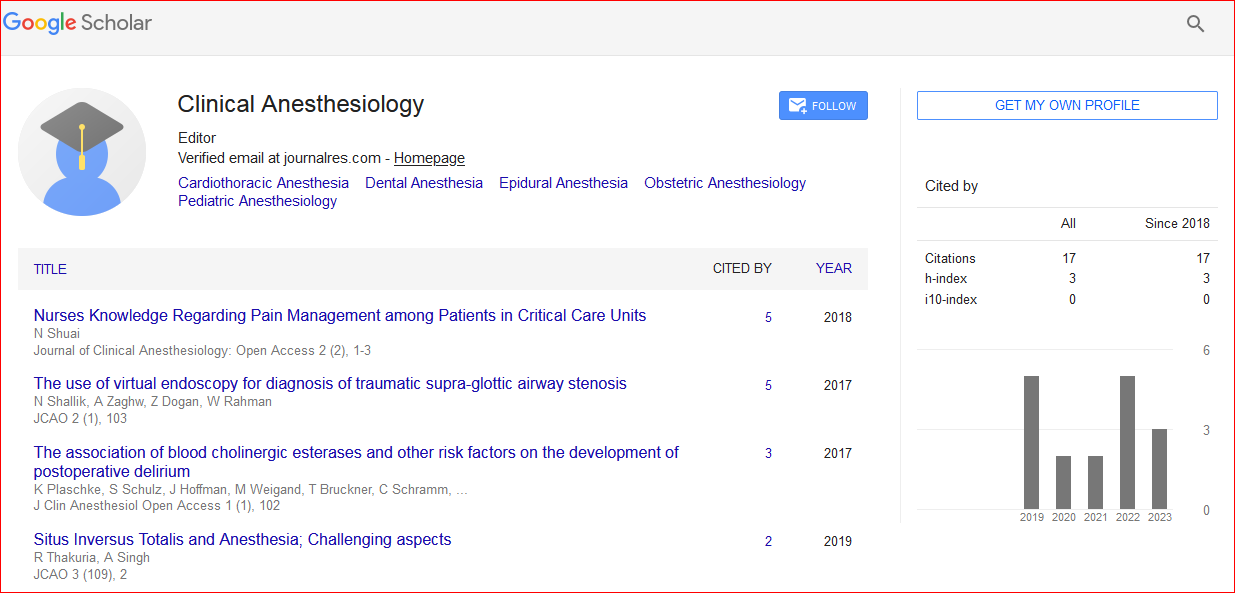
Journal of Clinical Anesthesiology: Open Access received 31 citations as per Google Scholar report