Brief Report - (2025) Volume 9, Issue 6
Received: 01-Nov-2025, Manuscript No. fsb-26-189979;
Editor assigned: 03-Nov-2025, Pre QC No. P-189979;
Reviewed: 17-Nov-2025, QC No. Q-189979;
Revised: 24-Nov-2025, Manuscript No. R-189979;
Published:
29-Nov-2025
, DOI: 10.37421/2577-0543.2025.9.265
Citation: Zahra, Fatima. ”Optimizing Bioavailability in Modified-Release Dosage Forms.” J. Formul. Sci. Bioavailability 09 (2025):265.
Copyright: © 2025 Zahra F. This is an open-access article distributed under the terms of the Creative Commons Attribution License, which permits unrestricted use, distribution and reproduction in any medium, provided the original author and source are credited.
The intricate science of bioavailability stands as a cornerstone in the development and efficacy of modified-release dosage forms. Understanding and manipulating drug absorption profiles are paramount for achieving targeted therapeutic outcomes and enhancing patient adherence to treatment regimens. Formulation strategies play a pivotal role in this endeavor, considering a complex interplay of drug properties, excipient selection, manufacturing nuances, and physiological influences that govern release and absorption kinetics [1].
The physical characteristics of drug particles, specifically their size and morphology, exert a profound influence on the dissolution rate and subsequent bioavailability of modified-release formulations. Advanced processing techniques are employed to meticulously control these attributes, ensuring consistent and predictable drug release patterns crucial for therapeutic success [2].
Polymers are fundamental to the design of matrix-based modified-release systems, offering a versatile means to regulate drug release. The selection of specific polymer types and their concentrations directly impacts swelling, erosion, and diffusion mechanisms, thereby modulating drug bioavailability and pharmacokinetic profiles [3].
Nanotechnology presents innovative avenues for augmenting bioavailability in modified-release dosage forms. Nanocarriers possess the capacity to improve drug solubility, provide protection against degradation, and facilitate targeted delivery, ultimately leading to more efficient absorption and the potential for reduced dosing [4].
Challenges associated with achieving consistent bioavailability for poorly soluble drugs within modified-release formulations are a significant area of research. Strategies such as solid dispersions, complexation, and micronization are continuously reviewed for their efficacy in overcoming these inherent solubility limitations [5].
Gastrointestinal transit time is a critical determinant of the bioavailability of orally administered modified-release dosage forms. Factors like food intake and underlying disease states can significantly affect transit, thereby influencing drug release and absorption dynamics [6].
The development of robust in vitro-in vivo correlations (IVIVCs) is indispensable for modified-release dosage forms. These correlations are vital for accurately predicting in vivo performance and ensuring reproducible bioavailability, streamlining both drug development processes and quality control measures [7].
The impact of food on the bioavailability of orally administered modified-release drugs is a crucial consideration during formulation design. The type and composition of meals can significantly alter gastric emptying, local pH, and drug dissolution, leading to variability in absorption and therapeutic effectiveness [8].
Sophisticated systems like osmotic pumps offer a refined approach to achieving zero-order drug release and optimizing bioavailability. The design principles and performance-influencing factors of these systems, including membrane permeability and osmotic pressure, are meticulously studied [9].
Patient-specific factors, encompassing age and disease status, can significantly influence the bioavailability of modified-release dosage forms. A comprehensive understanding of these individual variations is essential for the implementation of personalized medicine and the assurance of therapeutic efficacy across diverse patient populations [10].
The critical role of bioavailability in the design and performance of modified-release dosage forms is extensively explored, examining how formulation strategies influence drug absorption profiles to achieve desired therapeutic goals and improve patient compliance. Key factors considered include inherent drug properties, the judicious selection of excipients, the intricacies of manufacturing processes, and the dynamic interplay with physiological elements that govern drug release and absorption [1].
The influence of particle size and morphology on the dissolution characteristics and subsequent bioavailability of modified-release formulations is a subject of intense examination. Strategies aimed at controlling these physical attributes through advanced processing techniques are elucidated, underscoring their significance in attaining consistent and predictable drug release kinetics [2].
This study investigates the pivotal role of polymers in achieving controlled drug release from matrix-based modified-release systems. The authors meticulously explore how variations in polymer types and their concentrations exert an effect on swelling, erosion, and diffusion mechanisms, ultimately shaping drug bioavailability and pharmacokinetic profiles [3].
The application of nanotechnology in the realm of modified-release dosage forms to enhance bioavailability is a subject of ongoing discussion. Nanocarriers demonstrate potential in improving drug solubility, providing protection against degradation, and enabling targeted delivery, thereby promoting more efficient absorption and potentially allowing for lower effective doses [4].
This paper critically examines the inherent challenges in achieving consistent bioavailability of poorly soluble drugs when incorporated into modified-release formulations. A review of strategies such as solid dispersions, complexation, and micronization is presented, evaluating their effectiveness in mitigating solubility limitations and improving drug absorption [5].
The impact of gastrointestinal transit time on the bioavailability of modified-release dosage forms is critically assessed. Factors that can affect transit, including dietary intake and the presence of specific disease states, along with their subsequent implications for drug release and absorption, are thoroughly explored [6].
This article addresses the crucial application of in vitro-in vivo correlation (IVIVC) methodologies for modified-release dosage forms. The development of robust IVIVCs is highlighted as essential for the accurate prediction of in vivo performance and the assurance of consistent bioavailability, thereby contributing to the streamlining of both drug development and quality control protocols [7].
The influence of food intake on the bioavailability of orally administered modified-release drugs is a significant aspect of formulation design that warrants careful consideration. This review delves into how diverse food types and varying meal compositions can impact gastric emptying rates, alter the gastrointestinal pH environment, and affect drug dissolution patterns, potentially leading to variability in drug absorption and subsequent therapeutic outcomes [8].
This research focuses on the sophisticated design and implementation of osmotic pump systems as a means to achieve zero-order drug release kinetics and maximize drug bioavailability. The study provides a detailed account of the design principles and the various factors that critically influence the performance of these systems, including membrane permeability and the generation of osmotic pressure [9].
The impact of patient-specific factors, such as age and the presence of particular disease states, on the bioavailability of modified-release dosage forms is a subject of considerable discussion. Understanding these inherent variations is deemed crucial for the advancement of personalized medicine and for ensuring consistent therapeutic efficacy across a wide spectrum of patient populations [10].
This collection of research explores various facets of bioavailability in modified-release dosage forms. Key areas investigated include the impact of formulation strategies, particle engineering, polymer matrices, and nanotechnology on drug absorption. Challenges related to poorly soluble drugs, gastrointestinal transit time, food effects, and patient-specific factors are also addressed. Methodologies like in vitro-in vivo correlations and advanced delivery systems such as osmotic pumps are discussed for their role in optimizing drug release and bioavailability. The overarching goal is to enhance therapeutic outcomes and patient compliance through precise control of drug delivery.
None
None
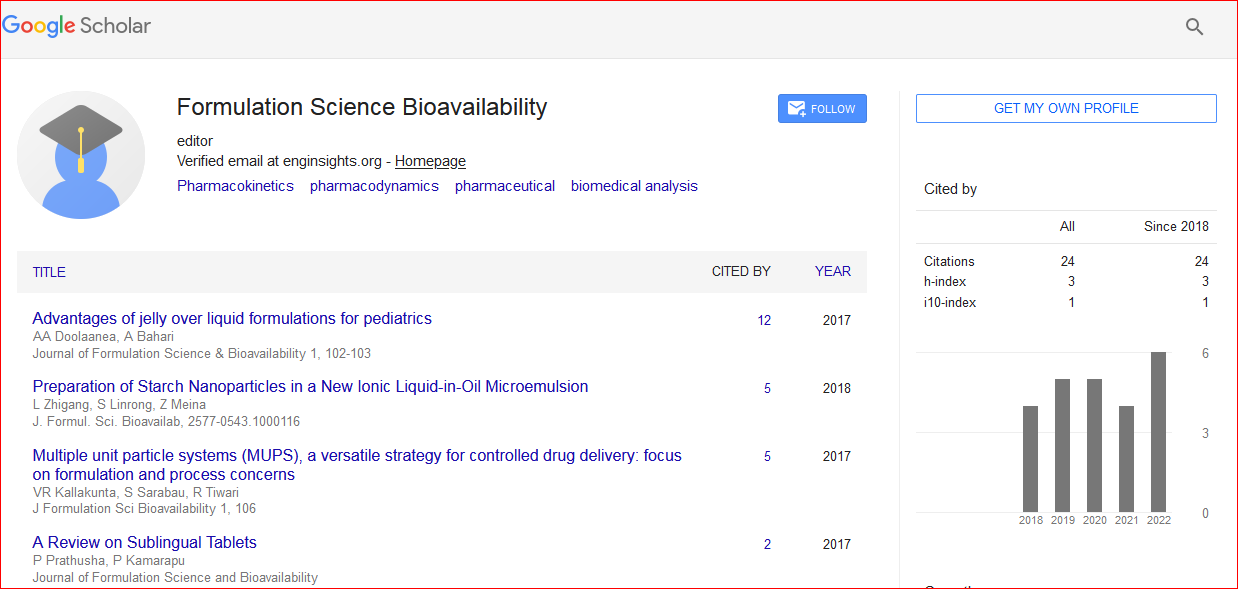
Journal of Formulation Science & Bioavailability received 23 citations as per Google Scholar report