Opinion - (2025) Volume 11, Issue 2
Received: 31-Mar-2025, Manuscript No. aso-25-166075;
Editor assigned: 02-Apr-2025, Pre QC No. P-166075;
Reviewed: 16-Apr-2025, QC No. Q-166075;
Revised: 24-Apr-2025, Manuscript No. R-166075;
Published:
30-Apr-2025
, DOI: 10.37421/2471-2671.2025.10.161
Citation: Kousi, Noutika. “Oncogene Expression Profiles as Diagnostic and Prognostic Biomarkers in Cancer.” Arch Surg Oncol 10 (2025): 161.
Copyright: © 2025 Kousi N. This is an open-access article distributed under the terms of the Creative Commons Attribution License, which permits unrestricted use, distribution and reproduction in any medium, provided the original author and source are credited.
The diagnostic utility of oncogene expression profiles stems from their ability to distinguish malignant from benign tissue and to identify specific cancer types and subtypes. Traditional histopathological examination, while essential, often faces limitations in accurately classifying tumors due to morphological similarities among different cancer types or the presence of poorly differentiated cells. Molecular profiling addresses these challenges by capturing the underlying genetic and epigenetic changes that drive oncogene activation. For example, certain oncogenes show distinct overexpression patterns in specific cancers, serving as molecular fingerprints. The identification of these patterns through techniques such as microarray analysis and RNA sequencing has improved diagnostic precision, particularly in cancers with heterogeneous histology or ambiguous clinical presentation. Moreover, oncogene expression signatures can aid in the early detection of cancer by revealing aberrant gene activity in premalignant lesions or circulating tumor cells, thus offering potential for non-invasive screening approaches [2].
Beyond diagnosis, oncogene expression profiles carry significant prognostic value by correlating with tumor aggressiveness, likelihood of metastasis, and patient survival. Tumors with high expression of particular oncogenes often exhibit more aggressive behavior, resistance to conventional therapies, and poorer clinical outcomes. For instance, elevated levels of the MYC oncogene have been associated with rapid tumor growth and unfavorable prognosis across multiple cancer types, including breast, lung, and colorectal cancers [3]. Similarly, overexpression of the HER2 oncogene in breast cancer identifies a subgroup of patients with a more aggressive disease course but also guides the use of targeted therapies that have dramatically improved survival. By quantifying oncogene expression, clinicians can stratify patients into risk categories, facilitating more informed decisions about the intensity of treatment and follow-up. This stratification is particularly important in cancers where overtreatment or undertreatment can significantly impact quality of life and long-term outcomes [4].
The methodologies employed to assess oncogene expression have evolved rapidly, enabling comprehensive and high-throughput analysis of tumor samples. Early approaches, such as northern blotting and reverse transcription polymerase chain reaction, provided initial insights into oncogene expression but were limited by low throughput and sensitivity. The advent of microarray technology allowed simultaneous measurement of thousands of genes, revealing complex expression patterns and networks. More recently, next-generation sequencing technologies have revolutionized transcriptomic profiling by offering greater accuracy, depth, and the ability to detect novel transcripts and splice variants. These technological advances have facilitated the discovery of oncogene signatures that integrate multiple genes, providing a more robust and nuanced picture of tumor biology than single-gene analyses. Such multi-gene signatures have been developed and validated for several cancers, demonstrating superior prognostic performance and aiding in clinical decision-making [5].
Google Scholar Cross Ref Indexed at
Google Scholar Cross Ref Indexed at
Google Scholar Cross Ref Indexed at
Google Scholar Cross Ref Indexed at
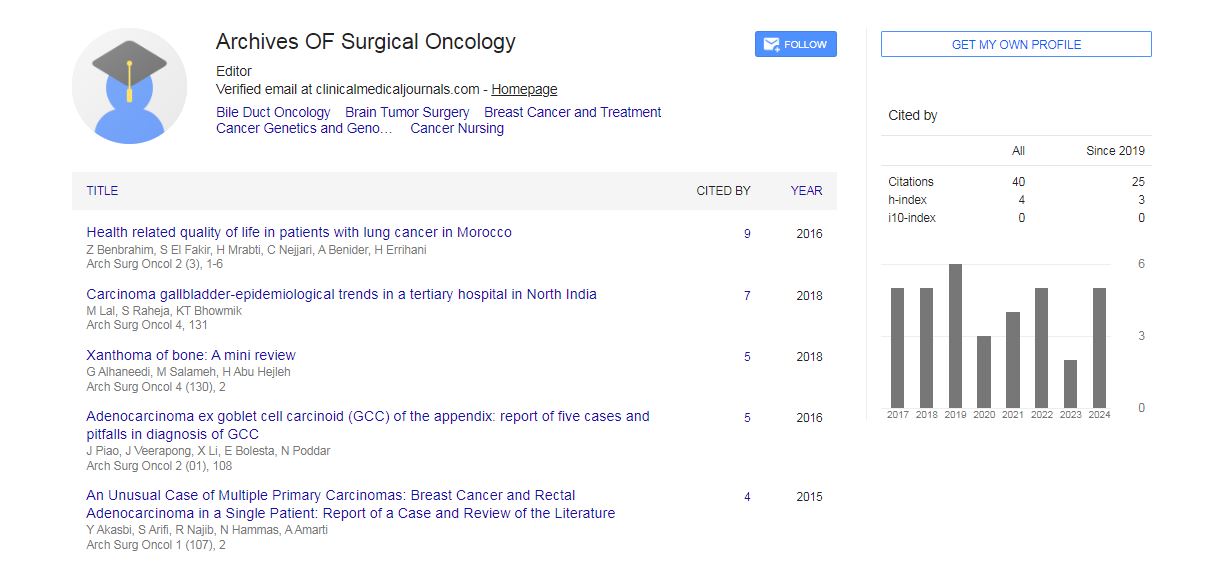
Archives of Surgical Oncology received 37 citations as per Google Scholar report