Commentary - (2025) Volume 13, Issue 2
Received: 01-Apr-2025, Manuscript No. jaat-26-183143;
Editor assigned: 03-Apr-2025, Pre QC No. P-183143;
Reviewed: 17-Apr-2025, QC No. Q-183143;
Revised: 22-Apr-2025, Manuscript No. R-183143;
Published:
29-Apr-2025
, DOI: 10.37421/2329-6542.2025.13.342
Citation: Smirnova, Elena V.. ”Observational Astrophysics: New Views Of The Cosmos.” J Astrophys Aerospace Technol 13 (2025):342.
Copyright: © 2025 Smirnova V. Elena This is an open-access article distributed under the terms of the Creative Commons Attribution License, which permits unrestricted use, distribution and reproduction in any medium, provided the original author and source are credited.
Recent advancements in observational techniques have profoundly reshaped modern astrophysics, offering unprecedented insights into the cosmos. Innovations in telescope technology, detector sensitivity, and data analysis methods have been instrumental in these breakthroughs, unlocking new perspectives on celestial phenomena. The field of gravitational wave astronomy has witnessed remarkable progress, particularly in the detection and characterization of events like black hole and neutron star mergers. Enhanced detector sensitivity has led to a growing catalog of such events, with significant implications for our understanding of stellar evolution and fundamental physics. Exoplanet atmosphere characterization has also seen dramatic improvements, largely due to advanced spectroscopic techniques and powerful instruments like the James Webb Space Telescope and the Hubble Space Telescope. The ability to detect a wider range of molecules is crucial for assessing planetary habitability beyond our solar system. The submillimeter and millimeter astronomy domains have been transformed by observatories such as the Atacama Large Millimeter/submillimeter Array (ALMA). Its unparalleled resolution and sensitivity enable detailed studies of star-forming regions and the early universe. X-ray astronomy is experiencing a revolution driven by new generations of space-based telescopes, offering improved spectral and temporal resolution. This allows for detailed investigations of high-energy phenomena and the complex processes around black holes and neutron stars. Optical and infrared astronomy have benefited immensely from large ground-based telescopes equipped with adaptive optics and integral field spectrographs. These instruments provide high-resolution imaging and spectral analysis of distant galaxies and stellar nurseries. Advanced neutrino detectors are opening new windows into the universe, enabling the detection of neutrinos from various cosmic sources. These detectors offer crucial information about stellar cores, dark matter, and the origin of cosmic rays. High-cadence and time-domain astronomy, facilitated by wide-field survey telescopes and robotic observatories, are crucial for discovering and characterizing transient astrophysical phenomena. This approach allows for the study of dynamic cosmic events like supernovae and fast radio bursts. The application of machine learning and artificial intelligence (AI) is accelerating progress in astrophysical data analysis. AI algorithms are proving invaluable for classifying celestial objects, detecting faint signals, and managing the immense data volumes generated by modern instruments. Finally, studies of the cosmic microwave background (CMB) radiation have reached new levels of precision. These measurements provide tighter constraints on cosmological parameters and offer avenues to explore the very early universe and fundamental physics.
Modern astrophysics is experiencing a transformative era driven by cutting-edge observational techniques that provide unprecedented views of the cosmos. Innovations in telescope technology, detector sensitivity, and sophisticated data analysis methods have collectively unlocked new frontiers in our understanding of celestial phenomena. These advancements have enabled detailed characterization of exoplanet atmospheres, enhanced the resolution and sensitivity of gravitational wave detectors for new astrophysical discoveries, and provided unprecedented imaging capabilities of new optical and radio telescopes that offer insights into galaxy evolution and the early universe. The integration of multi-messenger astronomy represents a paradigm shift, fostering a more comprehensive grasp of energetic cosmic events. Gravitational wave astronomy has emerged as a pivotal field, marked by significant breakthroughs in the detection and characterization of phenomena such as black hole and neutron star mergers. The enhanced sensitivity of detectors like LIGO and Virgo has facilitated the compilation of an ever-expanding catalog of binary compact object mergers. This progress carries profound implications for our understanding of stellar evolution, the equation of state of neutron stars, and the validation of general relativity. Future detectors hold the promise of probing even more distant and rare events, thus offering novel insights into the most extreme astrophysical phenomena. Exoplanet atmosphere characterization has advanced considerably through techniques like transmission and emission spectroscopy. With enhanced precision afforded by instruments such as the James Webb Space Telescope and the Hubble Space Telescope, scientists can now detect a broader spectrum of molecules within exoplanet atmospheres, including water, methane, and carbon dioxide. This capability is vital for elucidating planetary formation processes and assessing habitability beyond our solar system, with ongoing research focusing on atmospheric features across diverse exoplanet types. In the realm of submillimeter and millimeter astronomy, observatories like the Atacama Large Millimeter/submillimeter Array (ALMA) have spurred significant progress. These advanced facilities deliver exceptional resolution and sensitivity, enabling in-depth investigations of star-forming regions, protoplanetary disks, and the early universe. Key findings include the direct imaging of planet formation processes and the analysis of the chemical composition of cold gas and dust, which are fundamental to understanding the building blocks of stars and planets. X-ray astronomy is undergoing a significant transformation propelled by next-generation space-based telescopes. These instruments provide superior spectral and temporal resolution, facilitating detailed studies of high-energy phenomena such as active galactic nuclei (AGN), supernova remnants, and X-ray binaries. The research highlights the capacity to probe accretion processes around black holes and neutron stars with remarkable accuracy, yielding insights into fundamental physics and galactic evolution. Novel detector technologies play a central role in enhancing sensitivity and energy coverage. Optical and infrared astronomy are being advanced by large ground-based telescopes incorporating adaptive optics and integral field spectrographs. These instruments facilitate high-resolution imaging and spectral analysis of distant galaxies, stellar nurseries, and galactic centers. The research discusses novel insights into the formation and evolution of the earliest stars and galaxies, alongside detailed studies of star formation within proximate galaxies. The synergistic interplay between these powerful telescopes and space-based observatories is also underscored. Neutrino astronomy, powered by advanced detectors, provides a unique perspective on the universe. Progress in detecting neutrinos from supernovae, the Sun, and extragalactic sources is detailed, emphasizing how improved sensitivity and directional capabilities offer critical information about stellar cores, the nature of dark matter, and the origin of cosmic rays. The integration of neutrino astronomy with other observational methods is presented as essential for unlocking new astrophysical frontiers. High-cadence and time-domain astronomy are being propelled by wide-field survey telescopes and robotic observatories, enabling the discovery and characterization of transient astrophysical phenomena. This approach is vital for compiling comprehensive catalogs of transient events, such as supernovae, tidal disruption events, and fast radio bursts (FRBs), and for triggering timely follow-up observations, thereby deepening our understanding of dynamic astrophysical processes. The application of machine learning and artificial intelligence (AI) is revolutionizing astrophysical data analysis. AI algorithms are being employed for tasks including the classification of celestial objects, the detection of faint signals, the analysis of complex datasets from large surveys, and the optimization of telescope scheduling. The potential of AI to expedite discoveries and manage the vast data volumes produced by new observational instruments is a key focus. Studies of the cosmic microwave background (CMB) radiation are achieving unprecedented precision, yielding tighter constraints on cosmological parameters and enabling tests of inflation and searches for primordial non-Gaussianity. Future CMB experiments are poised to explore polarization signals and search for signatures of cosmic birefringence, offering novel pathways to investigate the very early universe and its fundamental properties.
This collection of articles highlights significant advancements in various fields of observational astrophysics. Innovations in telescope technology, detector sensitivity, and data analysis methods are providing unprecedented views of the cosmos. Key areas of progress include exoplanet atmosphere characterization using advanced spectroscopy, gravitational wave astronomy enabling the study of black hole and neutron star mergers, and submillimeter/millimeter astronomy revealing details of star formation and the early universe. X-ray and optical/infrared astronomy are benefiting from new space-based and ground-based telescopes, offering deeper insights into high-energy phenomena and galactic evolution. Neutrino astronomy and time-domain astronomy are crucial for understanding stellar interiors, transient events, and dynamic cosmic processes. Furthermore, the integration of machine learning and artificial intelligence is accelerating data analysis and discovery. Studies of the cosmic microwave background continue to refine our understanding of the early universe and cosmology.
None
None
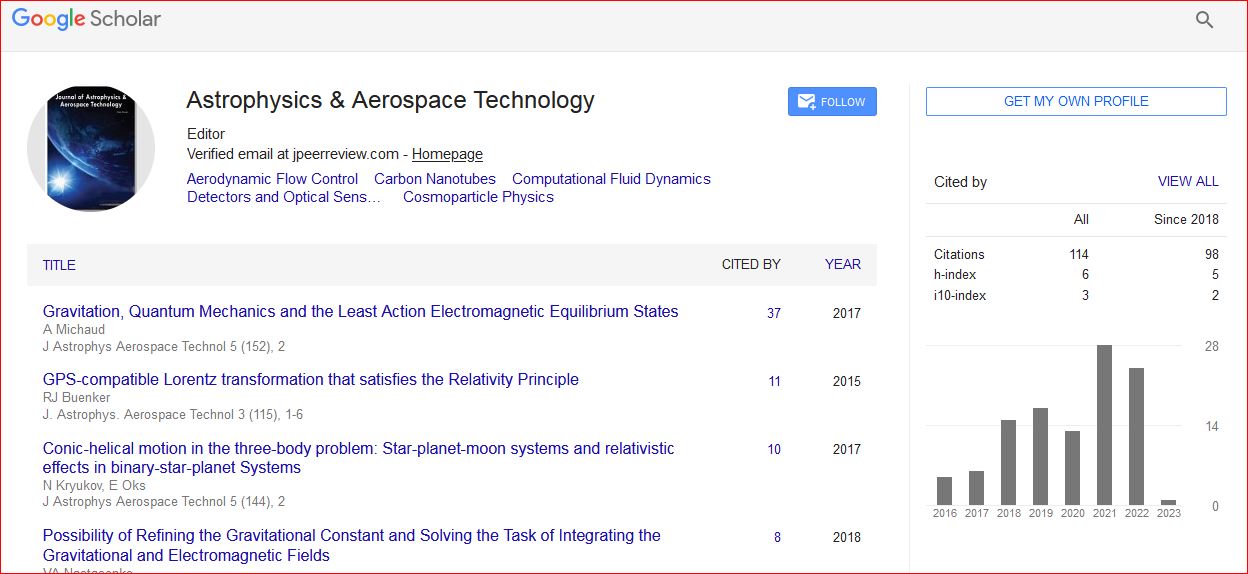
Astrophysics & Aerospace Technology received 114 citations as per Google Scholar report