Commentary - (2025) Volume 17, Issue 6
Received: 03-Nov-2025, Manuscript No. jcst-25-176310;
Editor assigned: 05-Nov-2025, Pre QC No. P-176310;
Reviewed: 19-Nov-2025, QC No. Q-176310;
Revised: 24-Nov-2025, Manuscript No. R-176310;
Published:
01-Dec-2025
, DOI: 10.37421/1948-5956.2025.17.734
Citation: Becker, Julia. "Nutrition's Multifaceted Influence on
Cancer Care." J Cancer Sci Ther 17 (2025):734.
Copyright: © 2025 Becker J. This is an open-access article distributed under the terms of the Creative Commons Attribution License, which permits unrestricted use, distribution
and reproduction in any medium, provided the original author and source are credited.
This collection of reviews and studies illuminates the critical and complex interplay between diet, nutrition, and cancer, covering various aspects from prevention to patient support. The Mediterranean diet, renowned for its emphasis on plant-based foods, healthy fats, and moderate fish and poultry, demonstrates a protective role against various cancers due to its anti-inflammatory and antioxidant properties [1].
Further exploring protective dietary strategies, plant-based patterns are consistently associated with a reduced risk of overall cancer and specific cancer types. This benefit stems from a high intake of fruits, vegetables, and whole grains, as synthesized from numerous meta-analyses [4].
The intricate relationship extends to the gut, where specific dietary components modulate microbial communities, thereby influencing host immunity and metabolic pathways relevant to cancer development and progression. This dynamic interaction can position diet, gut microbiota, and cancer as either allies or adversaries [2].
Conversely, certain dietary and lifestyle factors significantly increase cancer risk. Obesity, for example, is firmly linked to an elevated risk of several cancers. The underlying mechanisms include chronic inflammation, altered hormone metabolism, and insulin resistance, all contributing to tumor initiation and progression [3].
Similarly, dietary sugar intake shows a positive correlation with an increased risk of various cancers, with particular relevance to colorectal and breast cancers, potentially through insulin and IGF-1 pathways [5].
Moreover, the inflammatory potential of a diet, as quantified by various dietary inflammatory indices, confirms that diets promoting chronic inflammation are associated with an increased risk for several cancer types [10].
Beyond prevention, nutrition plays an indispensable role in the management and care of cancer patients. Proper nutritional support is critical for improving treatment tolerance, reducing complications, enhancing quality of life, and potentially impacting clinical outcomes by actively addressing cancer-related cachexia and malnutrition [6].
Building on this, the emerging field of personalized nutrition in oncology emphasizes the necessity of tailored dietary interventions. These bespoke plans are designed based on individual patient characteristics, tumor biology, and specific treatment regimens to optimize therapeutic outcomes and minimize treatment-related toxicity [9].
Exploring innovative nutritional strategies, intermittent fasting has garnered attention. Preclinical and clinical data suggest its potential to enhance therapeutic efficacy and reduce side effects in cancer treatment, primarily by altering cellular metabolism and stress responses in both tumor and healthy cells [8].
However, the role of specific micronutrients requires nuanced understanding; a systematic review on vitamins and minerals in cancer prevention revealed mixed evidence, noting potential benefits for certain micronutrients in specific cancer types but cautioning against high-dose supplementation without clear indication [7].
The collective body of evidence presented here profoundly underscores that dietary choices and nutritional interventions are not merely adjuncts but fundamental determinants in the complex landscape of cancer. From primary prevention through to advanced patient care, understanding and applying nutritional principles offers significant avenues for improved health outcomes.
The intricate relationship between diet, nutrition, and cancer forms a cornerstone of both preventative health strategies and therapeutic interventions. A substantial body of research highlights specific dietary patterns and components that either protect against or exacerbate cancer risk. For instance, the Mediterranean diet is celebrated for its protective role against various cancers, driven by its rich composition of plant-based foods, healthy fats, and moderate intake of fish and poultry. These elements synergistically contribute to its powerful anti-inflammatory and antioxidant properties, which are crucial for cancer prevention [1]. Echoing this preventative theme, adopting plant-based dietary patterns is strongly associated with a reduced risk of overall cancer and specific cancer types. This benefit is largely attributed to the high consumption of fruits, vegetables, and whole grains, as affirmed by comprehensive umbrella reviews of meta-analyses [4]. These findings collectively advocate for dietary choices rich in natural, unprocessed foods as a primary line of defense.
Conversely, several dietary and lifestyle factors are identified as significant contributors to increased cancer risk and progression. Obesity stands out as a major risk factor, with extensive evidence linking it to an elevated risk of numerous cancers. The mechanisms underpinning this association are complex, involving chronic inflammation, altered hormone metabolism, and insulin resistance, all of which create an environment conducive to tumor initiation and growth [3]. Beyond overall body weight, specific dietary components like sugar have come under scrutiny. A systematic review and meta-analysis found a positive correlation between dietary sugar intake and an increased risk of various cancers, notably colorectal and breast cancers, suggesting potential involvement of insulin and Insulin-like Growth Factor-1 (IGF-1) pathways in this process [5]. Furthermore, the inflammatory potential of a diet, as assessed by various dietary inflammatory indices, consistently demonstrates that diets promoting chronic systemic inflammation are linked to an elevated risk for several cancer types, emphasizing the systemic impact of food choices on health [10].
The role of nutrition extends beyond prevention to actively support cancer patients during their treatment journey. Effective nutritional support is paramount for enhancing treatment tolerance, mitigating complications, and significantly improving the overall quality of life for individuals undergoing cancer therapy. Addressing cachexia and malnutrition through tailored nutritional interventions can also positively impact clinical outcomes [6]. In recognition of individual variability, the concept of personalized nutrition is gaining prominence in oncology. This approach advocates for highly individualized dietary interventions, custom-designed based on a patient's unique characteristics, the specific biology of their tumor, and their particular treatment regimen. The goal is to optimize therapeutic responses while concurrently minimizing treatment-related toxicity, moving away from a one-size-fits-all approach [9].
Innovative nutritional strategies are also being explored for their potential to augment conventional cancer therapies. Intermittent fasting, for example, has shown promise in both preclinical and clinical studies. Research suggests that it can enhance the efficacy of existing treatments and reduce their associated side effects by favorably altering cellular metabolism and stress responses in both cancerous and healthy cells [8]. While the potential of micronutrients in cancer prevention is often discussed, a systematic review on vitamins and minerals revealed mixed evidence. While some specific micronutrients might offer benefits for certain cancer types, the review cautions against the widespread, high-dose supplementation of vitamins and minerals without a clear medical indication, highlighting the need for evidence-based guidance [7]. Together, these insights demonstrate that nutrition is not merely a supportive measure but a dynamic and influential factor throughout the entire cancer spectrum, offering profound implications for both public health and clinical practice.
The given data underscores the profound and multifaceted influence of diet and nutrition on cancer, spanning prevention, progression, and patient care. The Mediterranean diet and plant-based dietary patterns are consistently associated with a reduced risk of various cancers, primarily attributed to their rich content of plant-based foods, healthy fats, and their inherent anti-inflammatory and antioxidant properties [1, 4]. In contrast, significant risk factors include obesity, which drives cancer through chronic inflammation, altered hormone metabolism, and insulin resistance [3], and high dietary sugar intake, which shows a positive correlation with increased cancer risk, particularly for colorectal and breast cancers, via insulin and IGF-1 pathways [5]. The intricate relationship between diet and the gut microbiota also emerges as a key modulator, influencing host immunity and metabolic pathways that can either promote or inhibit cancer development [2]. Beyond prevention, nutritional support is critical for cancer patients during treatment, as it can significantly improve tolerance, reduce complications, and enhance quality of life by addressing issues like cachexia and malnutrition [6]. Emerging concepts like personalized nutrition offer tailored dietary interventions based on individual patient characteristics and tumor biology to optimize outcomes and minimize treatment-related toxicity [9]. Furthermore, intermittent fasting is being explored for its potential to enhance therapeutic efficacy and mitigate treatment side effects by altering cellular metabolism [8]. While some vitamins and minerals may offer benefits in cancer prevention, the evidence is mixed, and high-dose supplementation warrants careful consideration [7]. An overarching theme indicates that diets fostering chronic inflammation are reliably linked to an elevated risk for several cancer types [10]. This comprehensive perspective highlights nutrition as a dynamic and integral component in the continuum of cancer care.
Indexed at, Google Scholar, Crossref
Indexed at, Google Scholar, Crossref
Indexed at, Google Scholar, Crossref
Indexed at, Google Scholar, Crossref
Indexed at, Google Scholar, Crossref
Indexed at, Google Scholar, Crossref
Indexed at, Google Scholar, Crossref
Indexed at, Google Scholar, Crossref
Indexed at, Google Scholar, Crossref
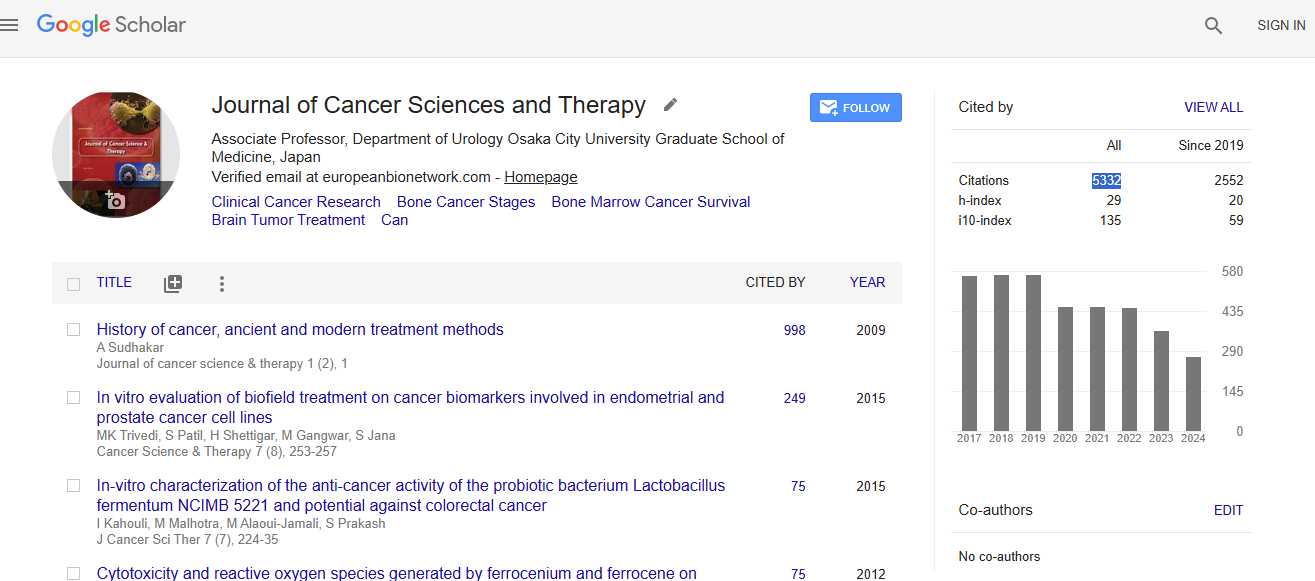
Cancer Science & Therapy received 5332 citations as per Google Scholar report