Perspective - (2025) Volume 14, Issue 3
Received: 01-May-2025, Manuscript No. VTE-26-180084;
Editor assigned: 05-May-2025, Pre QC No. P-180084;
Reviewed: 19-May-2025, QC No. Q-180084;
Revised: 22-May-2025, Manuscript No. R-180084;
Published:
29-May-2025
, DOI: 10.37421/2376-1318.2025.14.372
Citation: Romano, Lucia. ”Nutritional Assessment: Key To Health And Disease Management.” Vitam Miner 14 (2025):372.
Copyright: © 2025 Romano L. This is an open-access article distributed under the terms of the Creative Commons Attribution License, which permits unrestricted use, distribution and reproduction in any medium, provided the original author and source are credited.
Assessing nutritional status, particularly for vitamins and minerals, is paramount in clinical practice, requiring a comprehensive approach that integrates biochemical markers, dietary analysis, and clinical signs to detect deficiencies or excesses early and prevent adverse health outcomes [1].
Biomarkers play a crucial role in evaluating vitamin D levels, aiding in the assessment of sufficiency and guiding supplementation strategies, although variability in measurement methods necessitates standardized protocols for accurate results [2].
Iron deficiency remains a significant global health challenge, underscoring the importance of accurate assessment through various methods like serum ferritin, transferrin saturation, and hemoglobin levels, with careful interpretation in different physiological and pathological states [3].
Evaluating B vitamin status is vital, as deficiencies can lead to serious neurological and metabolic disorders, with biochemical markers and dietary assessments being key tools to understand the status of B vitamins such as folate, B12, and B6 [4].
The assessment of trace mineral status, including zinc and selenium, is critical for maintaining immune function and antioxidant defense, with challenges in assessment methods and the utility of various analyses highlighted [5].
Micronutrient assessment in special populations, such as pregnant women and the elderly, presents unique challenges due to specific life stage needs, emphasizing the importance of tailored assessment strategies [6].
Accurate assessment of vitamin A status is essential for its roles in vision, immune function, and cell growth, with various methodologies and the implications of deficiency or toxicity being key considerations [7].
Electrolyte balance is fundamental for numerous physiological processes, and assessment of key electrolytes like sodium, potassium, and calcium is crucial for understanding their impact on cardiovascular and neurological function [8].
Evaluating vitamin K status is important for coagulation and bone health, employing methods like plasma phylloquinone and undercarboxylated prothrombin, while acknowledging challenges in accurate assessment, particularly in individuals with malabsorption issues [9].
Assessing micronutrient status in athletes is critical for optimizing performance, training, and recovery, with individualized assessments identifying potential deficiencies that could hinder athletic endeavors [10].
The multifaceted approach to assessing nutritional status, encompassing biochemical markers, dietary intake, and clinical signs, is critical for early detection of imbalances and timely intervention in clinical settings, ultimately impacting health outcomes [1].
Laboratory assessment of vitamin D status relies on robust biomarkers to determine sufficiency and guide appropriate supplementation, though the field faces challenges related to measurement variability and the need for standardized protocols [2].
The comprehensive assessment of iron status extends beyond hemoglobin measurements to include markers like serum ferritin and transferrin saturation, enabling a more nuanced understanding of iron levels in various clinical contexts [3].
Evaluating the status of B vitamins, crucial for neurological and metabolic health, involves a combination of biochemical markers and dietary assessments to address potential deficiencies and understand their complex interdependencies [4].
Trace mineral assessment, particularly for zinc and selenium, is vital for immune function and antioxidant defense, with research focusing on improving assessment methodologies and understanding the clinical significance of these minerals [5].
Nutritional assessment strategies must be tailored to specific populations, such as pregnant women and the elderly, who have unique micronutrient requirements and face distinct challenges in maintaining adequate nutritional status [6].
Assessing vitamin A status involves evaluating various methods, from direct measurement to indirect indicators, to understand its crucial roles in vision, immunity, and cell growth and to manage potential deficiency or toxicity [7].
The assessment of electrolyte balance, focusing on sodium, potassium, and calcium, is fundamental for maintaining physiological homeostasis and understanding the clinical implications of imbalances in various disease states [8].
Evaluating vitamin K status utilizes specific biochemical markers to ensure adequate coagulation and bone health, addressing the complexities of assessment, particularly in individuals with compromised absorption [9].
Nutritional assessment of micronutrients in athletes is essential for enhancing performance and recovery, employing tools like food-frequency questionnaires and biochemical markers to identify and address specific needs [10].
Nutritional assessment is critical for maintaining health and managing diseases, involving the evaluation of vitamins, minerals, and electrolytes through biochemical markers, dietary analysis, and clinical signs. Specific focus is placed on assessing vitamin D, iron, B vitamins, trace minerals like zinc and selenium, vitamin A, and vitamin K, with tailored strategies for vulnerable populations and athletes. Accurate assessment methods are continuously being developed and refined to ensure timely intervention and optimize health outcomes. Electrolyte balance is also highlighted for its physiological importance.
None
None
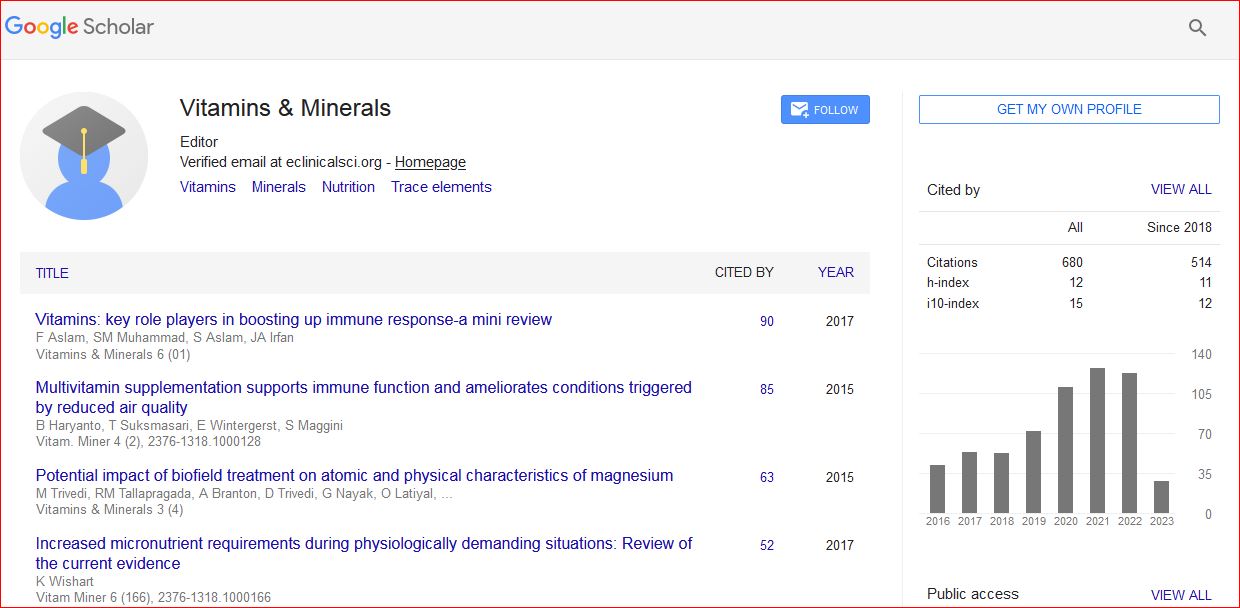
Vitamins & Minerals received 790 citations as per Google Scholar report