Opinion - (2025) Volume 14, Issue 6
Received: 01-Dec-2025, Manuscript No. jnc-25-178141;
Editor assigned: 03-Dec-2025, Pre QC No. P-178141;
Reviewed: 17-Dec-2025, QC No. Q-178141;
Revised: 22-Dec-2025, Manuscript No. R-178141;
Published:
29-Dec-2025
, DOI: DOI: 10.37421/2167-1168.2025.14.737
Citation: Mendel, Sofia. ”Nurses: Key to Infection Prevention and Patient Safety.” J Nurs Care 14 (2025):737.
Copyright: © 2025 Mendel S. This is an open-access article distributed under the terms of the Creative Commons Attribution License, which permits unrestricted use, distribution and reproduction in any medium, provided the original author and source are credited.
Nurses are at the absolute forefront of preventing infections within healthcare settings, undertaking a multifaceted role that is indispensable for patient safety and public health. Their responsibilities encompass a wide array of critical interventions, from the meticulous execution of hand hygiene protocols to the proper sterilization and disinfection of medical equipment, thereby creating a barrier against the transmission of pathogens. Furthermore, nurses are essential in implementing and managing isolation precautions for patients diagnosed with transmissible diseases, a vital step in containing outbreaks and protecting vulnerable populations. Their role extends beyond direct patient care to the crucial task of educating both patients and their colleagues on evidence-based best practices in infection prevention and control. The effective and consistent implementation of these measures by dedicated nursing professionals significantly contributes to reducing the incidence of healthcare-associated infections (HAIs), leading to improved patient outcomes and a notable lowering of overall healthcare costs [1].
This article underscores the critical importance of unwavering adherence to stringent hand hygiene protocols by all nursing staff across various healthcare environments. It thoroughly examines the robust body of evidence that supports the efficacy of diverse hand hygiene techniques, while also delving into the numerous barriers that nurses often encounter in achieving consistent compliance with these essential practices. Moreover, the paper meticulously outlines and proposes practical strategies designed to enhance adherence rates among nursing personnel, recognizing that this is a cornerstone of effective infection prevention. The authors emphatically stress that the unwavering commitment and diligent practice of hand hygiene by nurses are fundamental to maintaining a safe healthcare environment and preventing the spread of infections [2].
The nursing profession plays a paramount role in the active control and containment of the spread of multidrug-resistant organisms (MDROs) within hospital settings. This paper meticulously discusses the practical implementation of surveillance strategies, the imperative for early detection of MDRO colonization or infection, and the appropriate application of isolation measures, all of which are managed and overseen by nurses. It also thoroughly explores the significant educational responsibilities that nurses bear in preventing the transmission of MDROs throughout the complex healthcare environment, thereby safeguarding both patients and staff from these resilient pathogens [3].
This study critically examines the demonstrable effectiveness of nurse-led education programs specifically designed for patients and visitors concerning vital infection prevention practices. The findings emphatically demonstrate that well-informed patients and visitors are significantly more likely to comply with recommended preventive measures, such as hand hygiene and respiratory etiquette. This increased compliance, facilitated by nursing interventions, consequently contributes to the creation of a safer healthcare environment and substantially reduces the overall risk of HAI transmission, underscoring the proactive role of nurses in public health education [4].
Environmental cleaning and disinfection are unequivocally crucial components in the prevention of pathogen spread within healthcare facilities, forming a fundamental layer of defense against infections. Nurses play an absolutely vital role in ensuring that the patient care environments are consistently kept clean and sterile, and that appropriate, evidence-based disinfection protocols are rigorously followed. Their diligent attention to these environmental factors directly contributes to a significant reduction in the incidence of healthcare-associated infections, thereby protecting patient well-being and enhancing the overall quality of care provided [5].
The implementation of standard precautions and the judicious application of transmission-based precautions represent a fundamental and non-negotiable nursing duty in the ongoing effort to prevent infections within healthcare settings. This comprehensive article critically reviews the extensive evidence base that underpins these essential precautions and highlights the critical and indispensable role that nurses have in their consistent and accurate application. By adhering to these protocols, nurses actively protect themselves, their patients, and all other individuals within the healthcare environment from the potential transmission of infectious agents [6].
Nurses are undeniably instrumental in the correct use, meticulous management, and vigilant monitoring of various medical devices, which is essential for preventing device-associated infections. This includes critical interventions for conditions such as central line-associated bloodstream infections (CLABSIs) and catheter-associated urinary tract infections (CAUTIs). Their constant vigilance in the daily care of these devices and their prompt identification of any emerging complications are absolutely essential for averting serious patient harm and ensuring positive clinical outcomes [7].
Occupational health and safety for nurses are intrinsically and profoundly linked to the overarching goals of infection prevention and control within healthcare environments. This article thoroughly discusses the profound importance of nurses diligently adhering to established safety protocols to prevent any potential exposure to infectious agents. By prioritizing their own safety and preventing exposure, nurses not only protect their own health and well-being but also effectively prevent the onward transmission of infectious pathogens to vulnerable patients under their care [8].
The active role of nurses as champions in implementing and supporting antibiotic stewardship programs is absolutely critical in the global fight against antimicrobial resistance. This encompasses a range of essential responsibilities, including ensuring the judicious and appropriate prescribing of antibiotics, closely monitoring patient responses to antimicrobial therapy, and actively educating patients on the profound importance of completing prescribed courses of antibiotics. These efforts are vital in preserving the efficacy of existing antibiotics for future generations [9].
The integration of emerging technology and innovative solutions into the practice of infection prevention and control represents a dynamic and rapidly evolving area within healthcare. Nurses are frequently among the earliest adopters and the most key users of new technologies, such as sophisticated electronic hand hygiene monitoring systems and advanced sterilization equipment. Their active engagement and utilization of these innovations are crucial for enhancing the overall effectiveness and efficiency of their infection prevention efforts in modern healthcare settings [10].
Nurses are fundamentally positioned at the vanguard of infection prevention and control within all healthcare environments, a responsibility that encompasses a broad spectrum of vital interventions. Their role includes the scrupulous practice of hand hygiene, the thorough sterilization and disinfection of medical equipment, and the meticulous application of isolation precautions for patients with communicable diseases. Moreover, nurses are instrumental in educating both patients and their healthcare colleagues on the most effective evidence-based practices for preventing infection. Through the diligent implementation of these measures, nurses significantly contribute to the reduction of healthcare-associated infections (HAIs), thereby enhancing patient outcomes and reducing the economic burden on healthcare systems [1].
This article specifically highlights the paramount importance of consistent and unwavering adherence to established hand hygiene protocols by nursing personnel. It undertakes an in-depth examination of the scientific evidence that substantiates the effectiveness of various hand hygiene techniques, identifies the common barriers that nurses face in maintaining compliance, and proposes actionable strategies to improve adherence rates. The authors strongly emphasize that the dedication of nurses to practicing meticulous hand hygiene is a fundamental pillar of successful infection prevention efforts [2].
Within the complex landscape of healthcare, nurses play an indispensable role in the strategic control and mitigation of multidrug-resistant organisms (MDROs). This paper details the practical aspects of implementing surveillance systems, ensuring the early identification of MDROs, and applying appropriate isolation measures under the guidance and management of nurses. It further elaborates on the crucial educational responsibilities nurses undertake to prevent the transmission of MDROs within the healthcare setting, thereby protecting vulnerable patient populations [3].
This particular study focuses on evaluating the efficacy of educational initiatives spearheaded by nurses, targeting patients and their visitors regarding infection prevention practices. The research indicates that when patients and visitors are adequately informed about necessary precautions, they are more likely to adhere to recommended guidelines. This heightened compliance, facilitated by nurse-led education, directly contributes to a safer healthcare environment and a diminished risk of HAI transmission [4].
The critical role of environmental cleaning and disinfection in preventing the dissemination of pathogens cannot be overstated, and nurses are central to this process. They are responsible for ensuring that patient care areas are maintained in a state of cleanliness and that appropriate disinfection protocols are consistently applied. This diligent oversight by nurses directly contributes to a reduction in the incidence of HAIs, safeguarding patient health [5].
Adherence to standard precautions and the appropriate implementation of transmission-based precautions are foundational responsibilities for nurses engaged in infection prevention. This article provides a thorough review of the scientific literature supporting these precautions and underscores the pivotal role nurses fulfill in their consistent application to protect themselves, their patients, and others from infection [6].
Nurses are essential in the correct utilization and management of medical devices, which is crucial for preventing device-associated infections such as CLABSIs and CAUTIs. Their constant vigilance in device care and their ability to promptly recognize and report complications are vital for patient safety and positive clinical outcomes [7].
The occupational health and safety of nurses are intimately connected with effective infection prevention strategies. This article emphasizes the significance of nurses adhering to safety protocols to minimize their exposure to infectious agents, thereby safeguarding their personal health and preventing any potential transmission to patients [8].
Nurses are key participants in the successful implementation of antibiotic stewardship programs, playing a critical role in combating antimicrobial resistance. Their responsibilities include ensuring appropriate antibiotic prescribing, monitoring patient responses to treatment, and educating patients on the importance of completing their full antibiotic course [9].
The integration of technological advancements into infection prevention and control practices is an ongoing development, and nurses are at the forefront of adopting these innovations. They are often key users of new technologies, such as electronic systems for monitoring hand hygiene and advanced sterilization equipment, which enhance their infection prevention capabilities [10].
Nurses are central to infection prevention and control in healthcare settings, employing strategies like meticulous hand hygiene, equipment sterilization, isolation precautions, and patient education. Their adherence to protocols significantly reduces healthcare-associated infections (HAIs). Key areas of focus include hand hygiene compliance, control of multidrug-resistant organisms (MDROs), patient education, environmental cleaning, standard and transmission-based precautions, management of medical devices, occupational safety, antibiotic stewardship, and the adoption of new technologies. These efforts collectively enhance patient outcomes and safety.
None
None
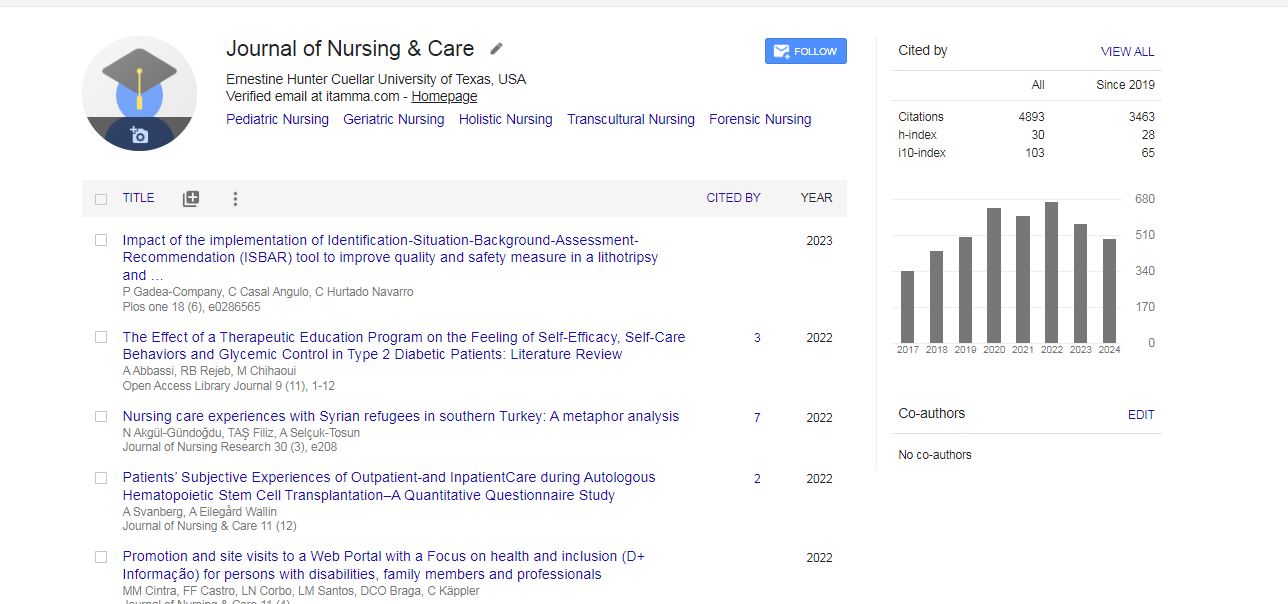
Journal of Nursing & Care received 4230 citations as per Google Scholar report